
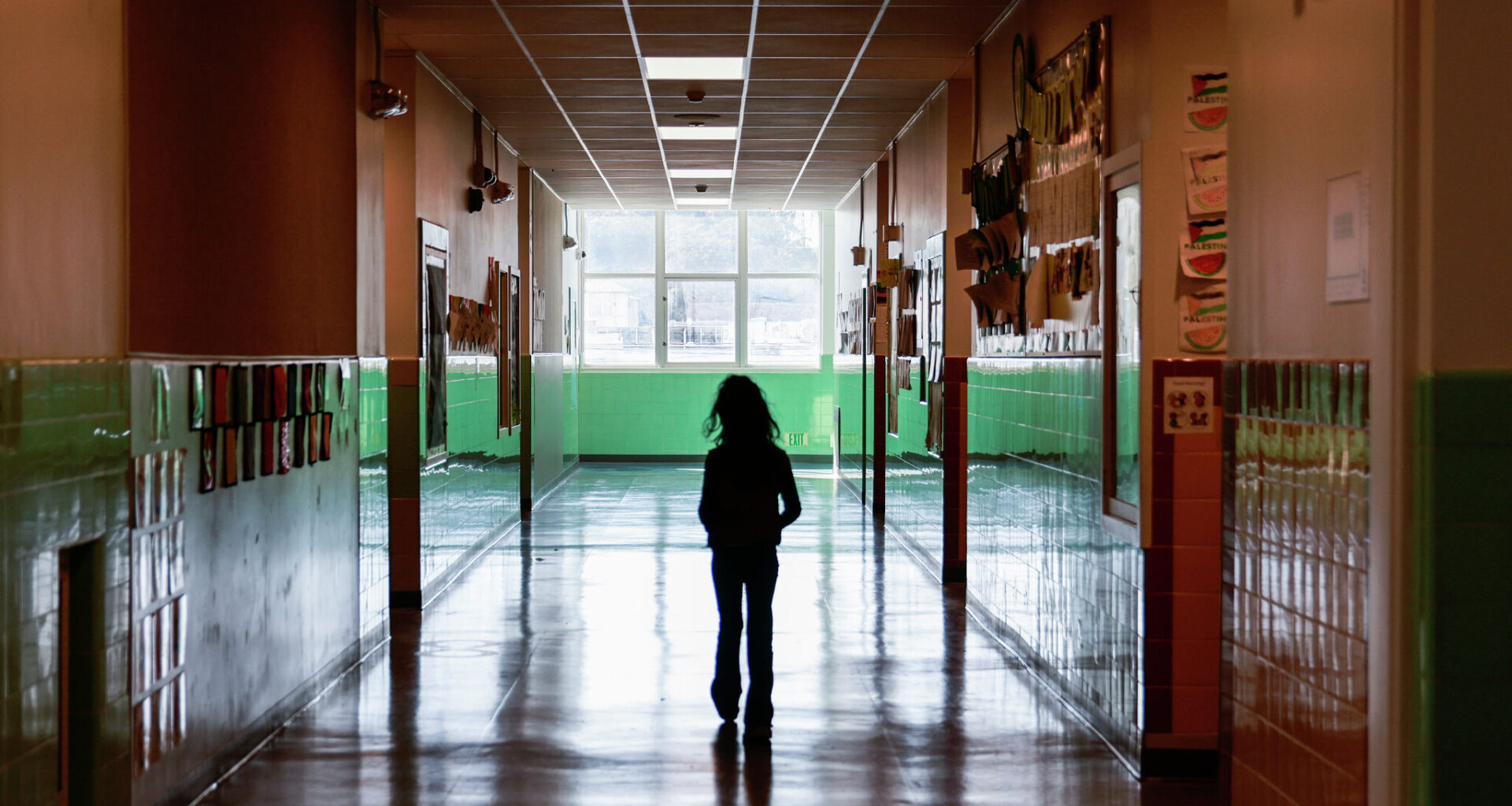
San Francisco’s Hillcrest Elementary School, pictured in 2024, is overseen by a state education leadership that is often at odds with itself.
Jessica Christian/S.F. Chronicle
Don’t worry, Californians, about obvious flaws in your state’s governing system. Our leaders will fix them.
All you have to do is wait a century or so.
California’s economy and culture reliably move at world-class speed, but its government often lags 100 years behind. This is the state that didn’t get around to ratifying the 14th Amendment, added to the U.S. Constitution in 1868, until 1959.
Article continues below this ad
Call it the 100-year rule. In 2020s California, we are fixing 1920s problems.
In 2024, we removed ecosystem-destroying dams that were added to the Klamath River 100 years ago. After the pandemic, the state updated early-20th-century health codes on infectious diseases. And our string of 2020s housing reform laws is overturning exclusionary zoning, local control and apartment building bans that date back to the Roaring Twenties.
San Francisco Chronicle Logo
Make us a Preferred Source to get more of our news when you search.
Add Preferred Source
But the best example of 1920s-inspired policymaking in the 2020s involves a drama playing out this year in the state education system.
On his way out the door, Gov. Gavin Newsom is pushing hard for a structural reform to fix a problem that has been obvious since 1920.
Article continues below this ad
That year, a Special Legislative Committee on Education identified the problem: California had two different entities in charge of education across the state.
One was the elected state superintendent of public instruction, which had few specific duties but had been a feature of the early Constitution of the state. The other was a governor-appointed State Board of Education, a regulatory body that added specific duties — from ordering textbooks to conducting investigations and setting standards for graduation — as education grew in importance and received federal funds.
The overlapping and uncertain authority threatened to produce political conflict between the board and superintendent — and contradictory guidance for school districts.
The 1920 report said: “The present California educational organization must be regarded as dangerous for the future, and it should be superseded at the earliest opportunity by a more rational form of state educational organization.”
The 1920 report’s “more rational” solution was to abolish the elected superintendent position and consolidate educational oversight under the State Board of Education. The board could appoint a “commissioner of education” (hired “free from restrictions as to politics, sex and residence”) to take charge of education policymaking in the state, from the certification, training and retirement of teachers to the conditions of school buildings to the curriculum itself.
Article continues below this ad
Was this simple idea enacted? Of course not. Eliminating the elected superintendent’s position required a constitutional amendment, and ambitious politicians opposed getting rid of a plum elected office. The Legislature still tried, placing an education reform amendment on the ballot in 1928, 1934, 1958 and 1968. Each time, voters failed to approve the change.
Over the past 30 years, six studies have urged major changes to California’s education governance model, according to a report by the nonpartisan Legislative Analyst’s Office. Most of these studies offered versions of the 1920 report’s recommendation, either reducing or eliminating the superintendent’s power.
All criticized the fact that no one person or institution could be held responsible for state education policy failures. They pointed out that the state board, the elected superintendent and the governor often give different directions to school districts, who are unsure what guidance to follow.
“The problem with California’s K‑12 governance system,” Gov. Arnold Schwarzenegger’s committee on educational excellence found in 2007, “is that everyone is in charge, and no one is accountable.”
That still hasn’t changed. Indeed, in recent decades, the State Board of Education and the elected school superintendent have given school districts contradictory orders on English as a second language programs, local finance plans, ethnic studies instruction and charter school rules.
Article continues below this ad
So, this year, Newsom is taking another run at enacting that 1920 idea, via a proposed statute.
The governor’s plan is different in two ways. First, he is not proposing a constitutional amendment that would require voter approval. Second, he would shift power over education to the governor’s office. A new, governor-appointed education commissioner would manage the Department of Education. The elected superintendent would become another member of the State Board of Education, which would oversee the new commissioner.
This is more complicated than eliminating the superintendent position. But it would put one official clearly in charge of education: the governor, acting through the new education commissioner.
“Adopting the new governance structure would allow for voters to hold the Governor accountable for change, reduce confusion about who is in charge, and improve oversight of existing programs,” the state’s non-partisan legislative analyst wrote recently.
So, is this one of those once-in-a-100-year moments?
Article continues below this ad
Guest opinions in Open Forum and Insight are produced by writers with expertise, personal experience or original insights on a subject of interest to our readers. Their views do not necessarily reflect the opinion of The Chronicle editorial board, which is committed to providing a diversity of ideas to our readership.
Read more about our transparency and ethics policies
Tony Thurmond, the current state superintendent, opposes the proposal. The powerful California Teachers Association, which gets friendly state superintendents elected, is not on board. Its opposition could doom the proposal.
So, don’t hold your breath. This could take another century.
Joe Mathews writes the Connecting California column for Zócalo Public Square.