
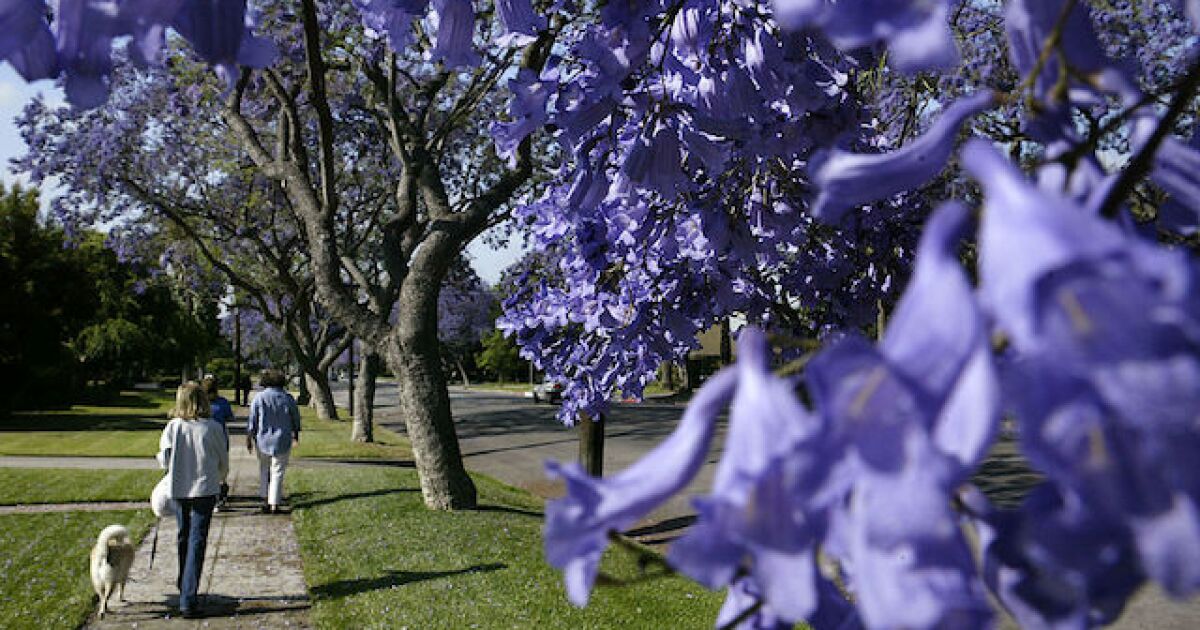
You might have noticed a little more purple on your commute in Los Angeles recently. Turns out the jacarandas are putting on their annual show of blooms a little early this year.
Originally from the tropics, jacarandas respond to changes in temperature. They typically flower in our region from late April to mid-June.
But remember that sweltering heat wave we got in March?
“They got the clear sign: ‘It’s over 90 [degrees], it’s hot out. Even though you weren’t quite prepared, it’s time to put out some flowers,’” Loral Hall, community forestry senior program manager at environmental nonprofit TreePeople, told LAist.
Keep up with LAist.
If you’re enjoying this article, you’ll love our daily newsletter, The LA Report. Each weekday, catch up on the 5 most pressing stories to start your morning in 3 minutes or less.
Hall said not only do jacarandas grace us every year with thick canopies and carpets of purple, they’re relatively drought tolerant, pest resistant and able to grow in urban areas (like in a small square patch of dirt surrounded by concrete).
“They’re attention-grabbers here in Southern California,” said Hall, who grew up in Hollywood and has childhood memories of playing with the fallen purple blooms at a local park. “In a place where we don’t have really obvious seasons, [jacaranda blooms] are a sign that warmer weather is on the way.”
Hall also shared a lesser-known fact about jacarandas: There’s a white cultivar, too. The white version is much more rare in L.A., though with some of the trees rumored to be in a non-public area of the L.A. County Arboretum, Hall said.
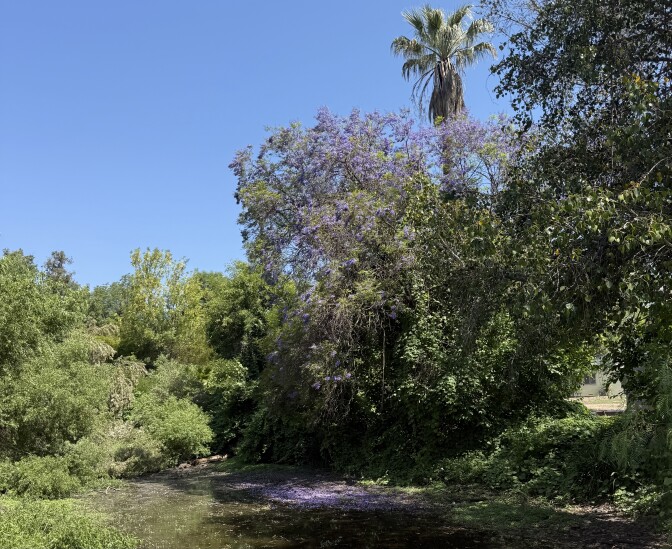
A jacaranda at the LA Arboretum.
How’d they get here?
The jacaranda is native to the tropical and subtropical regions of Argentina and Brazil.
While we don’t know exactly when the jacaranda first arrived in our area, we do know they were brought to Southern California in the late 19th century and proliferated thanks to a local horticulturist named Kate Sessions.
Where are the purple hot spots?
A couple years ago, a local data graphics editor even created an interactive map so you can find the purple hot spots.
They’re… everywhere, so it shouldn’t be too hard to stumble upon a jacaranda show.