
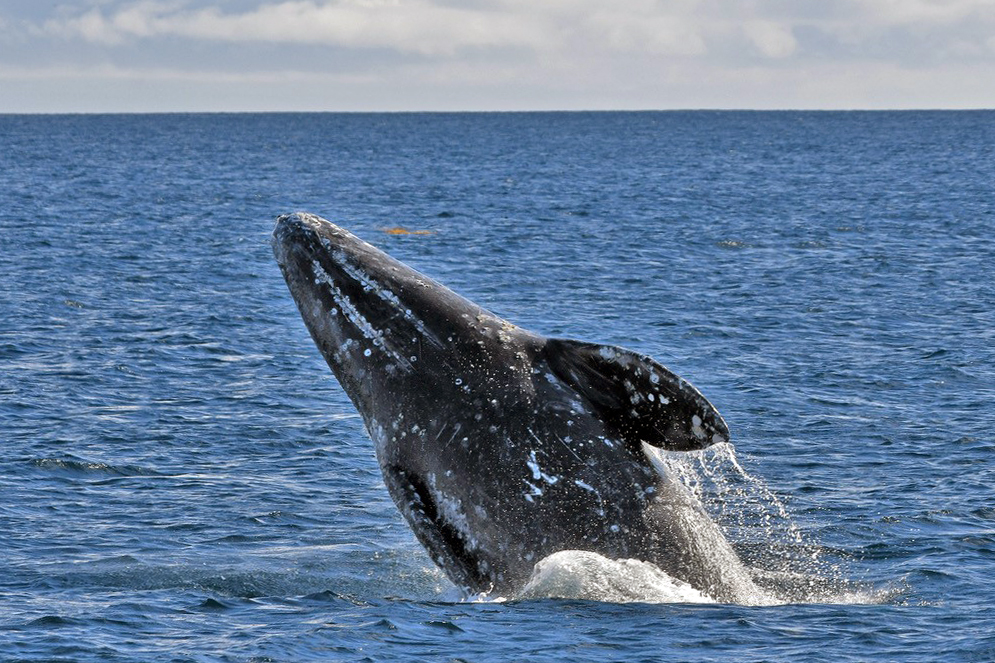
A gray whale, spotted from a cruise ship, breaches the surface of the Pacific Ocean off the coast of Long Beach in 2018. Ships are being asked to slow down along more of the California coast than before in order to prevent whales from being accidentally struck.
Nick Ut/Getty Images
A cargo ship is visible behind the breaking surf at Ocean Beach in San Francisco in March 2022. Ship strikes are a leading cause of whale deaths, but slowing down reduces the risk.
Carlos Avila Gonzalez/S.F. ChronicleCalifornia is expanding its voluntary ship speed reduction program to cover most of the coast, aiming to protect whales and reduce air pollution.Even in San Francisco Bay, numerous whale deaths in recent years have been linked to ship collisions.Participation in the speed-reduction program is rising, with 52 companies enrolled for the 2026 season, up from 44 companies that were part of it last year.
Starting this week, ships traveling along the California coast may be going more slowly.
The main reason is whales: California is significantly expanding a program that asks ships to slow down in order to kill fewer of them.
Article continues below this ad
The change, which takes effect Wednesday, increases the slowdown area from a patchwork of zones around marine sanctuaries into a more continuous stretch covering most of the California coast.
Ship strikes are a leading cause of death for several whale species off California, where some of the world’s largest cargo ships pass through key feeding and migration routes. Even in and around San Francisco Bay, at least 27 whale deaths were caused by boat collisions in recent years. Going slower also often reduces the amount of pollution ships emit.
Nearly 60% of vessel traffic in last year’s zones participated in the speed limit program, which asks ships to slow to 10 knots or less. Large cargo ships typically travel between 12 to 20 knots. About 80% of container ships participated, according to Alan Abbs, a legislative officer with the Bay Area Air Quality Management District. However, only about 25% of tankers and 20% of bulk carriers (which carry goods like ore that aren’t packaged in containers) participated.
San Francisco Chronicle Logo
Make us a Preferred Source to get more of our news when you search.
Add Preferred Source
Created in 2014, the Blue Whales and Blue Skies program has reduced ship speeds — and air pollution — along key corridors. In 2025, it cut thousands of tons of smog-forming emissions and greenhouse gases and reduced the risk of fatal whale strikes by up to 40%, Abbs said.
Article continues below this ad
Last year, 44 companies and approximately 800 ships slowed down as part of the program. For the 2026 season, 52 companies have enrolled, Abbs said. There are no penalties for opting out — companies that participate receive recognition.
Some marine life advocates want to make such speed limit programs mandatory, but doing so would be difficult. California does not have the authority to regulate oceangoing ships, which are governed at the federal and international levels.
While the program has broad support, there is also pushback.
The Pacific Merchant Shipping Association expressed unhappiness about the new boundaries at a recent California Ocean Protection Council meeting, calling the Wednesday rollout “unfeasible” because companies were given about six weeks to adjust complex shipping routes. The start date had already been pushed back from April 1 to accommodate industry feedback.
The group also argued that slower speeds could, in some cases, increase emissions.
Article continues below this ad
Jacqueline Moore, the association’s vice president, said in an interview that the exact boundaries of the expanded program are still being defined. She said the industry is pushing to ensure the program remains “feasible and based on science.”
“We’ve been involved in supporting VSR (vessel speed reduction) going back across 25 years,” Moore said, adding that the organization also endorsed the statewide expansion bill. “Industry is committed to this program, as long as it remains feasible and voluntary.”
Some companies already slow ships to conserve fuel amid spiking oil prices. Moore noted that scheduling constraints, weather conditions and safety concerns can limit how consistently vessels can maintain lower speeds.
Environmental groups say the expansion does not go far enough.
The California Coastkeeper Alliance wants the zones to extend farther offshore to include more whale habitat, particularly for endangered fin whales, and for the program to start earlier; last season it ran from May 1, 2025 to Jan. 15.
Article continues below this ad
Thousands of ships passing through feeding and migration areas generate low-frequency noise that interferes with whales’ ability to communicate and navigate, said Marty Farrell, a staff attorney with the alliance. Slowing ships can significantly reduce noise, as one of the benefits.
“This isn’t like a problem that we’re still searching for the solution for,” he said. “We know what the solution is. We know that slowing vessels is one of the most effective tools to solve both of those problems at the same time.”