
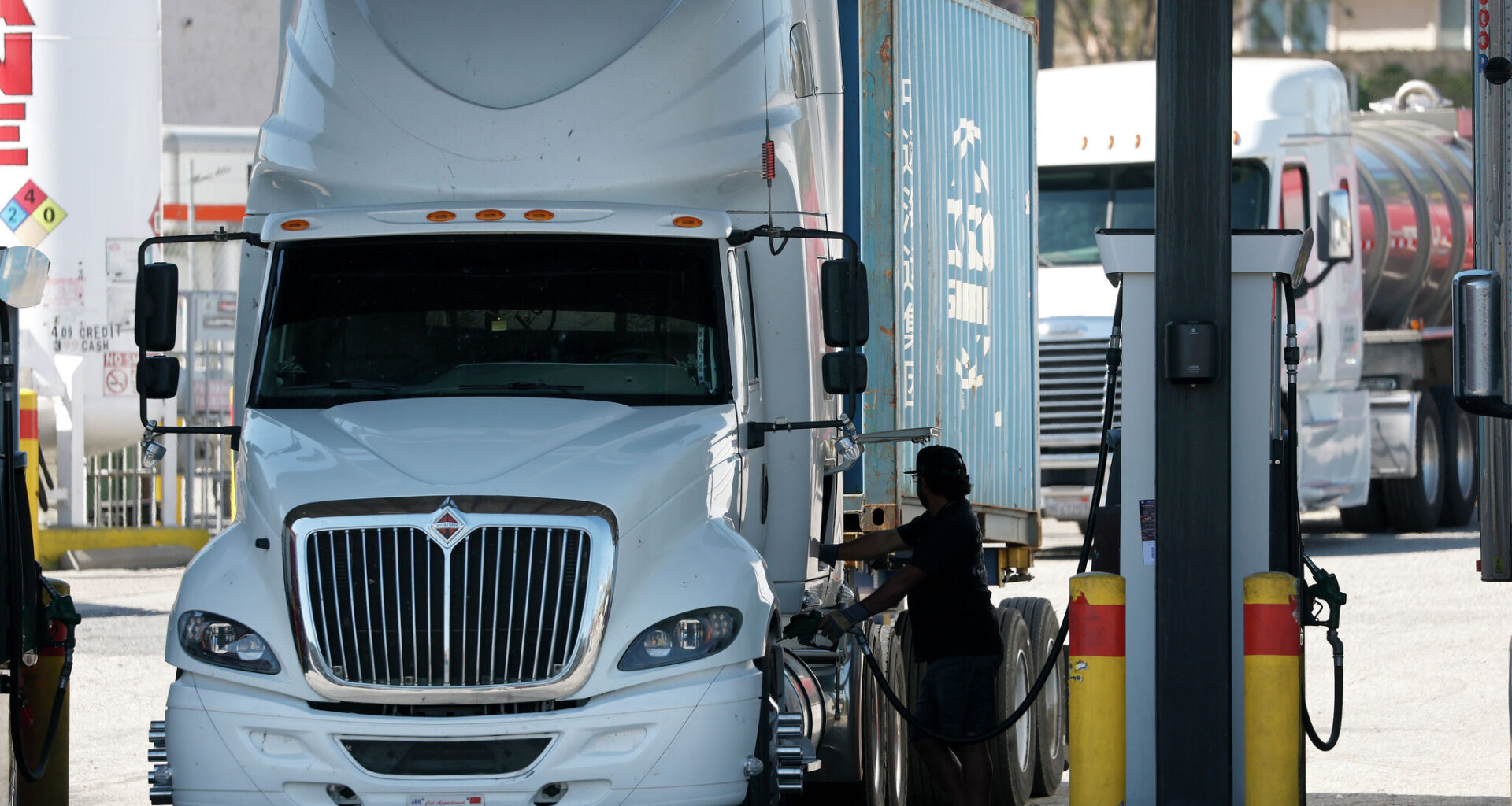
A driver fills up at the Castaic Truck Stop in Los Angeles County on March 23. A surge in diesel prices is raising costs for truckers, who drive some of the smoggiest vehicles.
Justin Sullivan/Getty Images
It’s tough to think of the early 2020s as a particularly golden time in California. We were mostly still stuck inside during the pandemic, and historic wildfires gave us orange days and generational dread. But in those years, California finally, heroically, passed major new standards to tackle the dirtiest, smoggiest vehicles on its roads: large diesel trucks. We were finally shifting to better, nonpolluting options.
If only we had stayed on track.
In 2025, the Trump administration took the best swing they could at California, using gimmicks in Congress to attack the vehicle standards protecting California’s air quality. The Environmental Protection Agency, meanwhile, has turned on itself, stripping away key federal authority to protect human life. The cost to California in the coming decades will amount to $50 billion in early deaths and health care expenses alone, according to an analysis from the Environmental Defense Fund.
Article continues below this ad
Things suddenly aren’t looking so good for fixing the largest source of air pollution in California — everything running on fossil fuels that moves on wheels.
Premium gasoline prices above $6 per gallon and diesel fuel prices above $7 a gallon are displayed outside of a Shell gas station in West Hollywood on April 14.
PATRICK T. FALLON/AFP via Getty Images
With diesel prices spiking 50% higher than before the war on Iran a mere month ago, what was a health and pollution problem is now barreling our way as an economic problem too. Three-quarters of commercial trucks in the U.S. have diesel engines, and California has the country’s busiest ports and the largest manufacturing output of any state. Because diesel is used for moving goods and manufacturing, demand for the fuel is less elastic, and it’s more likely to see volatile price spikes amid geopolitical chaos. The swings in diesel prices will cascade through the economy and hit Californians already hurting in the affordability crisis.
San Francisco Chronicle Logo
Make us a Preferred Source to get more of our news when you search.
Add Preferred Source
Simply put, diesel prices are the new cost of eggs.
Article continues below this ad
While the California attorney general and environmental groups battle it out in court with the Trump administration, leaders in Sacramento don’t have to just sit on their hands. The Trump administration has been wily and destructive. It’s time for California to be nimble and creative.
For one relatively simple maneuver, the state should use its budget to replenish a popular program administered by the California Air Resources Board that helps companies adopt nonpolluting trucks. The vouchers for this program fly out the door like hotcakes — and they’re likely to be in higher demand as companies become desperate to buffer their businesses from the increasingly unpredictable cost of a barrel of oil.
State air regulators have already estimated that California should fund that voucher program with $450 million this budget year. This kind of incentive stream is a triple-hitter — insulating the economy from the inflationary pressure of diesel, growing the state’s clean-vehicle manufacturing sector and saving Californians in health care expenses.
With the California budget outlook looking rosier than predicted as revenues come in higher than expected, this would be a good place to start.
For another fix, the state needs to equip itself with tools to battle pollution. In 2021, Southern California spearheaded a new kind of air quality program to clean up pollution from the goods movement industry. This kind of rule targets the hotspots that attract a stream of polluting vehicles — say, SoCal’s several thousand mega-warehouses larger than Union Square. If California were to enact these rules statewide, the state could hop and skip around the thorny issue of getting permission from the federal government with an EPA waiver. That means the Golden State could make steadfast progress to clean its air, no matter which way the wind blows in D.C.
Article continues below this ad
To make the dream of clean air a reality, California lawmakers should pass the California Clean Skies Act (Assembly Bill 1777), which would affirm that state air regulators can build these kinds of life-saving programs. This is a wise long-term investment for California for our lungs and basic quality of life.
Diesel is a cruder fuel than the unleaded gas in cars, and diesel engines run at higher temperatures than their gas counterparts. As a result, diesel trucks and equipment spew particulate matter — a pollution so fine it can cross the blood-brain barrier in people to cause problems in hearts and lungs and reach infants while they’re in the womb.
Guest opinions in Open Forum and Insight are produced by writers with expertise, personal experience or original insights on a subject of interest to our readers. Their views do not necessarily reflect the opinion of The Chronicle editorial board, which is committed to providing a diversity of ideas to our readership.
Read more about our transparency and ethics policies
Depending on how you count them, California has labored under a serious air pollution problem for six-plus generations. Industrial smoke and fumes were so thick one day in Los Angeles in 1903 that residents mistook the smog layer for an eclipse. When California began to transport the lion’s share of goods coming to the U.S. from Asia with the 1980s trade boom, large diesel trucks choked our skies in the rush to move goods.
If the state is not careful, the Trump administration will have outmaneuvered California to send us back to days of darker, smoggier skies just to keep the state relying on barrels of oil — a dated and dirty fuel with uncertain supply that people are dying in ugly wars over. But the writing isn’t on the wall just yet. California still has options to outfox the Trump administration and clean our skies.
Article continues below this ad
Adrian Martinez is the director of Earthjustice’s Right To Zero campaign and has worked on policy and legislation to clean up diesel pollution in California for over two decades