
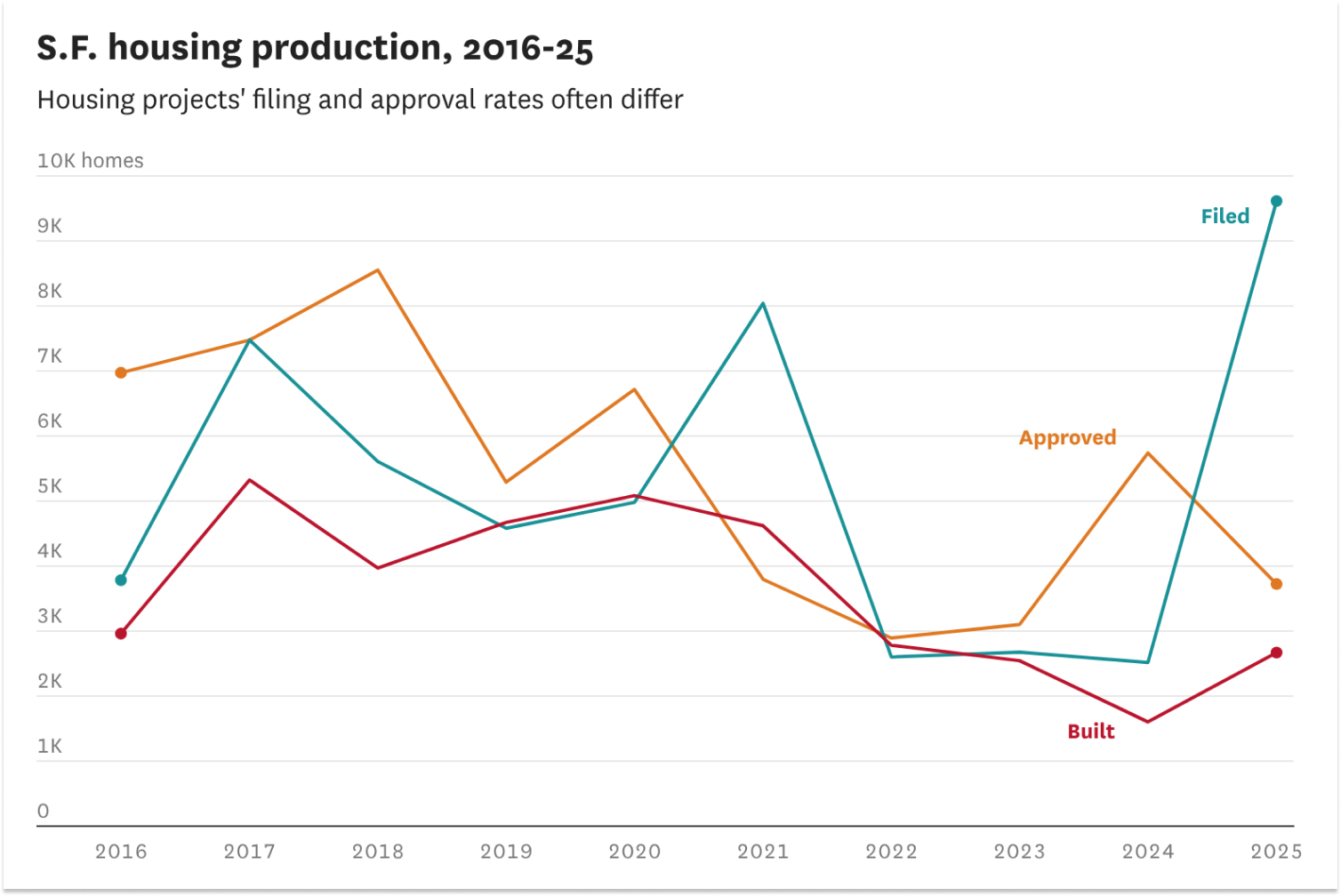
The San Francisco Planning Department received applications for more than 9,600 homes in 2025. The city also added about 2,700 units that year, including nearly 200 on Treasure Island.
Yalonda M. James/S.F. Chronicle
Developers applied to build more homes in San Francisco last year than in at least in a decade, a sign that construction could be coming back to the city. But don’t expect to see cranes in the sky anytime soon.
The San Francisco Planning Department received applications for more than 9,600 units in 2025, nearly quadruple the annual count for the preceding three years, according to the city’s annual housing inventory report. That was the most homes entering the city’s housing pipeline since 2007, before the Great Recession cratered housing production.
“The numbers don’t lie: We’re back,” said Dan Sider, chief of staff at the planning department, in an email. “Between raw application volume and the flood of subtle (and not-so-subtle) developer outreach, you can’t help but see the change.”
Article continues below this ad
Sider acknowledged that the number of homes that actually get built could be lower than the nearly 10,000 proposed if developers scale back projects or cancel them entirely. But some of the massive developments, which make up most of the newly proposed housing, have already received the green light. The city approved a 1,500-unit project in the South of Market neighborhood last year, along with the controversial Marina Safeway redevelopment, which would add 790 homes to the neighborhood.
The Planning Department’s data for 2025 doesn’t include revisions to projects proposed in previous years, including an additional 1,000 apartments added to a planned tower at 10 S. Van Ness Ave.
San Francisco, where rents and home prices have surged back to pre-pandemic levels amid an artificial intelligence boom, completed fewer than 2,700 units in 2025. That’s up significantly from the 1,600 completed in 2024, but still well behind its state-mandated housing goals. (Of the 82,000 homes the city needs to approve by 2031, fewer than 10,000 were permitted as of last year). Moreover, two-thirds of the homes built last year were affordable units, which are typically only built with public subsidies.
San Francisco Chronicle Logo
Make us a Preferred Source to get more of our news when you search.
Add Preferred Source
The neighborhoods where homes did get built last year were almost entirely on the east side of San Francisco, with SoMa adding about 600 homes and Bayview-Hunters Point adding roughly 300. Treasure Island, which has undergone a massive redevelopment project over the past decade, was another standout.
Article continues below this ad
Most neighborhoods saw only a handful of new homes. Mayor Daniel Lurie’s “Family Zoning” plan, which passed last year, upzoned much of the city’s western and northern neighborhoods, though the policy now faces legal challenges from neighborhood associations who argue it goes too far and pro-housing groups that say it doesn’t go far enough.
The city is not slated to see any significant market-rate developments come online this year. In 2027, the 303-unit, 22-story tower at 1111 Sutter St. is the only major project scheduled to open. And that project is unique, having a large enough affordable component that the developer was able to qualify for tax credits as well as state and federal money.
Barring the possibility that a few projects start construction this year — and most developers say that is unlikely — the next wave of market-rate homes won’t be ready for occupancy until 2029. By then, the San Francisco market could be under the weight of even more pent-up demand for both rentals and for-sale properties.
A major part of the hold-up is that investors are still not writing checks in San Francisco — despite the soaring rents, construction costs are high enough that most projects are economically infeasible. But developers are scrambling to prepare for when the money returns.
Article continues below this ad
“When the dam breaks, the people who are ready to go are the people who are going to win,” said developer Chris Foley, who is part of the team developing four Safeway properties in San Francisco.
In recent years, state and city officials have stripped away development restrictions that they say contribute to the high cost of building in California. But some developers argued that there’s still too much red tape at the state level. Foley said it’s likely that some condo developments would break ground this year if not for Senate Bill 800, a California law that gives homeowner associations a 10-year window in which to sue over construction defects. The regulation has meant that more than 80% of condo developers get sued over construction defects, Foley estimated.
Bora Ozturk, co-founder and principal of prolific San Francisco developer March Capital Fund, called the scene a “tale of two cities.” On the one hand, equity investors — who typically finance about a third of a typical multi-family project in San Francisco — are still not bankrolling market-rate development construction. On the other hand “there is an insatiable, irrational appetite right now for existing apartment buildings.”
But despite the fact that the city has cut fees and is in the process of possibly lowering affordable housing requirements and transfer taxes, Ozturk said the cost of building new housing in the city is still too high for market-rate units.
“The rents do need to go up quite a bit, still, for the math to make sense,” he said. “There is still no equity. If there was, you would be seeing a bunch of cranes. Where are those cranes? Everything that is being built right now is affordable.”
Article continues below this ad
Some developers are trying to get shovels in the ground. Oisin Heneghan, founder of N17 Development, which has three projects in the San Francisco pipeline, said he hopes to break ground on the 320-unit tower at 280 Hawthorne Ave. in the summer of 2027.
“That’s all I’m doing every day — meeting people to see if I can line up equity,” he said. “Just in the last month, there has been a lot more interest and excitement. I talked to a lender yesterday who said ‘We are all in on the San Francisco supply and demand story.’”
Heneghan added that the investor said that he “only writes checks for a certain size, but San Francisco is an exception.”
“He said, ‘We will do bigger deals there,’” Heneghan said. “So it’s coming. It’s coming.”
Article continues below this ad