
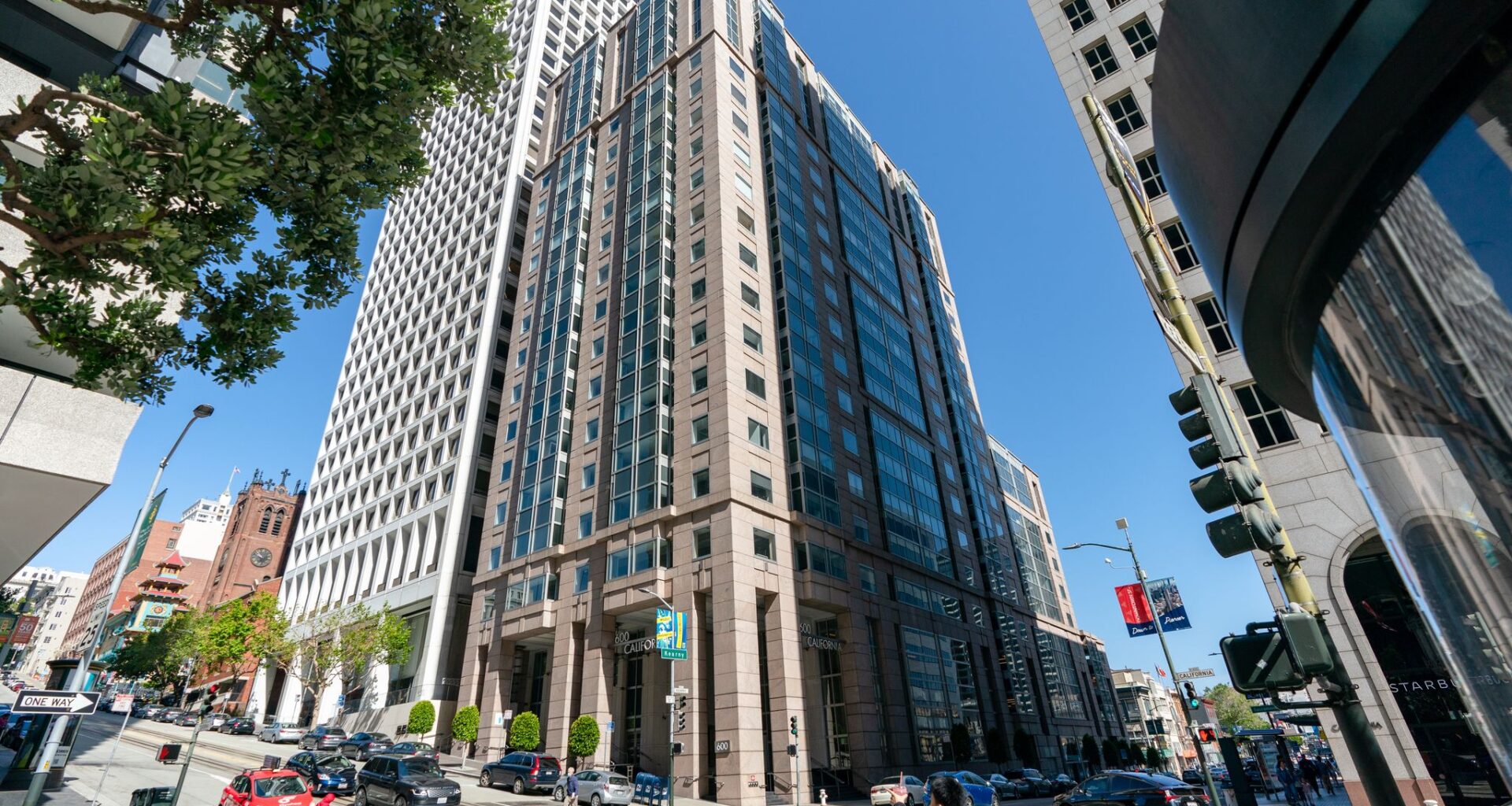
The former WeWork headquarters at 600 California Street in San Francisco was up for auction last week.
Adam Pardee/Special to The Chronicle
One of San Francisco’s notable office towers was up for auction last week, a 20-story, 360,000-square-foot Class A building on one of the most coveted corridors in the North Financial District. Nobody who showed up to the stretch of sidewalk in the shadow of City Hall where the sale was held Thursday to bid on the polished, quietly assertive building that was once valued at over $320 million.
It’s a bit of a reckoning for the property at 600 California St., which was tied to a distressed $240 million loan and pushed into receivership after its former anchor tenant WeWork stopped paying rent three years ago. With no contenders stepping forward to offer bids, Dallas-based Lone Star Funds became the official owner of the property, after the private equity group paid roughly $130 million to acquire the debt in January from Goldman Sachs, the original lender.
The quiet transaction felt closer to a casual curbside deal than a high-stakes transfer of a notable piece of the city’s skyline. Some market participants pointed out that 600 California’s anticlimactic sale underscores continued weakness in the office market, challenging claims of full recovery.
Article continues below this ad
Within minutes, Lone Star, which declined to comment, formally took ownership of 600 California through foreclosure, and in doing so, appeared to test the building’s perceived value. Appraised at $109 million in 2024 — a near 70% drop from 2019 — the group placed a credit bid of $216 million on the property, essentially using the debt it had already purchased at a discount to bid on the building.
“Let’s start with the biggest loan first — assuming none of you are here for that?” the auctioneer said to the group of property hunters gathered around him. Had outside bidders showed up to the auction, they would have been required to furnish an immediate deposit and proof of funds, without the opportunity to conduct due diligence.
San Francisco Chronicle Logo
Make us a Preferred Source to get more of our news when you search.
Add Preferred Source
In the end, Lone Star took over the largely vacant tower for an estimated $361 per square foot.
The auction effectively wrapped up the spectacular unraveling of 600 California, a decline tied in no small part to WeWork, the once high-flying flexible office space provider founded by Adam Neuman and Miguel McKelvey that briefly reigned as the country’s most valuable startup. WeWork’s involvement with 600 California came as its private valuation peaked at $47 billion in the years leading up to the pandemic, and was rather unusual.
Article continues below this ad
The company created WeCap, shorthand for WeWork Capital Advisors, an in-house investment arm set up to allow WeWork to move beyond leasing and operating office space to owning it more directly. Launched with a $1 billion equity infusion from one of the world’s largest pension funds, WeCap was supposed to become a $2.9 billion office investment vehicle, but quickly fell short of that big vision, which was overshadowed by WeWork’s failed IPO in 2019.
WeCap began purchasing buildings that WeWork would occupy as a tenant, including the California Street tower, which it acquired for roughly $900 per square foot as 2019 drew to a close. By then, WeWork’s rapid growth spurt had already resulted in the company operating multiple locations in San Francisco, including at 600 California, where it grew its footprint to nearly 200,000 square feet.
WeWork’s core business model of signing long term leases, typically between 10 to 15 years, and transforming its spaces into flexible coworking offices for which it sold shorter-term memberships and licenses, was akin to subleasing office space at a premium. While a lucrative model in flush times when occupancy was high, this approach became its “cardinal error” as the pandemic hit, leaving WeWork with “long-term liabilities and short-term income,” according to veteran San Francisco commercial broker Charlie McCabe.
As office demand dropped during the pandemic, WeWork owed landlords rent even as desks sat empty. The twist at 600 California was that WeWork was WeCap’s anchor tenant.
WeCap and its partner for 600 California, Rhone Group, were sued in 2023 by representatives of Goldman Sachs for falling behind on their mortgage payments in the tower months after WeWork stopped making rent payments, though the company continued to report spikes in demand for its flexible spaces, with WeWork stating that it accounted for 13% of traditional office space leased in San Francisco at the end of 2022. A year later, WeWork filed for chapter 11 bankruptcy.
Article continues below this ad
McCabe, the commercial broker, said that WeWork’s “2023 bankruptcy implosion continues to echo in San Francisco,” and that the 600 California tower is evidence of that.
The building’s foreclosure sale “dispels the perception that the local commercial property market has completely bounced back,” McCabe said, adding that the tower joins five other “troubled commercial properties over 250,000 square feet in size” that changed ownership this year.
But WeWork, which managed to retain a smaller footprint within the tower, appears to be betting on a comeback.
“With the sale to Lone Star Funds, we are pleased to see a path to conclusion in ownership at 600 California St.,” a spokesperson said in a statement to the Chronicle. “Our location at the building has seen incredibly strong demand, with footfall at our space up 34% since the start of the year, and we look forward to partnering with them on our continued operations.”
Article continues below this ad