
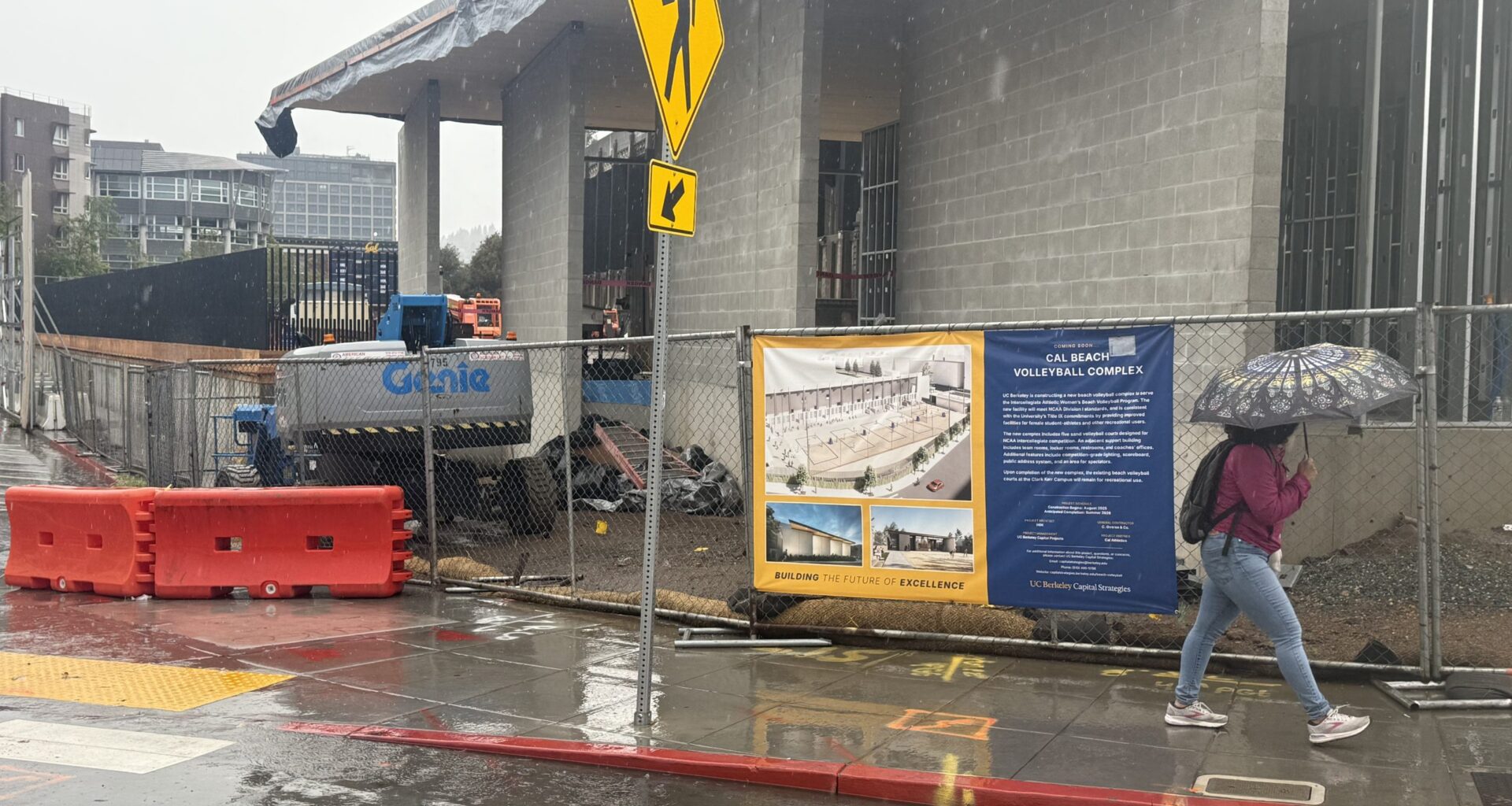
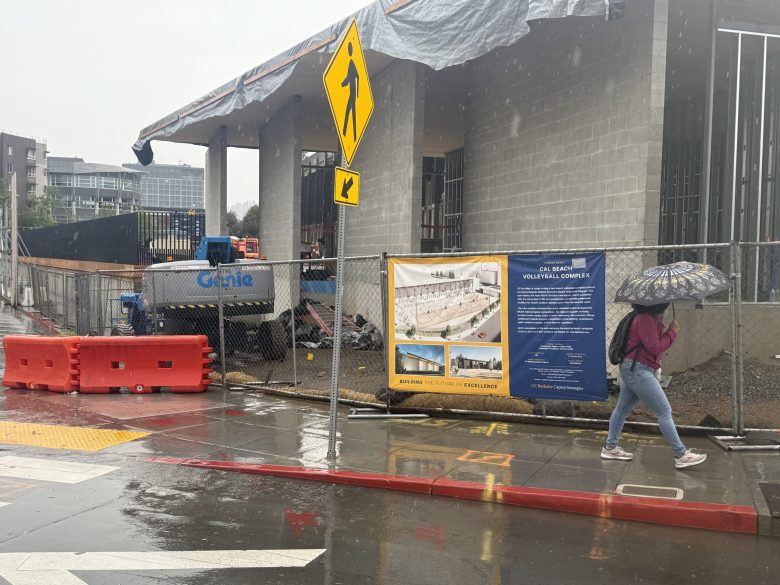
 Native American remains were found last week at a UC Berkeley construction site at Bancroft Way and Fulton Street. Credit: Felicia Mello/Berkeleyside
The Confederated Villages of Lisjan will work with UC Berkeley to care for Native American remains found at a construction site on the south side of campus last week, Corinna Gould, chair of the Ohlone group, said Monday.
Construction workers discovered the skeletal remains of at least one Native person while building a new beach volleyball court at the site on Bancroft Way and Fulton Street, according to university spokesperson Janet Gilmore and the Berkeley Scanner, which first reported that remains were found. The Alameda County coroner subsequently identified them as likely historic and not connected to any crime, Gilmore said.
Gilmore declined to say whether the site appeared to contain the remains of more than one person, and whether the university had paused construction on the site.
Under California law, county coroners must report discoveries of historic Native American human remains to the state’s Native American Heritage Commission, which then identifies and notifies the most likely descendants — usually a tribe with roots in the area. The descendants will then confer with the landowner to determine the next steps.
Gould said Confederated Villages of Lisjan had not yet met with university officials to come up with a plan.
Options in such cases could include giving the remains to the descendants, leaving them where they are to minimize disturbance, or moving them to another area on the site, said Gabriel Duncan, founder of the Alameda Native History Project.
There are hundreds of Native American ceremonial and burial sites in the Bay Area alone, Duncan said, many disrupted by construction over time as the area became densely developed. Strawberry Creek, which runs through the UC Berkeley campus, was once the site of a village inhabited by Chochenyo-speaking Ohlone people, he said.
“The idea of finding remains pretty close to the village is just indicative of the fact that there was a thriving community in the East Bay, specifically in that area, and that a lot of these buildings were all built a long time ago before people were really keeping track,” Duncan said.
A decade ago, workers building stores and a beer garden in Berkeley’s Fourth Street area unearthed two sets of human remains, raising questions about the boundaries of the West Berkeley Shellmound, a historic burial site that the city had designated as a landmark.
One of the challenges in assessing what to do with remains, which Duncan described as “heartbreaking,” is that sometimes tribes don’t have land on which to rebury ancestors.
The naming of most likely descendants can also be contentious. Bernadette Quiroz, executive director of cultural resources management for the Muwekma Ohlone Tribe, said her group believed they should have been named due to their status as a previously federally recognized tribe. “UC Berkeley sits on our ancestral homeland,” she said.
The California Native American Heritage Commission did not return a message seeking comment.
Berkeleyside partners with the nonprofit newsroom Open Campus on higher education coverage.
“*” indicates required fields