
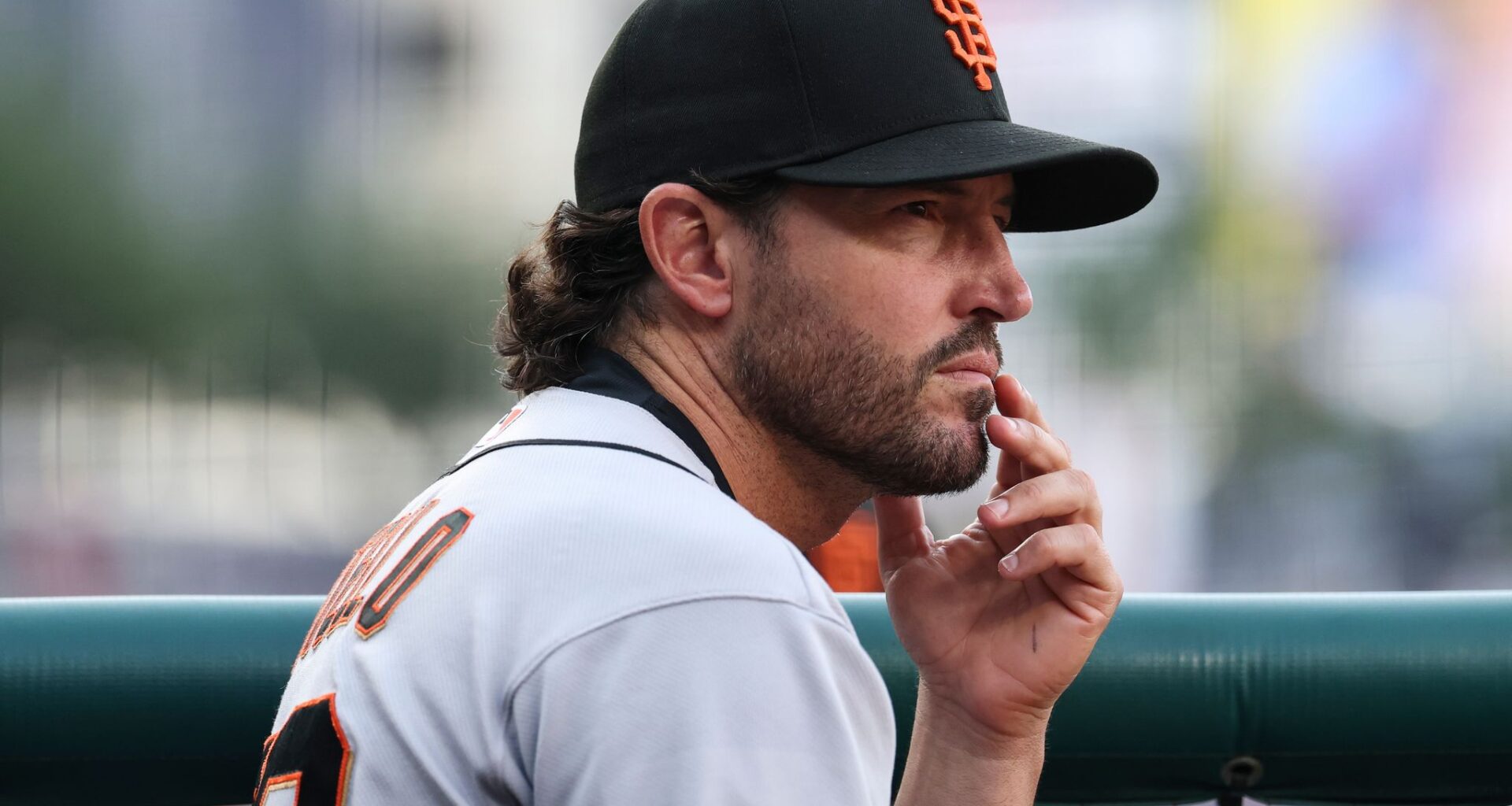
San Francisco Giants manager Tony Vitello is one of five first-year managers in MLB this year, but is the only one among them with no pro baseball experience.
Terrance Williams/Associated Press
Tony Vitello isn’t alone in this newness to major-league managing. There are five rookie skippers this year. At least one of them is glad that Vitello is among them, to be the focus of attention for the newbies.
“Yeah, a little bit!” said Washington manager Blake Butera, one of the two first-year managers the San Francisco Giants played against on their just-completed road trip.
Vitello is in a special category as the only manager to come straight up from the college ranks with no pro experience, but Butera, at 33, is the youngest manager in baseball since 1972. Two of his players are older than he is. He did manage in the minor leagues, but even there his youth stood out. He gets why he and Vitello get some extra scrutiny.
Article continues below this ad
“It’s a real talking point, for sure, just because it’s different,” Butera said this weekend when the Giants played the Nationals. “There aren’t many people like us. But when I was hired for this job, I had a couple of conversations with a couple of guys who are older than me and they said, ‘We don’t really care how old you are — can you help us? Do you care about us? That’s what we care about.’ Hearing the oldest guys on the team say that from the beginning makes me feel a lot more at ease.
“I know a lot of the guys over there with the Giants, like Willy Adames, and it seems like they really like Tony a lot because they know he cares.”
San Francisco Chronicle Logo
Make us a Preferred Source to get more of our news when you search.
Add Preferred Source
The first-year managers don’t have a group chat or anything, much as it might be nice to share their common complaints. Vitello, Butera and Baltimore’s Craig Albernaz said they tend to check in with the older, more experienced managers when they’re looking for insight.
Article continues below this ad
The other first-year guys are former A’s catcher Kurt Suzuki (running the Angels) and Craig Stammen (who has the Padres out to a 15-7 start). A sixth skipper is in his first full season, the Rockies’ Warren Schaeffer, but he was the interim manager for 122 games in Colorado last year before getting named to the full-time job.
Butera, Schaeffer and Albernaz did not play in the majors, which used to be unusual. Now it’s accepted, just as hiring college coaches is likely to be at some point.
All of the new managers share some of the same issues and concerns, though, no matter their background. Their responsibilities are far more extensive, with more players, more games, and more moving parts, plus far more media coverage and much bigger coaching staffs.
That makes for an odd mix of extra duties and distractions but fewer practical concerns. Vitello said he’s still uncomfortable having someone else carrying his luggage, a sentiment Butera echoed. The many coaches — Vitello has 12 — handle things such as scheduling, throwing batting practice and leading various group meetings. Support staffs are huge, with trainers, strength coaches, massage therapists, nutritionists, cooks, mental health professionals and analysts.
“I used to have to carry a printer with me on the road,” Butera said. “Now I don’t even hit fungoes during batting practice. It seems like every job, there is someone to do it.”
Article continues below this ad
Albernaz was on Gabe Kapler’s staff in San Francisco and then Stephen Vogt’s in Cleveland. As a bench coach and then associate manager, he was in on every meeting and decision making process, so his leap was not quite as great as Butera’s or Vitello’s. But even he is running into circumstances he’s never been in before.
“Every day, there is a new problem to solve, so you just have to have an open mind,” Albernaz said. “You don’t know what’s going to happen, and the only thing you can do is get all the information you can, then make the best informed decision you can.”
Vitello has a wealth of experience around him to help, including bench coach Jayce Tingler (who managed the Padres in 2020-21), and Ron Washington (who managed the Rangers and Angels for a combined 10 seasons). Washington said it really is just a matter of presenting options that might be helpful.
“I give Tony advice when he asks for it — he’s been in the trenches, he knows what he’s doing,” Washington said. “I’ll suggest something, maybe he takes it, maybe not. I don’t guide him. But when you make decisions, you want to have a lot of choices.”
Managers also seemingly never stop talking all day, which makes natural chatterers like Vitello, Albernaz and Butera well suited for the role. But it can be never-ending.
Article continues below this ad
“Navigating the day means conversations all day, and a variety of them: with players, the front office, the medical staff, the strength coaches, PR and media,” Albernaz said.
Media demands might be the most unexpected part for many new managers. There are reporter sessions pregame and postgame. TV and radio rights holders have their own regular times, too. National TV and the MLB Network, local radio talk shows, all of them frequently want hits with managers.
Albernaz has calendar invites and alerts set to remind him of all them. “You’re trying to plan the day, you’re talking to someone and. Buzz! ‘Oh, sorry, I’ve got to go do that,’” he said, almost right as his phone whirred to tell him he had a meeting with Apple TV broadcasters.
When it comes to that Vitello might be a little ahead of the curve; Tennessee is a high-profile college program that drew loads of interest.
“I’m comfortable doing it. I enjoyed it with those people,” Vitello said of the Knoxville media. “It’s a part of a routine, which doesn’t bother me, so probably my prior days help, to an extent.”
Article continues below this ad
There is much more negative coverage, though, than there typically might be in a college town — bigger fan bases, higher prices, unaffiliated media, huge social media followings. All of that can be wearing if things aren’t going well.
Bruce Bochy started out managing before social media, but quickly found out how tough MLB coverage and fans can be. “The first game I managed (for the Padres, in 1995) was against Houston and we got boat-raced,” Bochy said. “So I’m driving home, I turn on a sports-talk show and, oh, man, they were killing me, just ripping me.
“It’s just what you have to deal with as a manager. You have to develop thick skin right away because no matter what you do, half the fans will like you and half the fans won’t, and you get it — they live and die with every game. If you’re not having a great year, you have to be able to handle that.”
Cincinnati Reds manager Terry Francona, like Bochy a future Hall of Famer, said he occasionally missed his exit driving home as a young manager in Philadelphia because he was being thoroughly bashed on sports radio. That’s an especially tough fan base: His tires were slashed at the ballpark. On Fan Appreciation Day, no less.
Just dealing with the losing can be an adjustment. Playing 162 games inevitably means there are going to be more losses; the college regular season is just 56 games. Someone who takes every loss to heart will find it a tough road. Equilibrium is a necessity.
“It’s been very difficult, and it’s something that I was warned about by some of my friends,” Vitello said. “You have to deal with it the right way, otherwise it’ll sink you. If you get too high off a win or too low off a loss in this league in particular, you’re going to out black and blue, and it’s not going to work. Sure, it’s been hard.”
Coming out of the gate hot would have been preferable, but that’s not what happened. “It’s been new. It’s been difficult,” Vitello said. “I don’t have a magic formula yet.”
So much else is new, it’s tough for Vitello to enumerate. He loves a challenge and hates monotony. He’s embracing the novelty of each new experience.
“The differences are really, really small,” he said, “but they pop up every day and it’s impossible to put them in any one category. It’s just a lot of subtle differences.”
While he might not be checking in with the other fresh faces around the league, it’s nice to know they’re there, Vitello said.
“I think a little bit of it is comforting, that feeling of asking, ‘How’s it going?’ And knowing the answer isn’t what Bruce Bochy or Aaron Boone would answer,” Vitello said. “it’s more like, ‘I had this come up last week in a particular situation. What did you do?’ Or, ‘Did you hear about this?’
“You don’t feel like you’re walking the halls in high school and you’re the only kid that moved from Tennessee to California. There are other people going through what you are.”