
The Berkeley Chamber of Commerce a century ago placed its stamp of approval on April 23, 1926, on a proposal from the Berkeley Manufacturers Association to pave Seventh Street in West Berkeley, the Berkeley Daily Gazette reported, and turn it into a route that heavy trucks would use coming and going between Emeryville, Oakland and Berkeley factories.
Readers may recall that people who lived along Seventh Street, particularly north of Dwight Way, had hotly opposed the proposal on grounds that turning their street into a truck route would damage their quality of life. The chamber and the industrial leaders were undeterred, though, and the interests of Berkeley’s factory district would come first.
I haven’t done a review of where people lived in that era, but I suspect that most of the local industrialists and other business people who supported the plan lived far away themselves, in what were then called “high-class” residential districts and would find routing big trucks down their blocks unthinkable.
In other Chamber business, they also endorsed a proposal for creation of a “sunshine school” in Berkeley.
“The Sunshine School program … provides for outdoor classrooms, for periods of rest and relaxation and for special nourishment,” the Gazette reported, so that children would “not only gain in weight and in general health but also improve in their studies and …habits. By these simple precautions … many children are saved from tuberculosis and develop into strong, healthy adults.”
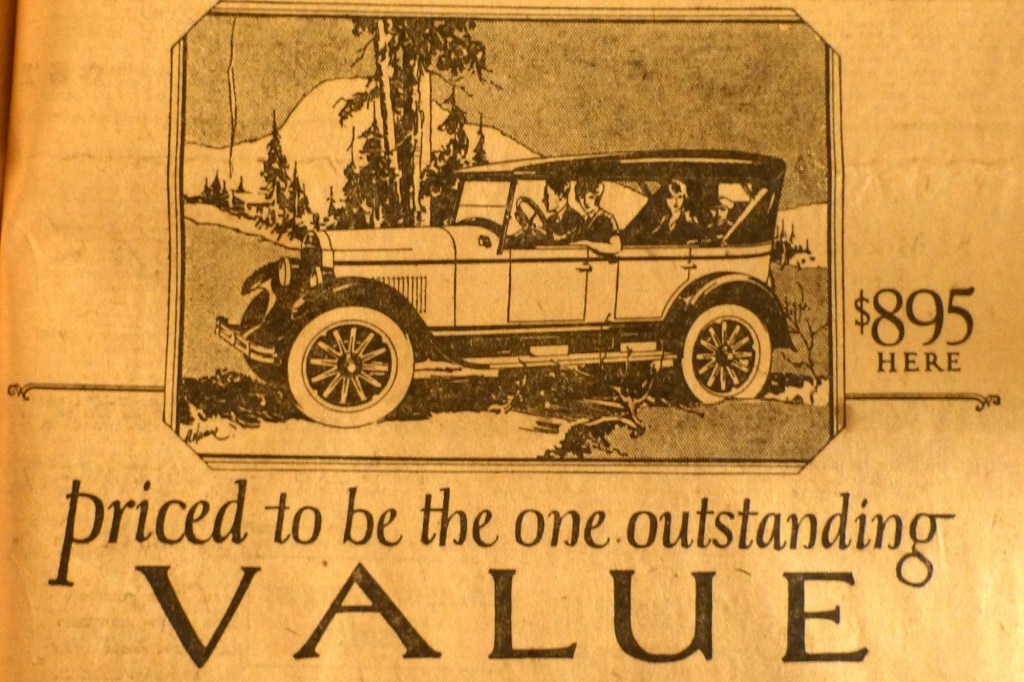
New cars: Automobile advertisements were common in the Gazette a century ago. An ad for the Berkeley Star Motor Co. praised the features of their new Star Six car including “heavy, natural wood, artillery wheels … a special exclusive Japanese Blue lacquer finish … (and) genuine Spanish leather upholstery.”
On sale for $895, the new car was featured in a drawing showing a countryside excursion, pointing up the growing popularity of “car camping” and automobile touring.
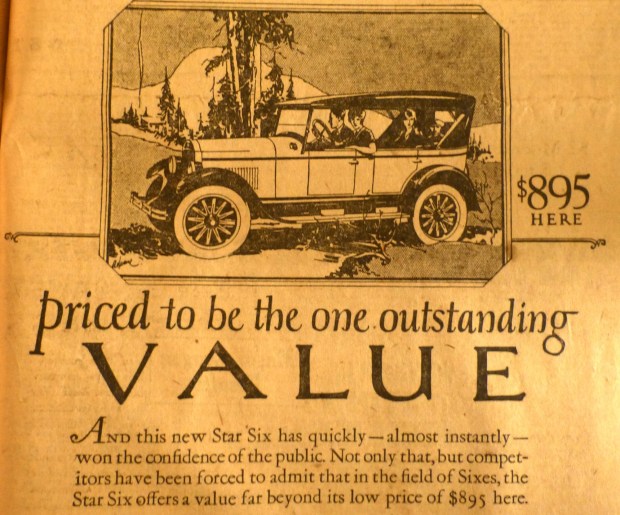 This handsome touring car was featured in Berkeley newspaper ads a century ago. The sale price shown equals about $16,200 today, according to an online inflation calculator. (photo courtesy of the Berkeley Historical Society and Museum)
Heat wave: “Heat Engulfs Whole State,” the Gazette headlined on April 26, 1926. Temperatures had soared to 86 degrees in Berkeley on the afternoon on April 25 and were expected to set a record the next day of more than 91 degrees. San Francisco was also sweltering.
Dig discoveries: Berkeley’s famed archaeologist, the Pacific School of Religion’s Dr. William Frederick Bade, was in the news April 26 after he reported by cablegram and letter the discovery of “three early Bronze Age tombs … of those who ruled in the dawn of history” at Tellen-nashbeh, Palestine. Bade was on a trip to conduct scientific excavations of Biblical sites.
Oldest student: Berkeley’s “oldest school girl” was featured in a Gazette story on April 24, 1926. She was Mrs. Martha A. McKenzie, age 71, of 2411 McGee Ave., who attended the Berkeley Evening High School.
“I don’t believe one ever is too old to learn,” she told the Gazette.
Born in Vermont, McKenzie’s formal education had ended when her father died. She worked in publishing for years, came west in the 1880s and lived in Portland, Oregon, before relocating to Berkeley for health reasons. She was involved in social welfare philanthropy and an opponent of smoking.
Liquor bust: On April 23 “for the second time in the same number of days the corner of Durant and Telegraph avenues has proven the Waterloo of the alleged bootlegging fraternity” the Gazette reported. Two young men were arrested there in police sting operations when they drove up and sold “a few pints of gin” to a woman customer who proved to be a police decoy.
Sea Scouts: A group of Berkeley boys was planning to organize a Sea Scout troop and had met April 23 to take the first steps in applying for a charter, the Gazette reported.
Bay Area native and Berkeley community historian Steven Finacom holds this column’s copyright.