
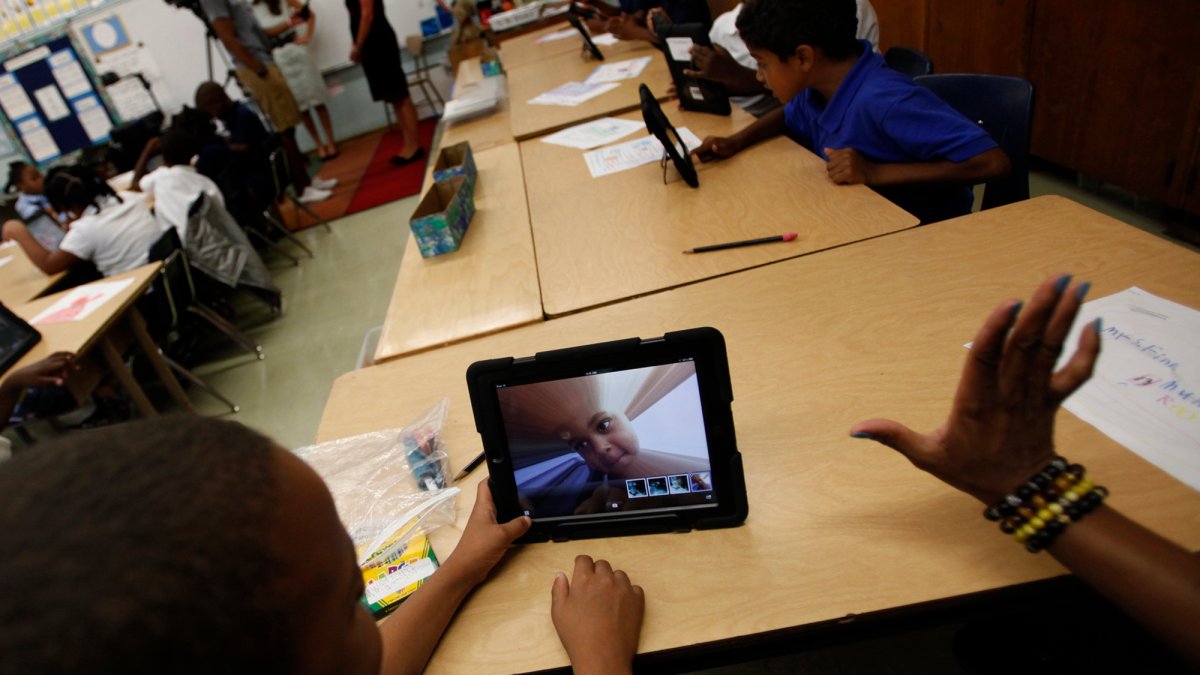
Development of a screen time policy that sets limits by grade, including for district-issued devices, will be considered Tuesday by the Los Angeles Unified School District Board of Education.
The item under consideration, which consumes several pages of the board’s published Tuesday meeting agenda, includes the use of district devices like Chromebooks and iPads. The resolution calls for establishing guidelines that would restrict the use of the devices in a significant shift for the nation’s second-largest district in its program to provide the technology to students.
The policy would establish time limits by grade, including elimination of student digital devices for early education through first-grade, prohibiting device use by elementary and middle school students during passing periods, lunch and recess, and considering prohibition of non-instructional gaming platforms such as Roblox and Fortnite on district-provided devices; and a resolution calling for a plan to increase access to early childhood education programs.
The resolution also seeks to “encourage the use of paper and pen assignments” and cites research about excessive use of digital devices.
“While access to and developing skills in technology are critical in a digital world, excessive screen time can be associated with vision problems, increased anxiety and depression, addictive behavior, reduced attention span, difficulty managing emotions, lower academic achievement, and weaker cognition, according to the American Academy of Pediatrics,” the resolution states. “A growing body of research indicates that excessive and unstructured screen use can negatively impact student attention, mental health, and overall wellbeing and can be particularly harmful for younger students. Research indicates that children 8 to 11 years old who exceed screen time recommendations are at higher risk for obesity and depressive symptoms and have scored lower on cognitive assessments.
Board member Nick Melvoin said the guidelines are part of a plan to find balance when it comes to use of technology. The district’s ban on personal devices, like smartphones and smartwatches, went into effect last year.
“My hope, like the cellphone ban, is that we kind of reset the relationship with technology,” Melvoin said.
The iPad program was meant to help students get a technological leg up on learning. About 9 in 10 public schools, 88 percent, had some type of computing program in the 2024-2025 school year that provided school-issued devices to students, according to the Institute of Education Sciences.
The meeting is scheduled for 10 a.m.