
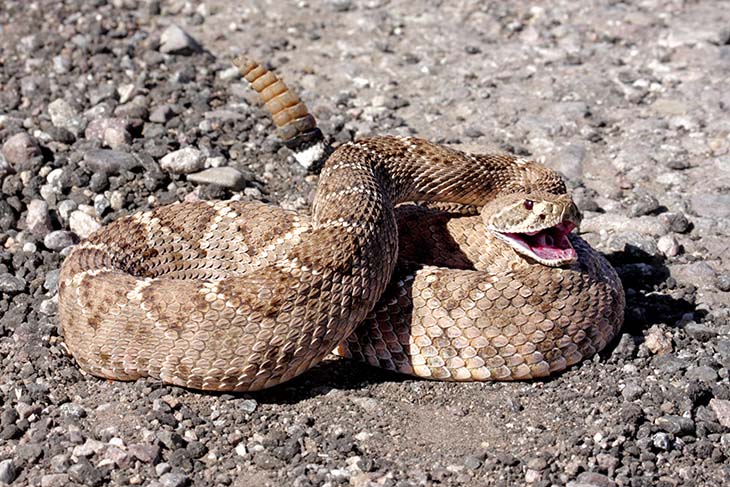
A 78-year-old Northern California woman died after a snake bite, marking the state’s third fatality of 2026 amid an unusual early surge in cases.
UC Davis
A Northern California woman died this month after being bitten three times by a venomous snake on a rural property in Mendocino County, marking an unusual start to a year that has already seen a spike in fatal rattlesnake encounters across the state.
The death, confirmed Monday by the Mendocino County Sheriff’s Office, is the third snakebite fatality in California since January. Historically, the state averages only one such death per year.
The victim, a 78-year-old Redwood Valley resident, was bitten April 8 while walking on the property and was taken by family to Adventist Health Ukiah Valley. Despite treatment, her condition worsened, and she died two days later on April 10, according to the sheriff.
Article continues below this ad
A preliminary coroner’s investigation by the Sheriff’s Office identified the cause of death as disseminated intravascular coagulopath, a severe blood-clotting disorder, and snake envenomation.
The fatality follows two other high-profile fatalities in Southern California earlier this spring.
San Francisco Chronicle Logo
Make us a Preferred Source to get more of our news when you search.
Add Preferred Source
In early March, 25-year-old Julian Hernandez of Costa Mesa died after a month-long battle in the ICU following a bite sustained while mountain biking at the Quail Hill Trailhead in Irvine. Weeks later, 46-year-old Gabriela Bautista of Moorpark succumbed to a bite suffered while hiking in Wildwood Regional Park in Thousand Oaks.
Wildlife experts and state health officials are tracking a significant surge in snake activity that has arrived nearly a month ahead of schedule.
Article continues below this ad
The California Poison Control System recorded 77 rattlesnake bite reports in the first three months of 2026 alone, a stark increase for a state that typically sees between 200 and 300 reports over an entire year.
“As temperatures warm in the spring, we see a dramatic increase in daytime surface activity,” Greg Pauly, curator of herpetology at the Natural History Museum of Los Angeles County, told the Los Angeles Times.
Following a winter of dormancy, snakes are now actively foraging and searching for mates.
Ecologists point to a “perfect storm” of environmental factors: heavy winter rains sparked lush vegetation growth, which led to a boom in the rodent population — the primary prey for California’s seven native rattlesnake species.
This abundance of food, combined with a record-breaking March heatwave, has drawn snakes out of hibernation earlier and in greater numbers.
Article continues below this ad
“The rattlesnakes use the warm temperature as a cue for when it’s time for them to come out,” Emily Taylor, director of the Physiological Ecology of Reptiles Laboratory at Cal Poly San Luis Obispo, told Backpacker.
Taylor, who also runs Central Coast Snake Services, noted that sightings in many regions peaked in March, whereas activity typically doesn’t “go crazy” until late April.
Despite the recent cluster of deaths, medical experts emphasize that fatalities remain exceedingly rare.
The Centers for Disease Control and Prevention estimates that of the 7,000 to 8,000 people bitten by venomous snakes annually in the U.S., only about five are fatal.
UC Davis Health advises outdoor enthusiasts to remain vigilant and stick to well-beaten paths. If bitten, the most critical factor is the speed of medical intervention.
Article continues below this ad
“A snake bite with venom from a rattlesnake causes significant stress on the body and can lead to organ shutdown,” Dr. William Woo of Kaiser Permanente told KTLA. “The effective treatment is antivenom, and the sooner we can administer it, the better off the patients are.”
Authorities warned against “old-school” first aid: do not use ice, tourniquets, or suction kits, and never attempt to cut the wound. Instead, remain calm, immobilize the limb, and call 911 immediately.