
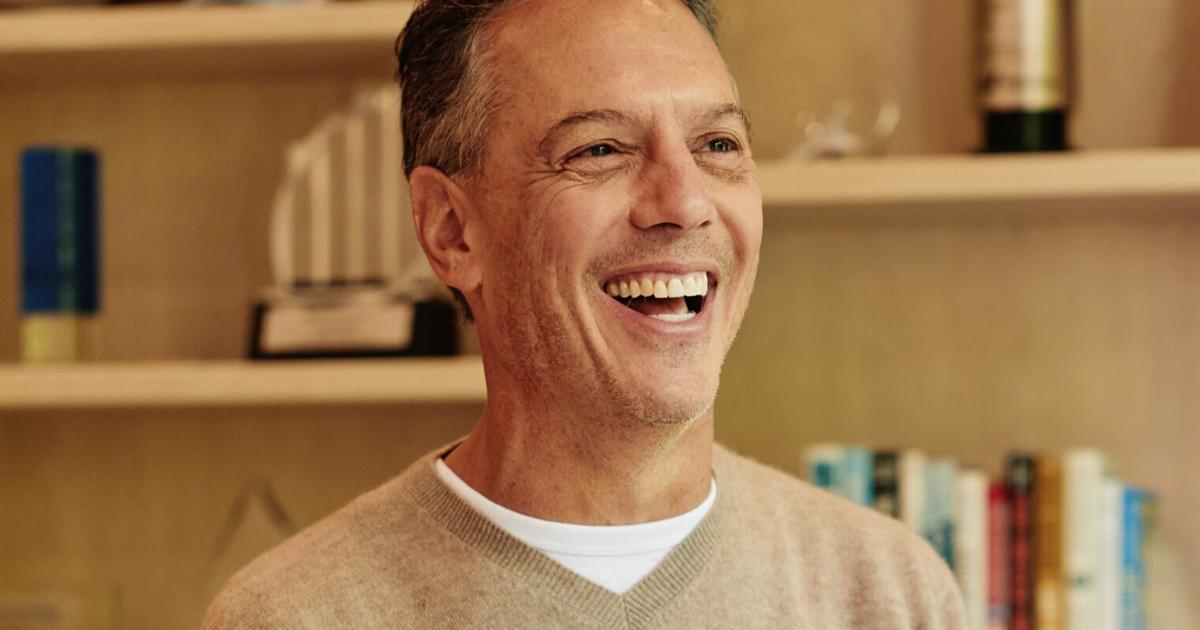
LOS ANGELES — Adam Miller is on the phone when he arrives at the coffee shop. He waves, holds up a finger, and steps over to the counter to grab a coconut water, paying at the register without breaking from his call. I follow him and order a bottle of celery juice. He offers to pay. I decline. In my years working as a consultant, I sat in meetings with founders and chief executives who answered questions fully while their phones hummed on the table. Miller, it turns out, is one of them.
He is running for mayor of Los Angeles as a first-time candidate, and he arrived alone. He is in a plain untucked button down and jeans, the kind of outfit a startup founder wears to both a board meeting and the social outing afterwards. He does not hide that he works sixteen hours a day, and his eyes say as much. He is in his mid-fifties, a builder by temperament, and he has the manner of someone used to being the person in charge of whatever room he is in.
Before we sit down, two men stop us at their table. They had just come from a Matt Mahan fundraiser at a mutual friend’s house. One of them introduces himself as Sam, says he co-hosted an event for Miller at the same friend’s home earlier this year, and tells him they keep seeing him on Instagram.
“It’s working,” Miller laughs. “I told people I’d be annoying everybody very soon. It’s gone from never heard of you, to I see you everywhere, to you’re annoying. I’m waiting until I get to really annoying.”
Sam laughs. “That’s the goal. You’ve got my vote.”
Miller thanks him, turns back to me, and picks up the thread as if the interruption had not happened. It is a practiced move, and he is good at it.

Adam Miller says his campaign is focused on city services, public safety, housing, homelessness and restoring confidence in City Hall.
Miller’s pitch starts the way it tends to start in his stump speech, with a catalogue of failures. He ticks them off the way a management consultant might. Homelessness and encampments. Trash. Broken streets and sidewalks. People feeling unsafe in their homes. He lives in Brentwood. He evacuated his family twice during the January 2025 fires. Friends in the Palisades lost their houses.
“But in addition to all of that, I’ve been running multiple businesses and nonprofits in LA,” he says, “and in particular, the nonprofit work I’ve been doing around homelessness has gotten me deeper into how the city functions behind the scenes. What I’ve learned is that it is extremely dysfunctional. As bad as people observe the city being today, it’s worse.”
Miller is the founder of Cornerstone OnDemand, the talent management software company he built in Santa Monica and ultimately grew to roughly 800 employees locally and 3,000 worldwide before stepping away from the chief executive role. He and his wife co-founded Better Angels, a homelessness nonprofit. He has chaired Team Rubicon, the veteran-led disaster response organization. When he makes the case for his candidacy, the through-line is the same. “I’ve been a leader for thirty-five years,” he says. “I’ve run businesses and nonprofits literally for thirty-five years. The buck stops with me.”
One word keeps surfacing as I read and listen to Miller ahead of the interview: execution. In his telling, Los Angeles does not lack good intentions. It lacks the capacity to act on them. I ask why he thinks he can do it better than career politicians who have been in the system for decades.
He does not pause. “A lot of the people in these positions have no leadership experience. They have no management experience. You work with business people, you know that often there will be somebody who does a very good job in their current position, and they get moved into management, and they’re terrible as a manager. It’s a different skill set.” He pauses. “Being an executive, the person who ultimately has to make the decisions, that defines the goals, that sets the vision, that aligns the team, is a very particular skill set. None of my competitors have any level of that experience, with the exception of the current mayor, who has clearly failed over the last four years.”
He checks his phone, then sets it back down, face up.
Listening to Miller, I find myself thinking about a thread in American political history that has quietly frayed. There was a time when the country celebrated the passage from private accomplishment to public service. Joseph Kennedy famously said that he amassed great wealth so his children would never have to worry about making money, freeing them to dedicate their lives to serving the public.. That ethic produced a president, two senators, and a political dynasty that the Democratic Party once held up as its ideal. Michael Bloomberg built a business and media empire and then spent twelve years running New York. The assumption was simple: if you had built something, you had earned the credibility to govern something.
That assumption has increasingly come under pressure within the Democratic Party, which has grown antagonistic toward the character-type Miller represents: the wealthy, self-made executive who believes his operational skills translate to government. What makes Miller’s case more complicated, and more interesting, is that the antagonism does not quite fit the caricature. He is not a billionaire parachuting in from a boardroom. He has co-founded a homelessness nonprofit. He has chaired a veteran services organization. He has built a workforce development pipeline for underserved communities. The resume reads less like a plutocrat’s vanity project and more like a case study in applied civic engagement. And yet the skepticism he faces from parts of his own party seems less about his record and more about what he symbolizes. The tension is ideological before it is personal.
I raise Bloomberg and Pritzker with him directly. Who does he study? “The most comparable person in recent LA history would be Dick Riordan,” he answers. “The difference is he was a Republican. I’m a Democrat. I come to this with the same values that the vast majority of Angelenos have, and with tremendous nonprofit experience.” He argues that coming to the race as a political outsider is a feature, not a bug. “I have no favors to repay, no alliances I have to uphold. I can work for the people of this city. I can make the hard decisions that need to be implemented to fix it.”
On housing, Miller is careful to stake out a position that is neither the Democratic Socialists of America left nor the protectionist homeowner right. “People call this NIMBYs versus YIMBYs,” he says. “I’m both. I don’t believe in either-or paradigms. We absolutely have to build more housing.” He argues that measures like Proposition ULA, the 2022 Los Angeles “mansion tax” on high-value property transfers, and the city’s rent-control framework have constrained new construction. Los Angeles, he says, is issuing roughly thirty percent fewer new home permits than it did in 2019, a figure he cites repeatedly on the trail.
What he does not believe in, he says, is density for its own sake. “LA has ninety-nine unique neighborhoods. You don’t want to treat the entire city as if it’s all downtown.” He cites Koreatown as a place where multi-family housing fits the existing fabric and infrastructure. He cites Encino, Cheviot Hills, and large parts of South Los Angeles as places where it does not. “Those neighborhoods should not have eight-story high-rises in the middle of them. But that doesn’t mean there should be no housing in any of those locations.”
His preferred model is what Larchmont activists have championed as the Livable Communities Initiative: one story of retail beneath four stories of residential, built along the dilapidated single-story commercial corridors that stripe parts of Pico Boulevard and Westwood. “You take something that doesn’t look good and you turn it into something beautiful, like a European city,” he says, “where you add incrementally more housing but you don’t ruin the character of the neighborhood. You enhance it.”
On homelessness, Miller rejects what he calls the “just build housing” framing that has dominated progressive policy in Los Angeles. He and his wife spent a year and a half researching the problem before launching Better Angels. “We’ve spent ten billion dollars in the last decade, at least eight billion of which we can account for. Nobody knows what happened to the other two billion. And we have thousands of people working in the homelessness ecosystem. Yet we have forty-four thousand people unhoused in LA City and seventy-two thousand in LA County.”
His answer, he argues, is not a single program but a portfolio: prevention, services, shelter, technology, and housing. He emphasizes service specialization. “You have people who are unhoused because of a financial shock. You have people who are unhoused because of addiction. You have people who are unhoused because of mental illness. You have people who have all three problems. You have to understand who the person is, what their situation is, and where they belong.”
I raise what many Westside readers, particularly in Venice, believe to be the core issue: severe mental illness among the unhoused. Mental health is a county responsibility, not a city one, and Los Angeles County only began implementing the CARE Act in 2026, four years after it passed. How does a mayor work across that jurisdictional divide? His answer is partly a management answer. “We need much better coordination across nonprofits and much better coordination between the city and the county. In fact, you can do this for less money than we’re spending today.”
The conversation turns to the middle class. Miller wants to talk about jobs. “We have forty percent fewer film permits today than in 2019. That translates to about a hundred and twenty thousand jobs. I’m not talking about the tier-one actors and directors and producers. I’m talking about the hairstylists, makeup artists, boom operators, electricians, key grips, busboys, writers, craft service. All of those people have been dramatically impacted by entertainment leaving the city.” The city, he argues, has too often treated employers and real estate developers as “the enemy instead of the customer.”
He pushes back when I mention that the Silicon Beach moniker never quite took hold the way its boosters hoped. “LA has become one of the top tech cities in the world,” he says. “When I started Cornerstone, it was not. I helped build the whole tech ecosystem here.” After the murder of George Floyd in 2020, Miller convened a group of Los Angeles technology chief executives and launched what he called the Thousand Interns Initiative, placing young people from South and East Los Angeles in internships at local tech companies. The program, he says, has now placed over two thousand interns and apprentices and is on track to place a thousand a year.
His phone lights up again. He glances at it, sets it aside.
What motivates him, I ask. He describes a carrot and a stick. The carrot is the possibility that LA can be fixed while the window is still open. The stick is Detroit. “If we stay on the current course for another four years, LA is going to end up like Detroit, and it’s going to be very difficult to dig us out of that hole. Right now we have a chance to get Hollywood to come back. If we don’t do it soon, all the talent that’s here is going to go where the jobs are. It will be very difficult to recover from that.”
The 2028 Olympics, he says, are a forcing function. “We have two choices. We can hide our problems or we can fix them. I want to fix them.”
We are running up against his hard deadline of three o’clock. I ask what he does for fun. He coached his boys’ soccer teams when they were growing up, he says. They still watch matches together. His club is Barcelona. He lists the Rams, the Dodgers, the Lakers, the mountains, the beaches. “LA is a very rare place on earth where you can do all those things near each other. You can do them all in one day. I’ve done that. I’ve been to the beach and to the mountain in one day.”
Before we stand up, I ask what keeps him hopeful. Miller has said that part of the reason he is running is so that his sons will want to come back to Los Angeles after college. I tell him I have noticed the same drift in my own neighborhood, where single-family homes increasingly sit as rentals because the owners’ adult children have left for cheaper cities. I am fortunate enough to still be raising young kids here, but the trajectory worries me too.
He nods. “If we fix it, LA is one of the greatest places on earth to live. We have incredible natural beauty. Incredible weather. An incredibly diverse and talented population. Incredible sports teams and cultural sites and museums and parks. It’s such an amazing city, and I want to see it reach its potential. LA should be leading the world.”
He adds, in the same matter-of-fact delivery he has used the entire half hour: “I don’t know every single politician, and I don’t know every single bill that got passed in the last thirty years. But I know how to get things done. I’ve done it across industries, across sectors, and across types of organizations. I know I can do it again for the city.”
His phone buzzes. He picks it up and we say goodbye.
Editor’s Note: This story is part of an ongoing series of candidate profiles published by the Current as part of our coverage of the 2026 election season.