
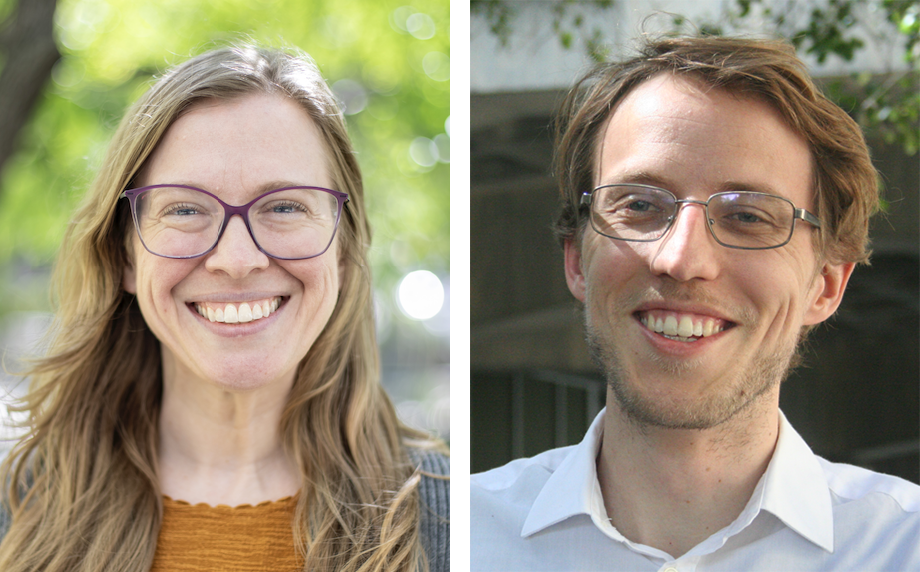
Hamilton: It’s been great. It’s been really fun to come back, reconnect with people, and meet brand new people. Now, we are in the neuroscience and statistics departments, and we’re having really interesting interactions across those departments and even in different departments, so that spirit of collaboration continues.
Our labs are up and running. Our space is really nice. I like that our labs are interacting a lot. We both moved with some grad students and postdocs who came with us from UT Austin. That was a big move for everybody, but we’ve tried to make it as smooth as we can.
Bob Knight has been super helpful in getting my lab up and running. He and I both do intracranial recordings. He’s helped me get collaborations established with Bay Area folks, and I’ve been in contact with his postdocs. It’s been really nice to be back and have that support here.
Huth: Yeah, it’s been really fun. I lived in California all my life before moving to Texas a few years ago, so it feels like coming home. The lab is doing the work we want to do. I’m excited about new postdocs, grad students, and collaboration opportunities.
I’m jazzed to use this sophisticated, high-resolution instrument, the NextGen 7T MRI scanner, to see how the brain works, is organized, and represents information, which we couldn’t see using existing scanners. A machine as ridiculously complicated as that one is not that useful without a big set of people who know everything about how to use it, so we’re interacting heavily with David Feinberg, Joseph Vu, and their groups.
Hamilton: There are a number of groups tackling the area of speech and language from different angles, whether it’s the hardware, algorithms, non-invasive versus invasive, translational applications, or even animal models. Having all these people together is really helpful to build up these bigger initiatives.