
Boston beat host Philadelphia 6-5 in a game with a final score that has been repeated hundreds of times through the years.
What made this different is that it was the first time for not only the score but the game.
One hundred fifty years ago today — April 22, 1876 — the National League debuted with the Boston Red Caps beating the Philadelphia Athletics in a game that lasted about two hours before a crowd estimated at 3,000 at the Athletics’ grounds located at 25th and Jefferson.
Boston opened the scoring in the second inning on a bad throw by A’s third baseman Ezra Sutton, according to a story from the Society for American Baseball Research (SABR).
“Fine hits” by Philadelphia’s George Hall and Bill Coon in the bottom of the second tied the game. Boston took a 3-1 lead in the third on hits by Jim “Orator” O’Rourke and Tim Murnane, aided by a defensive mistake by an A’s outfielder.
Philadelphia rallied again and it was 4-4 after six innings. The Bostons plated two runs in the top of the ninth, then survived one more A’s rally in the bottom of the inning.
With two outs, one run in and the tying run at second, Sutton had a “feeble hit” back to the mound. He was thrown out, and the first game was in the books.
This early version of baseball more closely resembled Sunday afternoon softball.
The game’s origins trace back three decades earlier. The first officially recognized game was recorded June 19, 1846 in Hoboken, N.J.; the New York Knickerbockers lost 23-1 to the New York Nine in four innings.
Abner Doubleday was credited with inventing the game seven years earlier, though historians dismissed that as myth years later. Alexander Cartwright is regarded as the modern father of the game, credited in 1845 for producing rules while with the New York Knickerbockers.
The game evolved somewhat since Cartwright produced the “Kickerbocker Rules.”
The National League was immediately preceded by the National Association, which was considered the first major league before folding following the 1875 season. The new league was started by William Hulbert, owner of the Chicago team, after the National Association collapsed because of issues ranging from corruption to rowdy, drunken ballplayers to gambling factions that damaged the integrity of the game.
Actually, maybe it hasn’t evolved so much, after all.
Most fans probably don’t give a second thought to the evolution of baseball when they’re at the ballpark. A century and a half provided ample time to get things dialed in. Here’s a glance at some of the differences when the National League debuted:
• The pitcher threw from only 45 feet away from the batter’s box, was required to throw underhand and the batter “called” for either a high or low ball (belt to shoulder or belt to knee).
The mound would not move back to its present 60 feet, 6 inches until 1893, when a mound replaced the pitcher’s “box.” Pitchers were not allowed to throw overhand until 1884.
• Baseballs had a rubber core, were wrapped with yarn and two pieces of leather were stitched together to cover them. There were some inconsistencies in the quality, which was magnified by one ball being used for an entire game.
They often became “mushy” midway through a contest, hence the “deadball era” before a livelier ball was introduced decades later with tightly wound yarn around a cork center.
• There were 90 feet between the bases in 1876, the distance decided on nearly two decades earlier. Home plate was square then, just like the other bases; it also was round at times before the pentagon shape, with the edges aligning with the first- and third-base lines, was introduced in 1900.
• Most players did not wear gloves in 1876, which is one reason there were many more errors in the early days. In that first game, only three of 11 runs were earned.
• In 1876, nine balls were required before a batter walked. That number changed from eight to seven to six to five over the next decade before they settled on four balls in 1889.
Three strikes, called or missed, were an out. But foul balls did not count as strikes until 1901.
• Foul balls caught on one hop counted as an out until 1883.
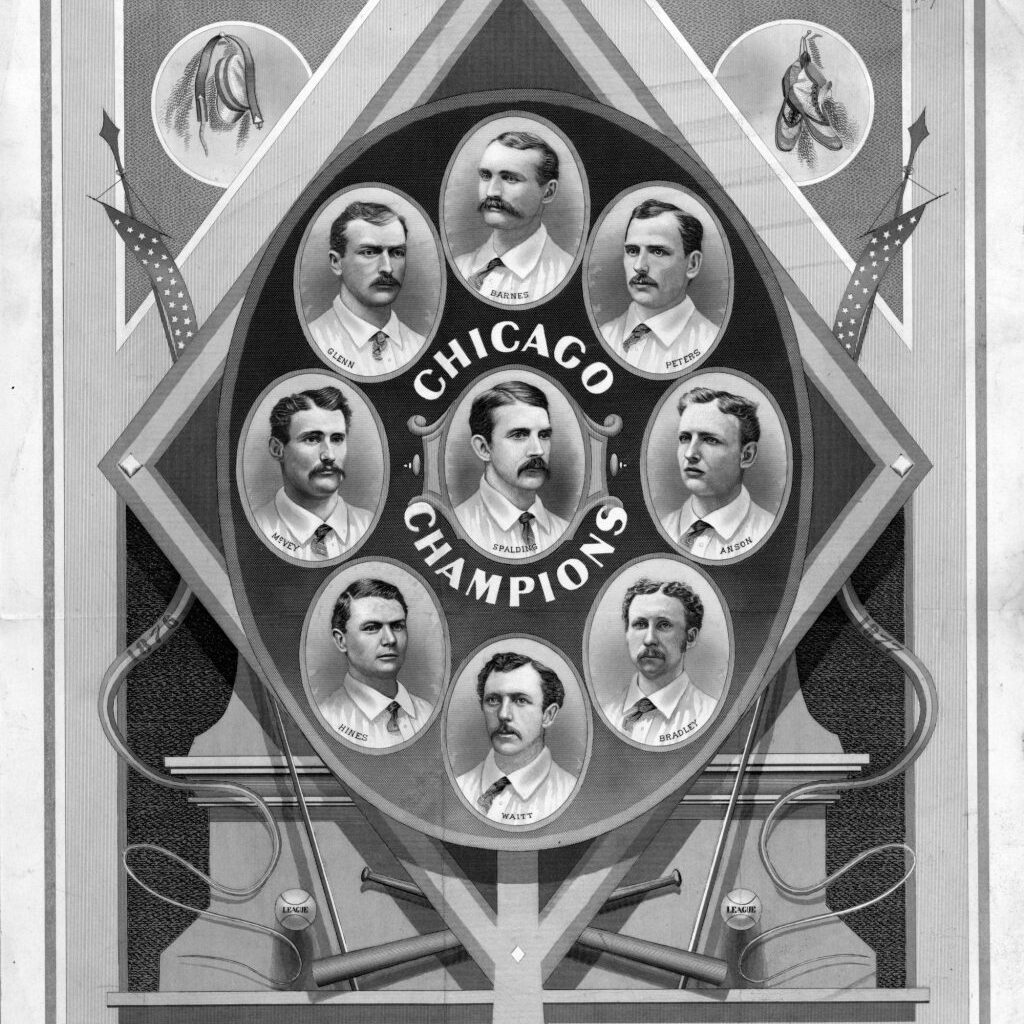
Chicago right-hander Albert Spalding pitched almost every game for the NL-leading White Stockings, winning a league-high 47 games. Spalding may have had an advantage. The official ball used by the NL was produced by A.G. Spalding and Co. Barely a year later, Spalding quit playing to focus on his sporting equipment business. The name Spalding appeared on all National League baseball for 100 years.
Then again, Spalding’s decision may have had something to do with his wages. He was among the league’s highest-paid players at a reported $4,000, but the average was said to be $1,000 for the six-month season.
“I was not able to understand how it could be right to pay an actor, or a singer, or an instrumentalist for entertaining the public and wrong to pay a ball player for doing exactly the same thing,” Spalding said.
1876 NL standings
TEAM W-L Pct. GB
Chicago White Stockings 52-14 .788 —
Hartford Dark Blues 47-21 .691 6
St. Louis Brown Stockings 45-19 .703 6
Boston Red Caps 39-31 .557 15
Louisville Grays 30-36 .455 22
New York Mutuals 21-35 .375 26
Philadelphia Athletics 14-45 .237 34.5
Cincinnati Reds 9-56 .138 42.5
1876 National League leaders
Batting average — Ross Barnes, Chicago, .429
Home runs — George Hall, Philadelphia, 5
RBI — Deacon White, Chicago, 60
Wins — Albert Spalding, Chicago, 47
ERA — George Bradley, St. Louis, 1.23
Strikeouts — Jim Devlin, Louisville, 122
These 10 Hall of Famers were part of baseball in 1876
George Wright, Boston, executive: A star shortstop for Cincinnati and Boston known for his bare-handed fielding skills and ability to throw with either hand. His best years as a player were before the NL originated, and he was elected to the Hall of Fame as an executive/pioneer.
Albert Spalding, Chicago, executive: Star pitcher for the White Stockings in 1876, who impacted the game more as an executive and entrepreneur. He moved to Point Loma in 1900. He died in San Diego in 1915, and his ashes were scattered at sea.
Deacon White, Buffalo, 3B: He played all nine positions, but was best known as a barehanded catcher.
Harry Wright, Philadelphia, executive: Regarded as the “Father of professional baseball playing,” he was one of the game’s first great managers.
Cap Anson, Chicago, 1B: Charter member of the 3,000-hit club who was regarded as the game’s first superstar. Credited with introducing hand signals and pitching rotations, among other innovations. Also a vehement racist who refused to play against teams with black players.
Candy Cummings, Hartford, executive: Credited with inventing the curveball while an amateur player in the 1860s.
Jim O’Rourke, New York Giants, LF: Among the game’s biggest stars in the 1880s. At 54, he became the oldest person to play and get a hit in the majors when he returned to the Giants in 1904 after 11 years out of the league.
Morgan Bulkeley, executive: He was the NL’s first president in 1876, but it regarded by some as the “least-deserving Hall of Fame inductee” because he served only one year in the position.
Pud Galvin, Buffalo, P: He was the first 300-game winner in major league history, posting a 365-310 record over 14 seasons. The Washington Post reported that he was the first player to use a performance-enhancing substance — Brown-Sequard elixir, which contained monkey testosterone — before a game in 1889.
William Hulbert, executive: National League founder who was president of the Chicago White Stockings. Wasn’t inducted to the Hall of Fame until 1995 by the Veterans Committee.