
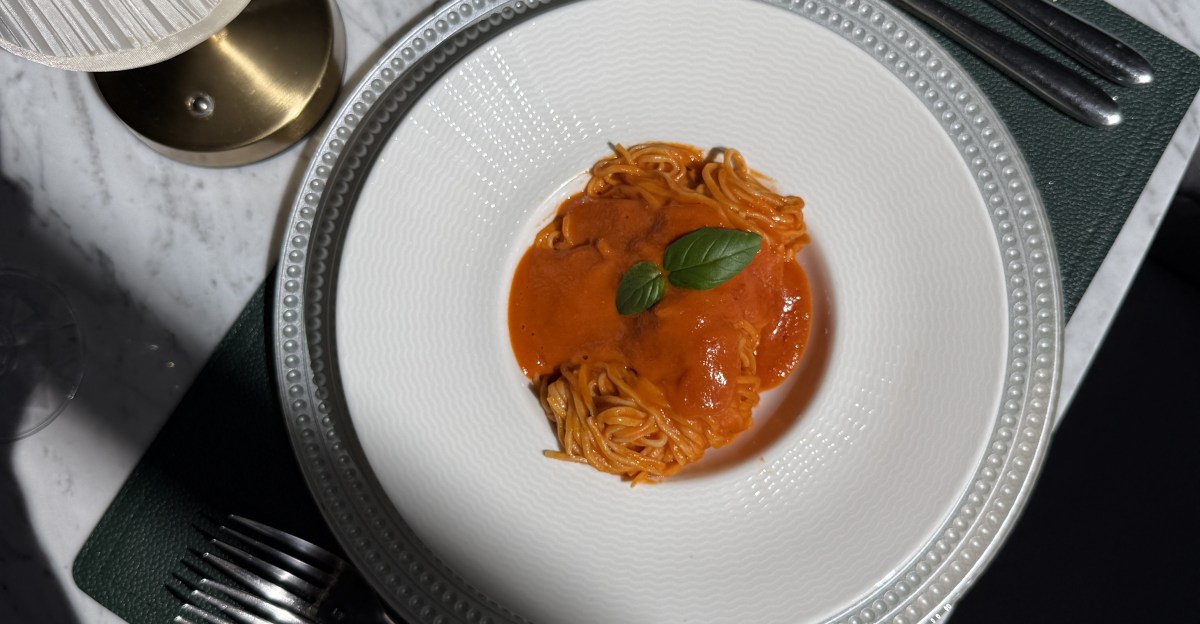
Pasta pomodoro seems like a simple thing. It’s a dish I’ve made at home and ordered in Italian restaurants countless times with varying results: The cherry tomatoes that pop pleasingly in a salad might suffocate in a sauce; the canned Italian San Marzanos that cost several dollars more than their domestic counterpart might lose their verve when pummeled with onions and garlic.
But this kind of mayhem never happens to the pasta pomodoro at da Barbara, a Hollywood Italian restaurant so discreet, it feels like a family secret. The pasta pomodoro at da Barbara, it’s no food writer’s exaggeration to say, is the best in Los Angeles.
Let’s start with the pasta: Tagliolini handmade by the restaurant’s chef and owner, Barbara Pollastrini, drapes delicately around the fork yet packs a pleasing heft, toothsome and tangy, as bright as the mid-summer sun on the Mediterranean. That has everything to do with the sauce — vermilion-colored, the texture of velvet, an essentially couture pomodoro whose ingredients change according to the seasons — what’s ripe and what Pollastrini deems worthy.
“I might use four, five, six different types of tomatoes, depending on the time of year,” Pollastrini tells me on a Wednesday afternoon at the Larchmont Farmers’ Market. It’s one of her go-to sources for tomatoes; she’s also a regular at the Sunday Hollywood Farmers’ Market. “I almost always take the tomatoes one week ahead, because when I buy them, they’re usually not ready to make a sauce. They need to sit on my counter for a week, they need to get very ripe. Then I can work with them.”
“I might use four, five, six different types of tomatoes, depending on the time of year.”
— Barbara Pollastrini
It’s a technique she developed not long after moving from Rome to Los Angeles in 2005. A caterer and cooking instructor who trained at Le Cordon Bleu, Pollastrini came to Hollywood with dreams of opening a restaurant and working as a food stylist for film and television. “That’s not a position that existed in Italy: ‘food stylist,’” she says, examining a carton of ruby and jade-hued cherry tomatoes (her verdict: “Good for salads, not for sauce”).
She ended up working on films such as He’s Just Not That Into You and The Girl With the Dragon Tattoo. Meanwhile, she tried her hand at making the pasta al pomodoro whose recipe she had honed back home.
“In Italy, I would use one kind of tomato, and our tomatoes are tiny — the more concentrated the tomato, the more flavor you have,” she says. “But American people like big stuff. These big tomatoes are full of water.” Her sauce suffered. Trial and error led her to the counter method, and over time and many farmers market trips, she figured out which vendors to patronize for pomodoro tomatoes and what varieties played well with each other (greens, yellows, and oranges never go into her sauce, only red).
This is not the sort of nuance that you can easily flex as a food stylist. Pollastrini eventually left Hollywood and went to work as the head chef of a fledgling Italian restaurant in Santa Monica. “I learned so much — how to create a menu, how to run a restaurant,” she says, as well as how the American way of doing things might differ from what she had learned back home and retrofitted to Los Angeles.
“They wanted me to use canned tomatoes for the tomato sauce, because my process of giving the fresh tomatoes a week to ripen was long,” she says. “I refused. I said, ‘We are going to be exactly like the restaurant across the street if we do that.’”
Drawing the line at canned tomatoes may seem dramatic, but it only takes one taste of Pollastrini’s transcendent pomodoro to see her side. In 2023, she opened da Barbara, a nine table restaurant that occupies a two-story condominium on Fountain Ave. You ring the doorbell to enter and Pollastrini greets you from the open kitchen, where tomatoes line up on the countertop, awaiting their turn. If a week doesn’t ripen them to Pollastrini’s liking, she roasts them in the oven with olive oil and a clove of garlic — if they’re still not sweet enough, she’ll caramelize some onions before blending and straining the whole shebang.
The deli container that houses the sauce exudes its owners humility. Same with the potted basil plant from which she’ll pluck a leaf before placing the pomodoro on your table. There are no condiments. “Some people will ask for Parmesan,” Pollastrini says. She asks them to taste first. “If you still want it after that first bite,” she says, “I’ll give it to you.”
You don’t need Parmesan. You don’t need crushed red pepper flakes. You may, however, need more. “The other day, someone came in and they liked the pasta so much, they ordered it twice,” Pollastrini says. The results of tireless trial and error can be as fruitful as that.