
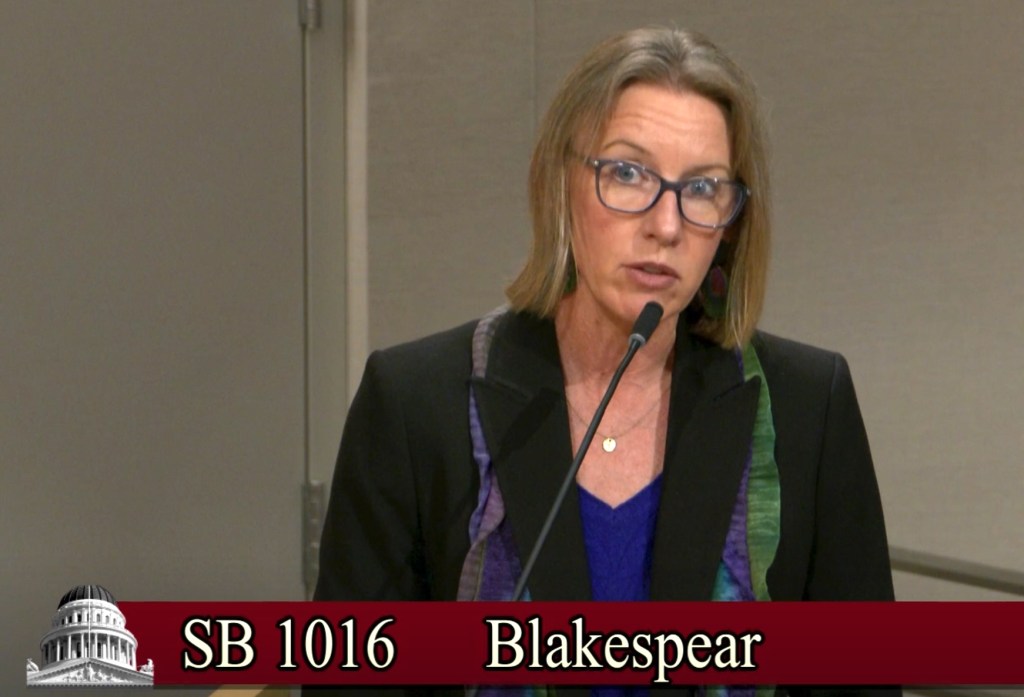
A pair of bills that seek to make it easier to get help for seriously mentally ill people cleared their first committee hearing in Sacramento on Tuesday despite opposition from some advocacy and professional groups.
Judiciary Committee members unanimously approved advancing Senate Bills 1016 and 989, legislation proposed by Sen. Catherine Blakespear, D-Encinitas, to appropriations after hearing from a dozen family members who said they support making changes that would make it easier for first responders to request mental health evaluations when the subjects of some petitions refuse to participate.
After hearing testimony, including opposing comments from the advocacy group Disability Rights California, committee chair Tom Umberg said he believes the proposed legislation could help reach Californians with severe mental illness who have so far fallen through the cracks.
“What we’re trying to do is we’re trying to provide a structure so that we can have these folks who have schizophrenia, bipolar disorder with psychotic features, who sadly many people think that they can never become productive members of society, and that’s not true,” Umberg said.
Umberg is co-author of the 2022 bill that created the Community Assistance, Recovery and Empowerment (CARE) Act. The legislation, which took effect in San Diego County in October 2023, and gradually throughout California, allows loved ones, first responders and other professionals to file petitions on behalf of residents with severe and untreated mental illnesses, such as schizophrenia, who are considered unlikely to survive in the community if they do not receive treatment.
But progress has been slow.
A recent California Judicial Council report states that while there have been 3,092 CARE petitions filed, generating nearly 7,400 hearings statewide, the process yielded just 684 voluntary agreements and 22 court-ordered care plans through November 2025. San Diego has been among the state’s most-active participants, reporting 516 local petitions through Feb. 23, with 182 agreements signed and 32 people having graduated from the program.
However, 297 petitions have been rejected. Ninety-eight of those rejections were because the subject of a petition was considered ineligible, likely due to their type of mental illness, but 79, 27% of total petitions, have been due to a subject “refusing services.”
It is this group that Blakespear’s bill highlights.
A growing number of community members are expressing their frustration that the CARE Act has been unable to reach some individuals, especially those said to suffer from anosognosia, the medical term used to describe situations where a person is unable to recognize their own physical or mental health impairments.
SB 1016 would allow a CARE Act petitioner to ask the court to order a mental health evaluation in cases where they believe the subject of their petition isn’t willingly participating “due to the severity of their mental disorder or lack of insight into their mental disorder.”
Dr. Aaron Meyer, a UC San Diego professor of psychiatry and behavioral health officer for the City of San Diego, has advocated for using an ignored part of a state involuntary treatment law that allows members of the public to request mental health care evaluations if they believe that a person’s behavior in the community meets standards of grave disability.
“These are often the sickest individuals, people who are deteriorating and may be unable to survive safely in the community without greater support,” Meyer said. SB 1016 closes that gap; it allows petitioners to alert the court when care may not be enough, and for a small number of people, create a true continuum of care so the sickest receive more help, not less.”
But even when the CARE Act was under consideration by the Legislature, there was push back against any notion that the program could lead to involuntary treatment and even conservatorship, the process that allows a court-appointed person to make decisions on a subject’s behalf.
Samuel Jain, a senior attorney for Disability Rights California, led the opposition, noting that SB 1016 would allow a judge to order an evaluation under the Lanterman Petris Short Act, which requires a person to exhibit severe behavior or evidence of grave disability, to be considered for involuntary treatment.
“This bill would allow a CARE Court judge, not a clinician, to order someone into a locked facility and wait up to three days before they see a provider,” Jain said. “Our system has better ways to address people in mental health crisis.
“We have mobile crisis teams where an individual will immediately see a provider who may provide crisis intervention services that prevent the need for involuntary hospitalization altogether.”
The bill is sponsored by the California State Association of Psychiatrists and several other mental health care advocacy groups, and is opposed by the California State Association of Counties and the Behavioral Health Directors Association.
San Diego and many communities across the state have increased spending on these resources, but have been unable to eliminate cases where some residents remain unhoused, cycling in and out of law enforcement custody. Meyer has said that initial assessments are often inadequate, especially in cases where an ongoing pattern of behavior is involved.
Blakespear also introduced Senate Bill 989, which also seeks to modify the CARE Act. The law currently requires first responders, such as police officers and firefighters, to file petitions on behalf of residents they encounter when responding to calls, but the bill would allow them to hand off that task to their local county behavioral health departments.
Meagan Subers, representing the advocacy group California Professional Firefighters, testified at Tuesday’s hearing that training for first-responders in how to file CARE Act petitions is far from consistent.
“We do have jurisdicitions where the local EMS personnel do not feel equipped to do the petiitions themselves, have not received that information and training at the local level, and this bill is aimed at those jurisdictions, giving them the resources to provide the information that they know about the individual to the county, and having the county follow up and do the petition based on their expertise at the county level with county social workers and the like,” Subers said.
Jain, the Disability Rights California attorney, predicted that adding additional language to the CARE Act would only add expense to an already expensive program that has not yet managed to enroll the majority of the people it targets into treatment.
“The state is spending hundreds of millions of dollars on this program without fully understanding the efficacy of the program,” Jain said. “A report from the state Legislature last year found the program cost $713,000 per participant.
“This bill would add yet another process, more complexity and more cost to an unproven program that’s struggling to meet its basic goals.”
Subers pushed back against the notion that relying on voluntary treatment, better applied, will ever reach the small population that is often picked up during 911 calls over and over again.
“From our perspective, if there was a way to get individuals the treatment they needed … we would not have the CARE Act today,” Subers said. “We are committed to seeing implementation work … the cycle of continuing to push these individuals to seek care through the EMS system is not sustainable and not fair to the person who needs help.”