
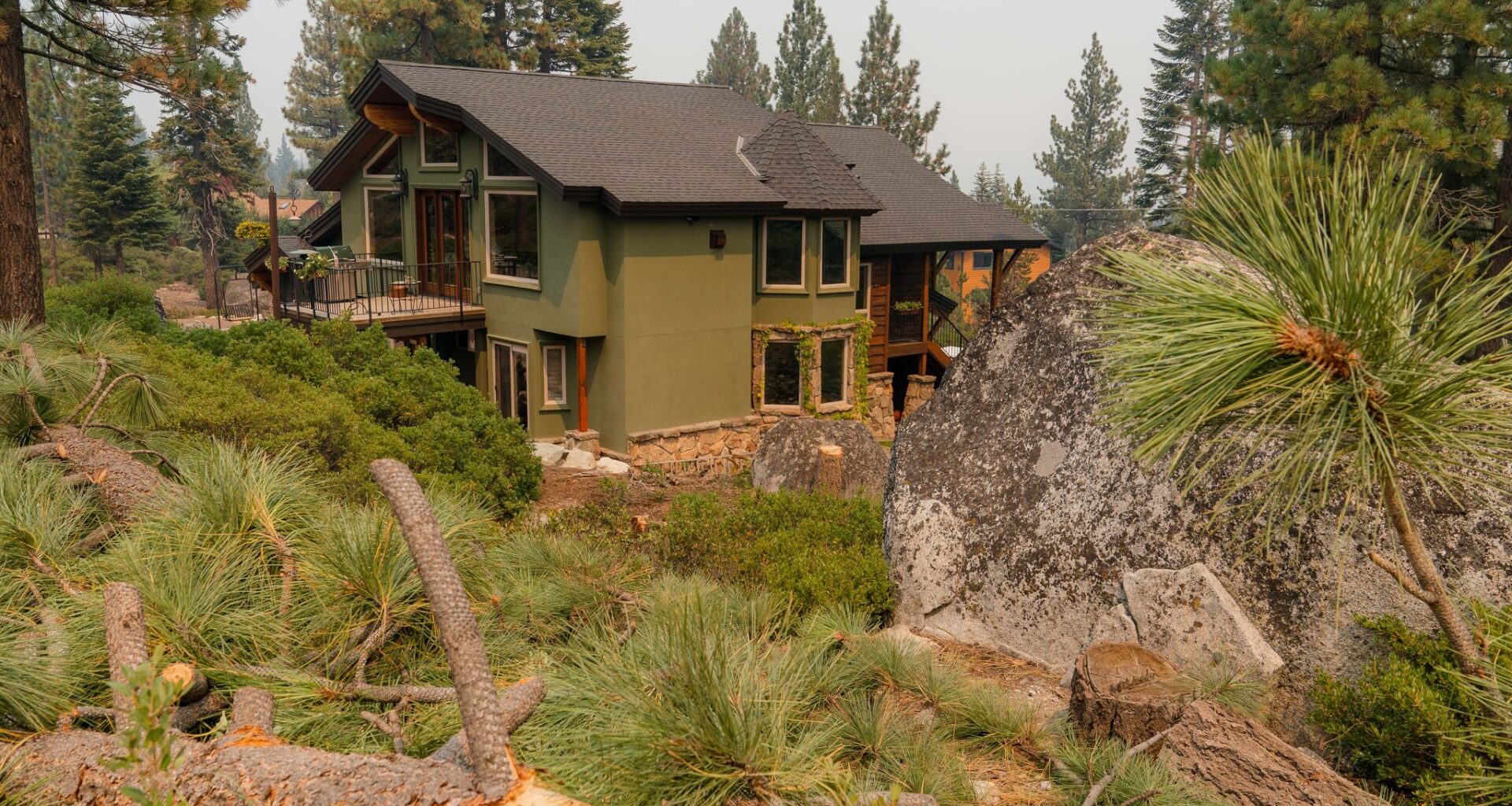
California homes in areas of high fire risk would have to pay a hefty extra fee if a bill under consideration in the state legislature passes.
Jungho Kim/Special to The Chronicle
A handful of California lawmakers are pushing to reinstate a controversial fee paid by rural residents for fire prevention, arguing that those who most need firefighting services should pay their share.
Legislation that advanced out of a Senate committee Wednesday calls for a charge of up to $150 annually on hundreds of thousands of homeowners in places where the state oversees fire management — mainly less developed, unincorporated areas — about a third of California. The money would be used by Cal Fire for fire prevention projects such as forest thinning, property inspections and hazard mapping.
Article continues below this ad
The fire fee previously existed from 2011 to 2017. It was created to offset some of Cal Fire’s costs during a budget downturn, but suspended six years later amid opposition. Many who paid the fee believed it was unfair or too costly, while Republicans in Sacramento saw it as a partisan jab by the Democrat-controlled Legislature.
Familiar fault lines along California’s red-blue and rural-urban divide have begun to emerge as the effort to revive the fee moves forward.
“We’re asking people who didn’t cause this problem to pay for it,” said Staci Heaton, senior policy advocate for the Rural County Representatives of California, who voiced opposition at Wednesday’s Senate Revenue and Taxation Committee hearing on the legislation. “These residents are already grasping with affordability issues.”
San Francisco Chronicle Logo
Make us a Preferred Source to get more of our news when you search.
Add Preferred Source
The author of Senate Bill 1404, Sen. Henry Stern, D-Sherman Oaks (Los Angeles County), acknowledged that his proposal wouldn’t be popular. He noted that he was throwing people in his district as well as his family “under the bus” by trying to make them cough up money. But he said the new revenue was vital to covering the costs of fire protection.
Article continues below this ad
“The pie as it stands right now is too small, just inherently, to deal with the problems we’ve got,” he said. “I guess the thesis of this bill is we’ve got to try to do some uncomfortable things to grow that pie to address wildfire risk.”
Stern, alongside co-authors Sens. Ben Allen, D-El Segundo, and Josh Becker, D-Menlo Park, said the legislation was introduced this year because state money that was allocated to backfill the fire fee a decade ago is getting increasingly tight.
That money has been coming from California’s cap and trade market, now known as “cap and invest,” a program that compels businesses to pay for climate pollution. In 2017, under a deal signed off on by then-Gov. Jerry Brown, Democrats agreed to get rid of the fire fee if Republicans supported an extension to cap and invest, with the program’s funds allocated to cover the revenue lost with the fee.
Today, however, the cap and invest program faces greater financial demands, as money pours into a growing number of programs that address climate change. Stern says those programs shouldn’t be short-changed to subsidize fire services for homeowners.
While the proposed fee could run as high as $150, lower rates are being discussed for residents in certain areas.
Article continues below this ad
“Their ability to pay $115 a year to make sure that they have adequate firefighting seems like a better source of funding than leaning on the greenhouse gas reduction fund where there is such a range of huge needs,” Stern said at an earlier hearing on the bill.
Still, critics note that many in rural areas where the fee would take hold are not well off and may live on fixed incomes, in which case even a nominal charge can be tough to afford. Some are already shelling out large sums for homeowner’s insurance and wildfire safety retrofits.
Another concern is that many people targeted for the fee are paying a local fire district for fire services, on top of their state taxes, meaning they could be charged two or three times for fire protection, with little added benefit. When the fee was previously in place, residents within the boundaries of a local fire agency got $35 off the standard $152 state bill.
The proposed fee is also being criticized by the Howard Jarvis Taxpayers Association. The organization is raising the same concern it did when the charge was around a decade ago: that the fee is a tax and needs a two-thirds vote of the Legislature for approval, instead of a simple majority. A lawsuit filed by the organization over the matter in 2012 was never resolved, since the fee was dropped.
On the other side of the issue, several environmental groups that want to preserve funding for climate programs, as well as ensure adequate funds for fire prevention, have registered support for the fee’s return. They include the Environmental Defense Fund and Natural Resources Defense Council.
Article continues below this ad
The legislation is projected to generate an estimated $90 million a year for fire prevention work, according to Stern’s office.
The fee would begin at the start of next year.
The Senate Revenue and Taxation Committee approved the bill Wednesday by a 3 to 1 vote, sending it to the Senate Appropriations Committee, where financial analysis will be done.
Members of the Revenue and Taxation Committee noted a handful of amendments that they’d like to see included in the final draft of the bill, to make the legislation more likely to advance to votes in the House and Senate.
Article continues below this ad
Among the suggestions were putting caps on the cost of administering the fire prevention fee and looking at ways to reduce the charge for residents who can’t afford it.