
Months after revealing high-profile plans to turn a Safeway in San Francisco’s Marina District into a housing project, the developer behind that effort is turning its attention to the site of a Trader Joe’s in an affluent part of Oakland.
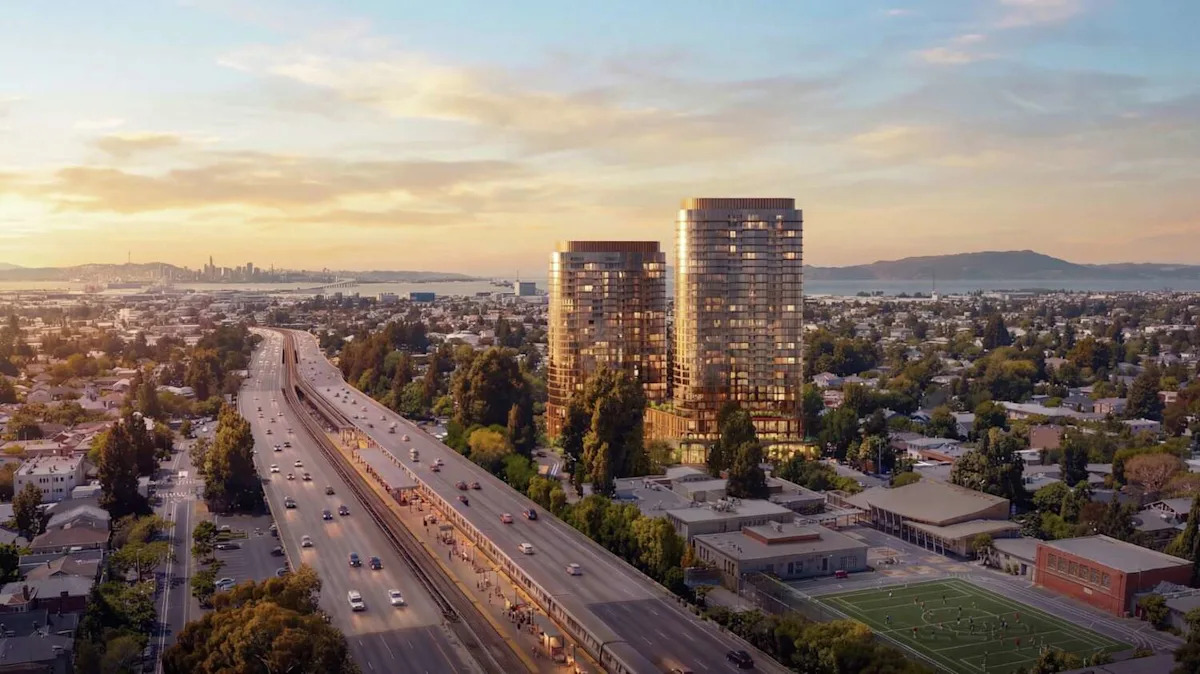
The low-slung grocery store at 5727 College Ave. and its expansive parking lot in the city’s Rockridge neighborhood could be replaced by a pair of towers that would house a 415-unit senior living campus within walking distance of a BART station.
The proposal, filed Wednesday by San Francisco-based Align Real Estate, calls for a 31-story tower at the property, as well as a second tower that would rise 25 stories. As designed by SCB Architects, the modern towers are set on a podium, would feature glass-clad facades and soar above the surrounding neighborhood, which is known for its well-kept residential streets, walkable commercial strip and largely characterized by low-rise development – though Oakland has certainly seen a number of tower proposals pitched or constructed around its transit hubs in recent years.
The new project reflects a broader push by Align to convert underused grocery properties into housing, with its plan to create more than 3,500 homes at Safeways in San Francisco. But this proposal has a key difference from those efforts: The Trader Joe’s store that currently operates on the 1.5-acre College Avenue site would not return.
The Rockridge property has long been owned by Safeway parent company Albertsons, which, over the past year, has partnered with Align to propose major housing plans to four of its sites in San Francisco and one in San Mateo, where Safeway stores currently operate.
All but one of those Safeways are set to reopen in larger format stores that will be part of Align’s future housing developments, once construction is completed. The only outlier so far is Align’s 1,800-unit housing project planned in San Francisco’s Fillmore District, where a Safeway store already shuttered earlier this year for reasons unrelated to the project, and a replacement grocery anchor has not yet been determined.
But Align, which is working with an undisclosed nonprofit on the Oakland plan, confirmed that the Trader Joe’s store – long a neighborhood mainstay – would shutter permanently once construction starts and won’t be replaced with a different grocer. That Trader Joe’s location was known for being the first in the country where workers successfully unionized, in 2022, a precursor of organizing efforts across the chain, which operates hundreds of stores nationwide.
As of this week, no closing date for the grocer has been provided, though a person with insight into the project’s development timeline said Trader Joe’s would likely remain open for several years, unless the grocer decides to shutter sooner. Because a nonprofit will be operating the planned retirement community, maintaining a commercial lease with Trader Joe’s would create “complexities,” the individual said.
Trader Joe’s did not respond to a request for comment.
The nearest full-service grocery alternative would be a Safeway half a mile from the project site, followed by a Whole Foods Market about half a mile away on Telegraph Avenue and Berkeley Bowl West in West Berkeley to the north. Oakland has just one other Trader Joe’s store near Lake Merritt, though there are three additional locations in neighboring Berkeley, Emeryville and El Cerrito.
The loss of the College Avenue Trader Joe’s would be offset by new housing designed to support seniors aging in place. The project would include 371 independent living residences, along with 18 assisted living units and 26 memory care rooms. About 70% of the planned community’s residents are expected from Oakland and East Bay neighborhoods, and Align said it expects demand for senior housing in the area to outpace supply in the coming years.
Align said that its nonprofit partner – which it declined to share, but described as a “leading Bay Area nonprofit senior living organization with more than 65 years of experience serving older adults” – is recognized for its robust wellness, educational and cultural programming and emphasizes keeping residents engaged in their communities through volunteer opportunities and other civic and enrichment programs.
The project is expected to create 200 permanent jobs in healthcare, hospitality, administration and facilities management, as well as hundreds of union construction jobs, the developer said.
“This project is about helping seniors stay in the neighborhoods they call home,” said David Balducci of Align Real Estate. “By placing senior housing near transit, services and shops, we’re giving older adults the opportunity to age in place with dignity and independence, while also freeing up family homes for the next generation. In turn, this will reduce pressure on families and the healthcare system while strengthening the long-term vitality of the Rockridge corridor.”
The College Avenue site was identified as a housing “opportunity site” in Oakland’s current housing element, which is a required general plan laying out how cities and counties in the state will meet their housing goals. The developer is planning to build the two-tower project using various state laws meant to unlock and accelerate denser housing construction, including the State Density Bonus Law and Assembly Bill 130, which exempts qualifying projects from a lengthy environmental review process.
In San Francisco, Align’s push to transform aging Safeways into housing has been both celebrated as a bold response to the city’s housing crisis and rejected as an overreach into neighborhoods concerned with affordability, neighborhood character and scale – depending on whom you ask. The split was evident late last year, when the firm proposed a 25-story, roughly 790-unit to replace a longstanding Safeway in the upscale Marina District. That tower – while initially intended to be much taller – drew immediate criticism from neighbors, the area’s supervisor and Mayor Daniel Lurie.
The proposal quickly became a flashpoint in San Francisco’s broader housing debate, highlighting the tension between the state goals of adding density to meet the city’s pressing housing needs and entrenched resistance to taller development in some neighborhoods. The developer has also put forth proposals to develop Safeway properties in Bernal Heights, the Outer Richmond and the Fillmore where the proposal calls for twice as many units as the Marina plan.
The Oakland proposal echoes dynamics seen in San Francisco’s Marina District. Both Rockridge and the Marina rank among the highest-income neighborhoods in their respective cities and have historically seen little high-density development.
Oakland’s neighborhoods, however, are not unfamiliar with denser development near transit, with projects such as the 24-story Skyline tower near MacArthur BART completed in recent years and others, like the long planned Mandela Station development, which includes a 31-story residential tower, moving toward construction and another transit-oriented development featuring two high-rises shaping up at the Lake Merritt BART Station.
This article originally published at Popular Trader Joe’s in Oakland could be replaced by two apartment towers for seniors.