
As part of West Coast Conference basketball media day last week in Las Vegas, players were ushered to a room for promotional video spots. In the middle of the room was a long table where you tried to roll ping pong balls into mini nets attached to the end.
Two USD players giddily began rolling the balls.
The third, Vuk Boskovic from Bosnia, rolled his eyes. “Too old for this,” he joked.
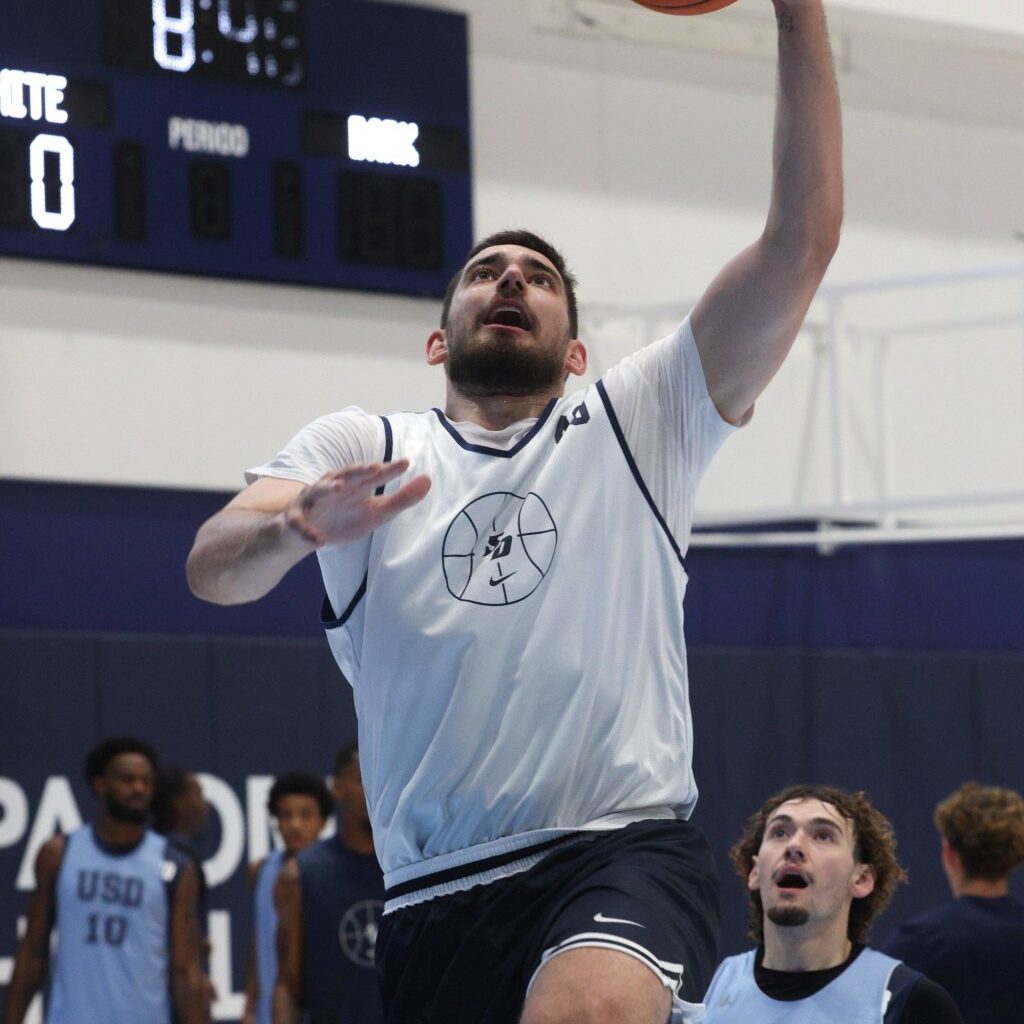
He is 22, with a full beard and a grown man’s body, 265 pounds of sausages and vegetable stew packed into a sturdy 6-foot-6 frame, a grizzled veteran of four years in the Bosnian pro league, the kind of guy who’s seen a few things.
One of the questions to players at media day was whether you’d rather give up coffee or social media. Boskovic didn’t hesitate: “Social media. Not giving up coffee.”
He’ll be in Viejas Arena on Wednesday night with the Toreros for a 7 p.m. exhibition against San Diego State, the latest exponent of a growing exodus of European pros to college basketball and the bearded face of a revamped USD roster that includes 14 new players.
Wait, European pros can play in college now?
They can. And they are.
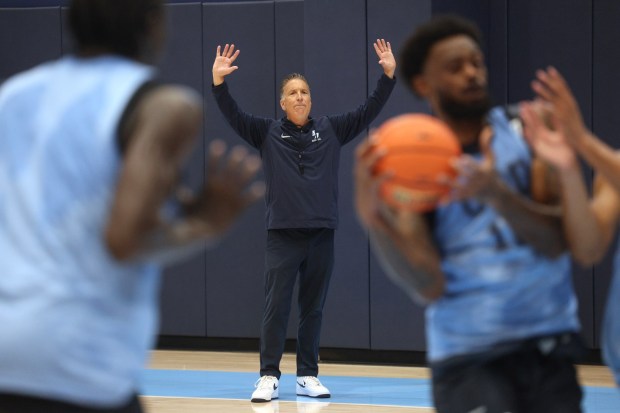 Head coach Steve Lavin signals to his players during USD’s first official basketball practice at the USD Basketball Performance Center in San Diego on Tuesday, Sept. 23, 2025. (Hayne Palmour IV / For The San Diego Union-Tribune)
Coach Steve Lavin had assembled a roster through the spring after 12 of his top 13 scorers from a disappointing 6-27 season exhausted their eligibility or transferred. After two months of summer practice, now permissible in Division I, he determined that “we liked the group, but it was clear we could use some depth to bolster the front line.”
So they got two European pros. In September.
Boskovic came from Borac Banja Luka, where he was a first-team all-league selection after averaging 14.2 points and 6.3 rebounds per game. He was out of contract, and his agent broached the idea of U.S. college basketball, which can now pay players through outside NIL contracts and school revenue-sharing — in many cases, more than they can make in Europe.
USD, which for the first time has seven-figure NIL resources, also got Piotr Winkowski, a 6-10 center who averaged 9.5 points and 5.7 rebounds per game for Astoria Bydgoszcz of the Polish pro league.
“There was a need on our roster for size,” Lavin said. “Now you’re looking within the country and outside the country in terms of personnel that can come in and enhance our roster. In doing that research and making the phone calls and talking to their representatives, it made sense.”
Said Boskovic: “It’s a big opportunity for me to improve myself, to help the team, to increase our level from past seasons. It’s a big trend.”
He’s not alone.
Bosnia and Herzegovina is a Balkan nation with a land mass slightly smaller than West Virginia and a population (3.1 million) slightly smaller than San Diego County, yet it has 20 basketball players on U.S. college rosters this season. Fourteen are with Division I teams, including Indiana, Auburn and Arkansas.
Poland has 12. Slovenia has 15. Montenegro has 17. Belgium has 19. Ireland has 21. The Netherlands has 25. Greece has 34. Lithuania has 41. Spain has 61. Germany has 64. England has 73. Serbia has 76. France has 84.
Boskovic is represented by BeoBasket, a Serbia-based sports agency founded by Miško Ražnatović. He’s expected to have close to 50 players in college basketball this season.
“(Ražnatović) used to not even pick up the phone for the NCAA before,” Dražen Zlovarić, BeoBasket’s North American director, told The Athletic last spring. “It’s basically fair game for everybody now. Like, the guys that you never think would come to college are actually coming to college.”
College teams have had European players for years, but not full-blown pros in their early 20s. The big change came two years ago, when 7-2 Croatian center Zvonimir Ivišić, who had been playing professionally since he was 16, unexpectedly received NCAA clearance at Kentucky midway through the season.
Last year, BYU bought out the pro contract of 6-9 Russian point guard Egor Demin from Spanish power Real Madrid for a reported $1.5 million, then paid him another $1.5 million in NIL money. Demin played one season and was the No. 8 overall pick in the NBA draft by the Brooklyn Nets.
No program has made a bigger splash in Eastern European players than Illinois, where Lithuanian guard Kasparas Jakučionis played last season before being picked No. 20 overall by the Miami Heat. This year, the Illini have two players from Croatia, one from Serbia and one from Montenegro.
Even a program like USD can dip into the burgeoning market, able to pay in the low six figures. Boskovic and Winkowski were each granted two years of NCAA eligibility.
“Naturally,” Lavin said, “their representatives aren’t going to send them somewhere unless it’s equal or better than their situation currently. I do think we’re seeing a trend because of the NIL and revenue share, where international agents are aware there are now opportunities in the States in college that didn’t exist before. This is a better move for their clients.”
New Mexico has a 22-year-old Croatian forward. UNLV added a 22-year-old wing who has played in New Zealand’s pro league the past five years. After striking out on several domestic recruits, Fresno State got three pros from France and one from Slovenia.
SDSU has had a steady stream of South Sudanese players in recent years, but all attended high school in the United States. Transfer guard Latrell Davis is from England, but he went to high school in Florida and played at San Jose State for two seasons.
For Aztecs coach Brian Dutcher, the primary issue with overseas recruiting, particularly European pros, is that it’s largely transactional.
“I get calls every day from agents over in Europe who represent kids,” Dutcher said. “I usually am not looking at it that strong. If you’re just NIL-driven, if an agent calls you and says, ‘Here’s what it’s going to cost,’ then it’s all about money. We have money but it’s always been more about fit for us first. Like, you want to be here because you want to get better and do all these things (before talking about money).
“It’s hard to sit there and peel the onion with a guy overseas to find out what it’s really about.”
Another honor for Byrd
SDSU’s Miles Byrd has been named to the 20-man Julius Erving Award watch list for the nation’s top small forward.
Byrd is considered questionable for the USD exhibition. He came off the bench for limited minutes in the Oct. 17 exhibition against UCLA after missing nearly two weeks of practice with an abdominal strain.
Magoon Gwath has been a partial practice participant this week but hasn’t been cleared for live action. Everyone else is believed to be healthy.
The game, which is part of SDSU’s season-ticket package, will not be televised.
San Diego State vs. USD (exhibition)
When: 7 p.m. Wednesday
Where: Viejas Arena
TV/Radio: None