
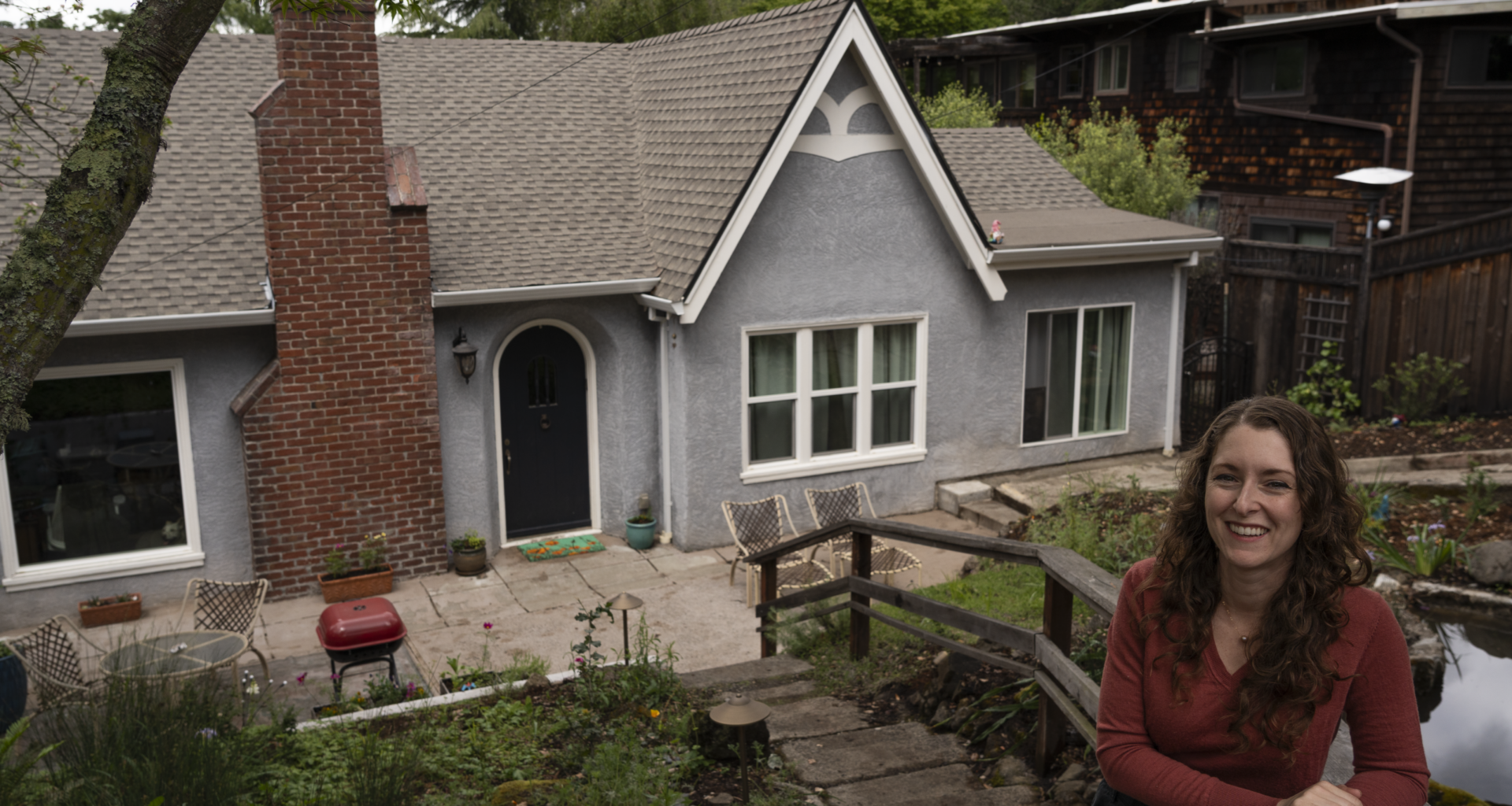
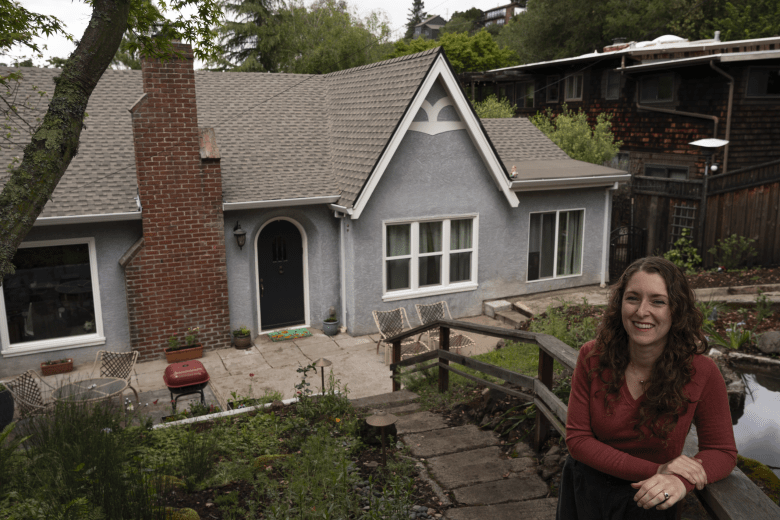
 Jessica Golden Edberg in her Berkeley Hills backyard. Credit: Jordan Edberg
The morning my parents tried to evacuate Los Angeles, they headed north on I-5. It was closed. Another fire. They turned around and joined the gridlock pushing in every other direction, barely moving. They stopped at their public library, thinking it was safe. It closed. They found a diner and waited there for hours, no cell service, the roads still choked. The only communication I had with them was over Wi-Fi from the places they managed to stop and rest. By midday, in near panic, I managed to book them onto the only flight out of Burbank to Oakland and got them on it. They stayed with us for a week, tense with fear that their home would not be standing when they returned.

Amplify Berkeley is our new series featuring stories told by Berkeley residents in their own words. Got a story to tell? Let us know.
Fortunately, they suffered only smoke damage.
In Altadena, just to the east, the devastation was unthinkable. Entire city blocks erased. And yet here and there, in the middle of the wreckage, a single home still stood. How is that possible? How does one house survive when the one beside it is gone?
It comes down to embers. In a wind-driven wildfire, it is rarely a wall of flame that first ignites a structure. It is airborne sparks, sometimes traveling hundreds of feet, landing in the mulch under a deck, in a planter pressed against the siding, in dry leaves caught at a foundation. Those embers find fuel. The fuel catches. The house catches. The houses that survived in Altadena were, in many cases, the ones with nothing for an ember to ignite within arm’s reach of the structure.
This is the science behind Zone 0, and it is why I support Berkeley’s EMBER ordinance.
Standing in our Berkeley Hills neighborhood in the weeks after the fires, looking at our steep grades, our dense canopy, our narrow roads, I could not stop running the comparison. So my husband and I made the decision, before any ordinance required it, to assess our own property and remove the trees and shrubs that posed the highest risk. The camellias that had grown leggy and were leaning over each other. The Japanese maples, their canopies threaded with standing deadwood. An orange tree planted too close to the house to ever get adequate light, let alone produce fruit.
Taking down a tree has an emotional weight. Even when it is the right thing to do. Even when you made the decision freely. There is grief in it.
I want to name that, because I think a lot of my neighbors in the Grizzly Peak and Panoramic Hill mitigation areas are feeling it right now, and I do not think it is being talked about enough.
I am a materials chemist. I have spent 15 years working on technologies designed to address climate change: more efficient lighting, transparent solar cells, longer-lasting batteries for electric vehicles and the grid. I believe in the science of wildfire behavior as clearly as I believe in the science of battery chemistry. The research on Zone 0, the 5-foot non-combustible buffer the EMBER ordinance now mandates around structures, is unambiguous and well-grounded: Ember ignition was identified as the primary mechanism of structure loss in wildland-urban interface fires in the late 1990s. And with California only now on the verge of finalizing its Zone 0 rules after years of debate, I’m glad Berkeley did not wait to enact its clear, enforceable policy.
But I also understand the grief.
The Berkeley Hills are beautiful specifically because of how people have gardened here for a century. Wisteria on a fence. A Japanese maple gone red in October. Camellias that a family has tended for decades. This landscape is ours in a way that goes beyond property lines, and the loss of pieces of it, even in service of something rational and necessary, deserves acknowledgment.
I also want to shed light on what we found on the other side of this transition.
We replaced what we removed with plants that belong here: ceanothus, manzanita, mountain mahogany, coffeeberry, huckleberry, osoberry, California hazelnut. The result is a garden that is more beautiful and layered as what we had before, and which is now doing something the previous garden was not: providing habitat, producing food, and helping to keep our home and our neighbors safe. Since making the transition, we have seen birds on our property that I have never encountered even in Tilden. We have flowers in bloom 12 months of the year. Our two dogs have developed a complex relationship with the local nesting robins.
I am not suggesting the transition is painless. The costs are real, the timeline is tight, and the ordinance gives residents a clear picture of what must go without always providing a clear picture of what can replace it. That gap is worth addressing within our community.
But what most of us love about this neighborhood — its richness, its texture, its sense of being genuinely embedded in a living landscape — does not have to be sacrificed to make our homes safer. It can be rebuilt. We can rebuild better.
The inspection window opens in May. If you are feeling the weight of that deadline and do not know where to start, you are not alone. This neighborhood is full of people who care about these same things. We should be talking to each other.
Jessica Golden Edberg is a materials chemist and Berkeley Hills resident living in the Grizzly Peak mitigation area. She holds a Ph.D. in chemistry from USC and has spent 15 years working on climate change mitigation technologies including advanced batteries for electric vehicles and the grid.
We know that most readers don’t get to the end of the article. But you did! To support our in-depth, rock-solid reporting, please consider making a donation to our nonprofit newsroom today. We rely on our readers — particularly the ones who read the whole story!
“*” indicates required fields