
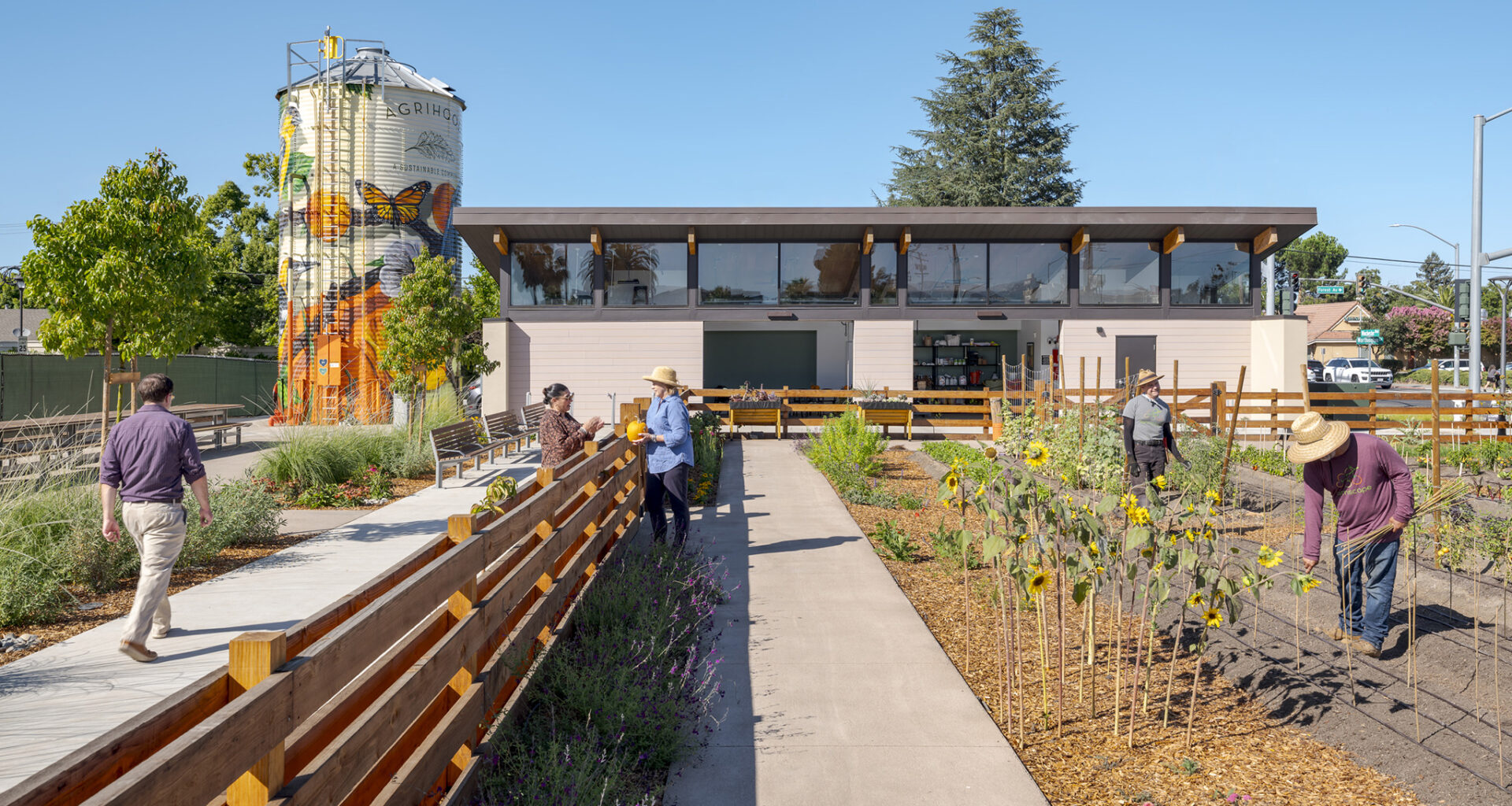
When it was time for Megan Keithly’s baby to try his first solid food, she took organic zucchini from the farm down the street and steamed it. A few years later, she’s making homemade diaper cream for her second child with Calendula flowers that also grow on the farm, a skill she learned from the farm staff. But this isn’t a tradwife rural fantasy made for Instagram. Keithly lives in a densely suburban area of Orange County in one of California’s agrihoods — a residential community built around a working farm.

As a new generation of aspirational homeowners looks to amenity-focused living, traditional luxuries like golf courses have gone by the wayside in favor of open space, trails and even farms. These agriculturally minded, master-planned developments have been gaining popularity, attracting new residents seeking community along with a life closer to the land.
California pioneered the creation of agriculture-centered housing developments more than 40 years ago. A local company even trademarked the term “agrihood” in 2016. No matter what you call them, more and more proposed planned communities in California integrate tenets of this concept, despite criticisms about land use and affordable housing. And as the state’s existing agrihoods increase in popularity, developers across the globe are using them as examples to improve the approach to this new kind of master-planned community.
Article continues below this ad
‘I’m supposed to be here’
Keithly, 34, grew up in Orange County and knew she wanted to put down roots near her parents after getting married. She and her husband put their name on a list for new homes at Rancho Mission Viejo, a growing agrihood in an area she had always found beautiful, and moved there in 2022.
A view of Esencia Farm in Mission Viejo, Calif.
Photo courtesy of Esencia Farm
Her home is one of the more than 4,000 units now built on the family-owned, 23,000-acre historic cattle ranch. That land has slowly transitioned over the past four decades as the family, descendants of the original owners who purchased the property in 1882, has begun a new vision for the space. Planning began decades ago to develop roughly 6,000 acres while preserving about 75% of the land as open space, including professionally managed farmland.
Article continues below this ad
Make SFGATE a preferred source so your search results prioritize writing by actual people, not AI.
Add Preferred Source
Before they moved in, Keithly volunteered on the farm and later went to the grand opening of some of the new community’s amenities, which include hiking trails, picnic areas and an event space. She said she turned to her husband and said, “I’m supposed to be here.”
The mission of the community aligned with her values, especially her degree in nutrition, she said, and she loved how many families lived in the neighborhood. “I’ve fallen more and more in love with it since moving in,” she continued.
She now volunteers regularly at the farm, always taking home freshly harvested produce, and often takes her children along with her. She said it’s completely changed her family’s approach to food — one-third of the produce they eat at home comes from the farm, and for the rest, they eat much more seasonally. She said she had never heard of the term “agrihood” until she moved into Rancho Mission Viejo, but for her, it’s about more than just the food from the farm. It’s the friends she’s made while working there and the way it has changed her daily life, driving less to do errands and getting more from her local, more walkable neighborhood.
Article continues below this ad
A view of Esencia Farm in Mission Viejo, Calif.
Photo Courtesy Of Esencia Farm
The development is unsurprisingly a big draw for families. But a growing “wellness push” in the U.S. is drawing a new kind of buyer to these developments, said Rancho Mission Viejo Marketing Director Stephanie Walker. About 70% of residents work remotely at least three days or more, Walker said, and she thinks that has also helped broaden the interest of new residents in the past five years.
“We’ve seen an influx of people not just from Southern California but from a much greater reach because they want to be in South Orange County, but it doesn’t feel like you’re in Orange County when you get here,” she said.
The company stopped using the word “agrihood” as often in marketing materials — even though it trademarked the term — and instead touts “community farms” integrated into its expansive open space. Walker said they saw a surge in interest during the COVID-19 pandemic and even tweaked their approach to planning future amenities based on the growing desire for more trails and open space. Rancho Mission Viejo plans for around 14,000 total homes by 2030, including thousands of units dedicated to housing for those 55 and over.
Article continues below this ad
A California pioneer
The agrihood concept in California dates back to the early 1970s, before the trademarked term even existed.
That’s when Davis residents Mike and Judy Corbett began dreaming about building a sustainable, environmentally conscious housing development after learning about the growing threat of climate change. Their development would have solar power, a natural drainage system, streets that prioritized walking and biking, and a percentage of land dedicated to open space and community gardens. Instead of backyards, a shared common space between houses could be dedicated to any purpose, with agriculture being one option.
The Corbetts fought fiercely for years to realize their vision, Village Homes, eventually buying up an old 70-acre tomato field with the help of friends and family who bought into the idea. “I don’t think there’s any place else in the United States or any other city that we could have done this other than Davis,” Corbett said, detailing the hurdles they had to jump, from financing the project to convincing the Planning Commission and the City Council.
Article continues below this ad
Erik Fredericks via Flickr CC 2.0
Today, Village Homes is known as one of the most innovative housing communities built in the U.S. in the last 50 years, and it was lauded as the “world’s best example of sustainable development” by Time magazine in 1999. On the communal property near her home, Corbett has an apple tree, a persimmon tree, a pomegranate tree and a pear tree, among others. While it’s not built around a farm, per se, it follows Village Homes’ guidelines to choose food-producing plants over ornamental ones. Corbett said she doesn’t know any homeowners who buy fruit at the grocery store; there’s just so much to eat on the property. Having common orchards “saves a lot of money,” she said, lamenting how much food prices have gone up recently.
She said it’s hard to estimate how much cheaper it is to live in a sustainable community like Village Homes, but she never buys fruit, her utility costs are “practically nothing,” and if you’re able to bike commute, you have few transportation costs. “The cost of living in a place like this is just so much less,” she said.
It’s also a sought-after place to live. While initial home prices ranged from $31,000 to $75,000 in the 1970s, the average home price now hovers around $843,640, according to Zillow, and homes don’t come up for sale often, according to Corbett.
Article continues below this ad
‘Most of it is greenwashing’
At Rancho Mission Viejo in Orange County, home prices start around $1 million. That’s not exactly affordable for many Californians, a criticism that often comes up with these new developments. Some of them integrate affordable housing in their planning, including Agrihood Santa Clara in the San Francisco Bay Area, which set aside 165 of around 361 units as affordable apartments for veterans and other adults over 55. Fox Point Farms in Encinitas, near San Diego, includes around 40 affordable homes within its 250-unit agrihood.
A view of Agrihood Santa Clara in Santa Clara, Calif.
Photo courtesy of Kyle Jeffers
The Cannery, which bills itself as a “farm-to-table” housing community in Davis, has around 60 affordable units out of its nearly 500 homes. Finished in 2016, it was built on formerly industrial land, so its urban farm required extensive soil restoration. That’s a rare transformation of California land; most agrihoods are built on former agricultural lands, shrinking their footprint and replacing them largely with housing — another common criticism of agrihoods.
Article continues below this ad
“We are not protecting prime agricultural land on the urban fringe very well,” Stephanie Pincetl, a UCLA professor and the founding director of the California Center for Sustainable Communities, told SFGATE.
Pincetl called turning certain lands into agrihoods “perverse,” stressing that the smaller agricultural lands that these communities integrate will never produce the same amount of food that the original agricultural land once did. She appreciates the idea of multifamily buildings with access to urban agriculture — she even consulted on the Village Homes project when it was being built — but ultimately, “most of it is greenwashing,” she said of the agrihood concept.
Without professional management, the farms would also likely falter, Pincetl said. Most combat that with urban farming companies. Farmscape professionally manages all three farms at Rancho Mission Viejo and gets help from more than 100 volunteers each season. From 2020 to 2025, they harvested 65,000 pounds of produce, all of which went to either residents in the community, local farm stands, commercial farm sales or local food banks. The company also manages Agrihood Santa Clara and commercial projects, such as the gardens at Levi’s Stadium and Oracle Park.
A view of Agrihood Santa Clara in Santa Clara, Calif.
Photo courtesy of Kyle Jeffers
Many housing developments today need a “story” to secure the capital needed to fund a project, said Vincent Mudd, a partner at the architectural firm Steinberg Hart, which designed Agrihood Santa Clara and Fox Point Farms. But he insists the agrihood moniker, at least in their case, isn’t greenwashing. Mudd said that with our warming climate, developments that integrate agriculture and open space can help cool the surrounding area, as well as have other trickle-down environmental benefits like protecting biodiversity. Mudd joked that the main misconception they have to overcome is that the whole area is going to smell like cow manure or that all you’ll hear are chickens clucking.
Article continues below this ad
A 2025 study of agrihoods found that these neighborhoods can promote healthier lifestyle choices and enhance a sense of community. Still, the authors pointed out that “agrihood” needs a standardized definition and that longer-term studies would increase the findings about these developments.
“The authenticity of these agrihoods will draw people to them, and the next iteration will be even better,” Mudd said.
200 and growing
A 2015 estimate found that there were around 200 agrihoods already built or in development around the country. There are undoubtedly many more now. Live Oak Farm, a small community of homes built around an organic farm, began selling homes in 2024, calling itself Sonoma County’s first agrihood. Miralon in Palm Springs transformed a former golf course into a desert version of an agrihood, planting more than 7,000 olive trees on-site and building community gardens; it began selling homes starting in 2020. A 2,638-acre agrihood has been approved in Santee, California, though it’s fighting litigation from a coalition of environmental groups. A new government campus proposed in Placer County was designed with an “agri-hood” concept in mind.
Article continues below this ad
A view of Fox Point Farms in Encinitas, Calif.
Photo courtesy of Kyle Jeffers
From a public policy standpoint, these projects are getting easier to develop, Mudd said. (A 2018 study agrees.) Zoning is getting a bit more flexible, especially in current or previous agricultural areas. And there are now examples of what these neighborhoods look and feel like. Concerns about declining home values at these developments have mostly disappeared. “By adding the agricultural use to them, they’re actually more successful developments,” Mudd said.
In a state that’s starved for housing, cities are looking for new ideas for how to build. “Most of the city councils and counties are actually hungry for solutions … because everyone’s afraid,” Mudd said.
Steinberg Hart, the architecture firm, is engaged with another potential client who wants to develop an agrihood after seeing Fox Point Farms, Mudd said. They liked the idea of preserving farmland, he said, but he thinks they were most impressed by how fast the units at Fox Point Farms sold.
Article continues below this ad
Walker at Rancho Mission Viejo said they’ve had plenty of interested developers tour the property to get a better understanding of how to incorporate agriculture into planned developments, and Judy Corbett at Village Homes said she’s had “quite a number” of people who have sought her advice over the years. What people find most amazing, ultimately, is the sense of community that the neighborhood amenities, like the farm, create, they both said.
A view of Agrihood Santa Clara in Santa Clara, Calif.
Photo courtesy of Kyle Jeffers
When Village Homes has conducted surveys of the people who live there, an overwhelming number have said that the sense of community keeps them there, Corbett said. Joint ownership of the agriculture brings them together, she said, as does working in the community garden, partaking in the harvest and participating in activities like making olive oil out of the orchard’s olives.
“Community happens if you have a place and a reason to come together, and this kind of development does that,” Corbett said. “I guess that not everybody recognizes the value of that part of it, but it’s certainly something that people value that live here.”
Article continues below this ad
“It might be a relatively smaller neighborhood that you live in, but you just have this abundance of amenities and areas to make connection and real community,” Walker said. “It sounds cheesy, but that’s what people are yearning for, especially today, more than ever.”