
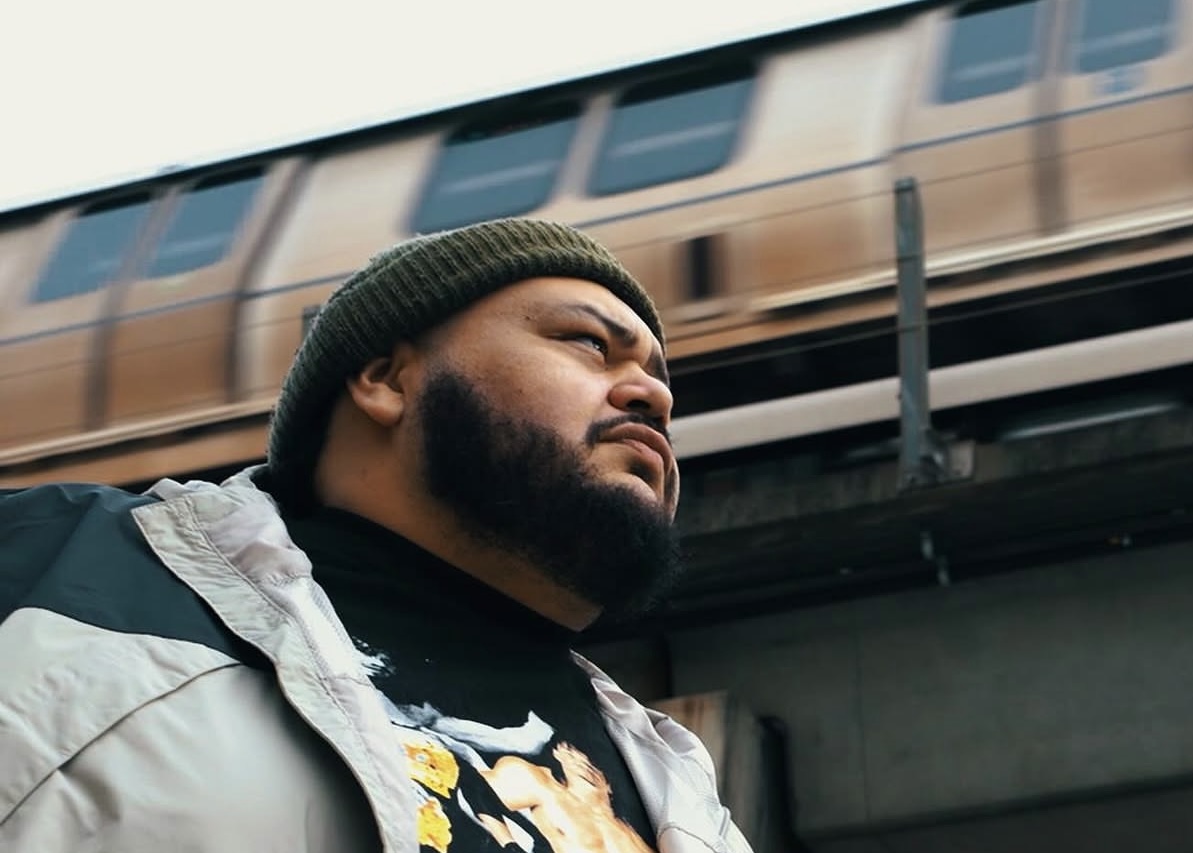
Travel the country’s regional rap circuit — Atlanta, Detroit, Houston, New Orleans — and you’d be hard pressed to find a local scene that is as saturated with as much cultural, diasporic multiplicity as Oakland.
The area boasts a tradition of artistic diversity and independent hustlership: within the span of a few miles, you’ll encounter rappers who are IndoFijian, Jewish, Filipino, Black, Japanese, and Panamanian. From self-starting entrepreneurs who have launched their own music labels to Grammy-winning songwriters, rappers from Oakland and surrounding cities exist in every shape, size, and style.
And yet, for all of its depth of talent, it’s rare to find one particular class of Oakland emcees: bilingual Mexican American lyricists. One could even argue that the visibility of Mexican rappers is severely underrepresented relative to the community’s size. (According to the census, people of Mexican heritage make up about 18% of Oakland’s population).
Nán Fiero is an exception. He’s among the few Chicano emcees making noise right now.
This year, the West Oakland wordsmith — who began rapping as a middle schooler, and launched his professional career as a battle rapper after watching GrindTimeNow.net in high school — has been quietly dropping some of the hottest rap albums. From “El Sxl Fiero” (an eight-track collaboration with Portland producer, Sxlxmxn, which debuted in February) to “MEDALLA II” (a collaborative album with BigDaddyChop and Mon$rock, scheduled for a Cinco de Mayo release), Fiero has been keeping West Oakland on the map with his lyrical dexterity, hyphy-inspired funk, and underground craftsmanship.
Notably, he’s doing all this while proudly highlighting his roots as the son of Mexican immigrants.
“My parents came from Michoacán in the early 80s,” said Fiero, whose real name is Hernán Duran Barrera. “They could’ve settled anywhere, but The Town was their choice.”
Mexican history in West Oakland is generally overlooked, if not completely forgotten. When thinking about Mexican cultural identity in Oakland, many point to Fruitvale — where taquerias, paleteros, and Oakland’s annual Dia de los Muertos festival abound — rather than the Lower Bottoms.
But West Oakland was once a historic community of Mexican families before the construction of BART and the Nimitz Freeway pushed them out.
“Contrary to what some might think, the first Latinx Oakland neighborhood was located in West Oakland,” Azucena Rasilla wrote in a 2023 essay about the city’s history of Hispanic culture. “It was there where Mexicans fleeing the revolution of 1910 migrated to this Oakland neighborhood to build community… [they] were not the only group to settle there; Puerto Ricans, (and later Mexicans from the Southwestern United States) also migrated to West Oakland to join the African-American community.”
Like many Mexican immigrants, Fiero’s parents arrived in California in 1981 with big dreams and empty pockets. They initially made it to Half Moon Bay, where Fiero’s grandparents and a sizable migrant community awaited. Fiero’s parents slept in a garage to make ends meet. They quickly bounced to San Jose, but were shaken by an immigration raid that took place at the restaurant where Fiero’s father worked. By 1982, they settled in West Oakland with Fiero’s aunt. Though they lived there for decades, Fiero’s parents later relocated to Dinuba (a suburb of Fresno), after Fiero’s older brothers strayed into street life, which resulted in the family’s Chevy Suburban truck getting shot up in front of their house. Fiero would attend high school in Dinuba, and largely credits that community and his time away from Oakland in shaping his sense of self. But he was set on returning to West Oakland as an adult, where he now lives near his childhood home.
“Imagine if I grew up in Half Moon Bay,” Fiero says. “I love visiting there, on some Larry June shit. It’s beautiful: the views, the water. But I’m hella glad I got to grow up in West Oakland.”
That all matters to Fiero, who heavily references West Oakland in his music, and also resists the regurgitation of any tropes that portray his neighborhood as an emergency broadcast on the nightly news. For him, West Oakland is filled with salsa made in molcajetes, beat-up Toyota Highlanders, and soul music.
In a profession and genre as community-bound as hip-hop is, Fiero feels he lucked out. Born in the Acorn Projects, his family bounced all over West Oakland — Adeline Street, Peralta, Campbell. He describes his community throughout the 90s and aughts as being incredibly diverse, while acknowledging the importance and influence of Black culture, in particular.
“Black and brown unity is strong,” he says. “The Brown Berets [helped] provide security for Black Panther events at DeFremery Park [Lil Bobby Hutton Park].”
His cousins purchased a home that had once been a headquarters for the Black Panthers. His older brothers and uncles exposed him to local rappers like E-40 and Mac Dre, but also bombarded him with Hot Boys, Wu-Tang Clan, and more. At the same time, his parents would listen to Los Tigres del Norte and Banda Machos, iconic regional Mexican bands. The result is a distinctly Bay Area swirl of culturally infused, first-generation pluralisms.
“I grew up on romanticas, corridos, cumbias. Los Bukis is my favorite Mexican band,” he says. “But I also grew up on MF DOOM. Hieroglyphics. Stuff that you have to replay to catch a dope line on the fifth listen. That’s the battle rapper in me.”
In the modern era, when rap music can feel particularly evanescent online, Fiero’s artistry feels home-cooked on low-and-slow heat, much like the mole he raps about on Thizzler. The result is a complex sauce of bilingual word play, verbal boasting, personal memories, storytelling, humor, and Oakland pride, poured over smooth production and served up for audio consumption. It’s not meant to be commercial. It’s not feeding algorithms in hopes of going viral. Instead, it’s nourishing the spirit.
Fiero’s music isn’t mindless rap by mimesis; it’s West Oakland truthtelling. It’s a lyrical lineage that can be traced back to the hyphy movement and the early 2000s video game Tony Hawk’s Pro Skater, when Fiero was coming of age at Cole Middle School. His style is a mosaic of Oakland sounds that many mainstream listeners might not expect.
In his song “Wayne Wonder,” the rapper doubles down as an Oakland emcee: “They say I ain’t got that Oakland sound, so how that’s ‘spose to sound?”
He presents a rhetorical paradox: What defines Oakland rap? Does it have a singular characteristic? If so, what does or doesn’t qualify as being Oakland rap?
Fiero is quick to mention Boots Riley and The Coup, along with Del the Funky Homosapien, as early inspirations who paved a path for cerebral lyricism and creative nerdisms. He also highlights his East Oakland contemporary and collaborator, Nimsins, who often raps about social justice and celebrates Oakland’s cultural riches, and North Oakland battle rap legend, Passwurdz, who is recognized as a clever punchline guru.
Fiero never dismisses rappers who rap about aspects of street life, either.
“Mac Dre was a witty motherfucker; he could rap his ass off,” he said. “Yeah, Hiero had the multisyllabic backpack rap down. But so did Mac Dre. People don’t talk about that. In the Bay, a lot of [listeners] look past the technicality of rapping. They want to vibe out to a song, but if you appreciate rap, you can find that with many Bay Area rappers.”
“My Ghetto Report Card” was the first album Fiero recalls embracing as a 7th grader. On his own track “Title Belts,” savvy listeners will catch references to Stunna Shades and white tees. In effect, the Bay Area’s textures are rife in his lyrics. You just have to listen closely. Thunder (the former mascot for the Golden State Warriors), “Full House,” Barry Bonds. It’s all there.
“That’s the beautiful thing about Oakland. There’s everything here,” Fiero said. “With my music, I have the freedom to talk my talk, to be me, to say some fly shit. But then I might also drop a punchline about eating frijoles, feel me? Although I don’t rap like the usual Oakland or Bay Area norm, I still try to make sure they can hear the Town when I speak.”
“*” indicates required fields