
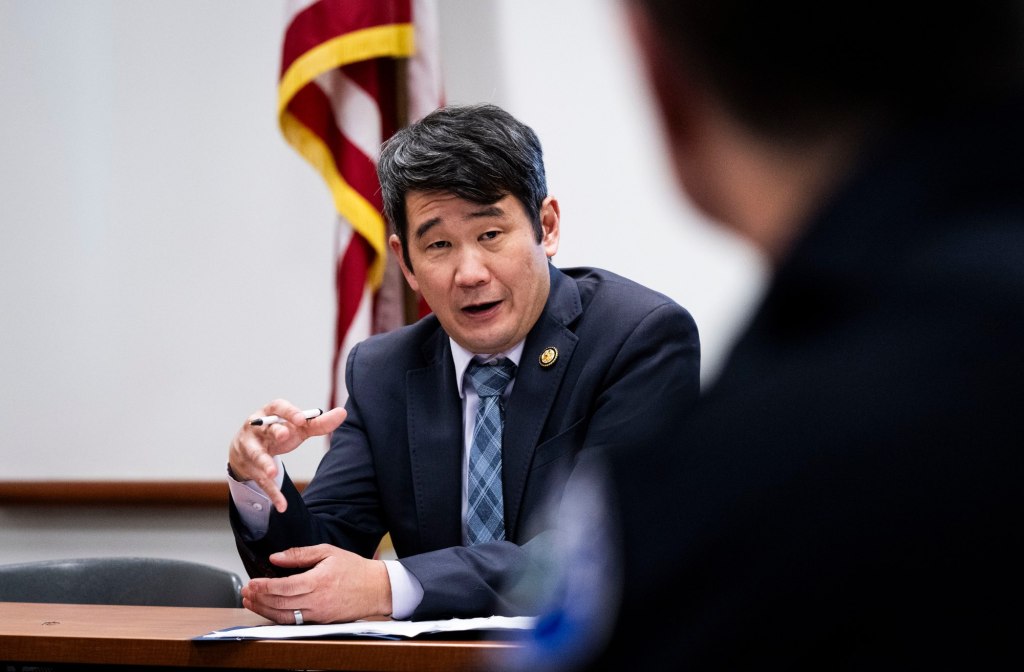
Rep. Dave Min has introduced legislation that would require the U.S. Department of Homeland Security to reimburse local police and fire agencies called on to assist federal agents during immigration enforcement operations.
The proposal would shift responsibility, Min said, for what he called an “unfair burden” of costs placed on local taxpayers.
The RECOUP Act of 2026, introduced in Congress this month, would require DHS to reimburse state and local first responders for operational costs incurred while assisting U.S. Immigration and Customs Enforcement or Customs and Border Patrol officials during arrests, detentions or deportations.
“Local law enforcement is already required to respond. They don’t have a choice, right? Because they’re asked to protect public safety,” Min, D-Irvine, said in a phone interview Tuesday. “But why should local taxpayers pay for a mess that ICE created?”
Inspiration for the legislation came when Min attended a January field hearing in Minneapolis, where Minnesota officials testified that federal agents often lacked personnel to manage volatile crowds and frequently called on local police to “bail them out.” The bill targets enforcement tactics Min called “operationally unwarranted policing” in high-profile public places that “inflame the masses”, rather than discrete, warrant-based arrests.
Min said creating a streamlined automatic payment process might deter “shock and awe” tactics, which he argued “stir the pot” and escalate into confrontations requiring local crowd control, leaving jurisdictions to address “messes and bad situations created by ICE.” The bill could include retroactive reimbursements.
Does that mean the Santa Ana Police Department could potentially bill the federal government for more than half a million dollars for resources expended responding to anti-ICE demonstrations in June 2025?
At Tuesday’s City Council meeting, Santa Ana Police Chief Robert Rodriguez said the decision to deploy officers on the first day of community demonstrations last June was intended to “try to create some distance between our community and the federal officers,” after City Attorney Sonia Carvalho received a direct call from the Department of Justice.
“It wasn’t in a threatening manner,” said Carvalho, who told the council she was informed by DOJ officials that federal resources would be brought in to assist immigration agents if the SAPD could not “provide the security that we need.”
“We had a discussion about what that might look like in terms of safety for our community and what that would mean to people in our community,” Carvalho explained.
The protests erupted in Santa Ana after immigration enforcement operations targeted day laborers at Home Depots across the city that day. According to a staff report, the demonstrations — later declared an unlawful assembly by police, required “enhanced staffing levels, extended deployments, and mutual aid coordination,” resulting in overtime and additional personnel costs.
At this early stage in the bill process, it’s not immediately clear how successful the legislation will be in the Republican-controlled Congress.
Anaheim spokesperson Mike Lyster, also part of the Contigo team that responds to reports of immigration enforcement activities in the city, said there’s been an observable shift away from roving or random federal enforcement operations following the highly publicized shooting of two civilians in Minneapolis earlier this year. Now the trend has been more targeted actions about once every 10 or so days, he said.
“Our most disruptive incident was at a car wash where chemical agents were used,” Lyster said. “There was a bit of a scuffle and a large crowd, and those are the kind of scenes that you just don’t ever wish to see in your city.”
When asked about the bill, Lyster said the city is aware of the early-stage proposal and will continue to monitor it. He added that as of right now, prospective costs incurred by agencies such as the Anaheim Police Department wouldn’t extend much beyond normal operations.
“It’s a relatively narrow bill,” Min said. “What we’re trying to do is force the federal government to actually pay for the cost here.”
DHS officials did not respond to a request for comment.
The bill would also restrict DHS from releasing the names, badge numbers or agencies of local first responders without a court order. Min said the clause protects officers from guilt-by-association when legally obligated to assist federal operations. He emphasized that the exemption does not apply to police misconduct, which remains subject to California transparency laws.
“They’re not ICE,” Min said. “We want to make that distinction to not create further distrust with law enforcement.”
David Lloyd, legal director with the First Amendment Coalition, confirmed that the bill’s privacy clause would not preempt state and local agencies’ obligations to disclose information about their officers.
Ultimately, Min said the bill’s success, if it makes its way through Congress, would be measured not by dollars collected, but by dollars never spent.
“If this bill becomes law and we end up actually having $0 spent, that’s a good thing,” he said. “It means that ICE is not behaving badly.”