
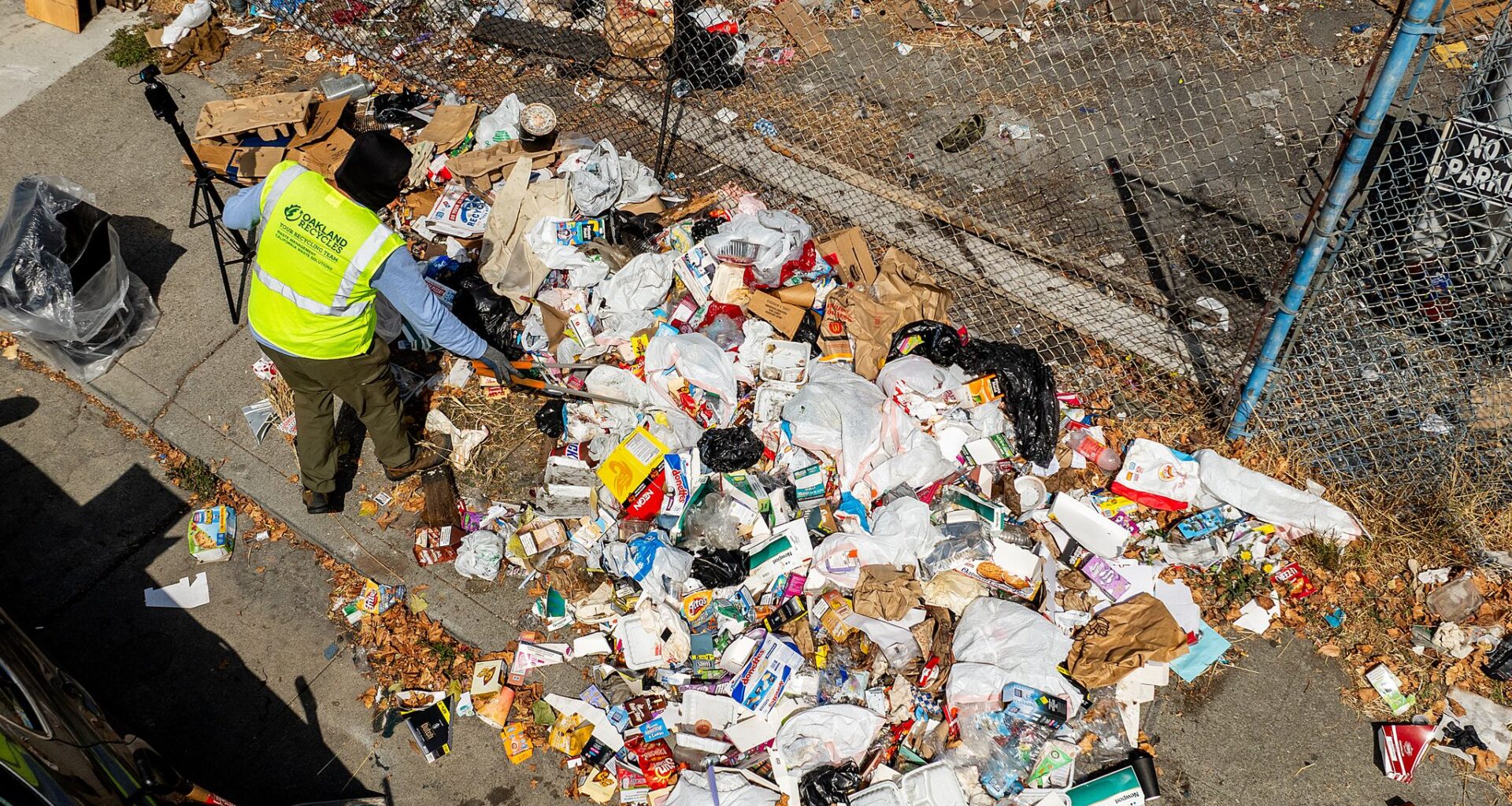
Andy Wang cleans up a trash pile along West Grand Avenue in Oakland in September. Wang, who goes by pengweather on Reddit, posts before-and-after shots on social media that have made him something of a local celebrity.
Noah Berger/For the S.F. Chronicle
Trash lines a West Grand Avenue sidewalk in September.
Noah Berger/For the S.F. Chronicle
Last year, the city of Oakland spent more than $2 million to collect just $16,000 in illegal dumping fines.
That’s one of the findings of a new report released Thursday by City Auditor Michael Houston, which found that even as Oakland has expanded surveillance and enforcement tools, it struggles to hold illegal dumpers accountable.
City leaders are trying to change that. This month, City Council passed an ordinance to increase penalties for illegal dumping and close some of the loopholes that have allowed offenders to evade fines. The move is part of Mayor Barbara Lee’s “Keep the Town Clean” initiative to address dumping across Oakland.
Article continues below this ad
Trash has become one of the city’s defining issues. Last fiscal year, Oakland spent $12 million on illegal dumping and picked up more than 7 million pounds of illegally dumped waste, according to the audit. An average of 70 complaints of illegal dumping were filed daily — a total of 25,000 over the course of the year.
The consequences for violators haven’t historically deterred dumping. While police and sheriff’s deputies can issue citations, criminal cases require a higher standard of evidence. From January 2024 to December 2025, just six cases were referred to the Alameda County District Attorney’s Office by local law enforcement.
San Francisco Chronicle Logo
Make us a Preferred Source to get more of our news when you search.
Add Preferred Source
Instead, most of the work to catch violators falls to the city’s Environmental Enforcement Unit, which traditionally levy administrative fines of between $100 and $750.
The new law passed this month, sponsored by Lee and Council Member Zac Unger, increases fines for first-time dumpers to $1,500. Citations increase to $3,000 for a second offense and $5,000 for subsequent offenses. That brings Oakland’s fines closer to other cities, like San Jose and Santa Cruz, which charge penalties of $2,500 for first-time violators and $10,000 for the third offense. San Francisco charges between $100 and $1,000.
Article continues below this ad
The ordinance also makes it illegal to transport waste in a vehicle without a license plate, and would hold a vehicle’s owner responsible for dumping.
“I am ready for enforcement around illegal dumping — enforcement that is swift, significant and certain,” Unger said at a press conference this week. The ordinance is set to go into effect in May.
Several factors contribute to Oakland’s dumping problem. Trash-hauling rates for single-family homes are 23% to 40% higher than those in other nearby cities that also contract with Waste Management, the audit found. The City Council signed its current contract with Waste Management in 2015 and, in 2022, approved an extension through 2030.
Delinquent businesses also add to the risk of illegal dumping. As of late 2023, the city estimated that between 2,500 and 6,800 businesses in Oakland were not signed up for mandatory trash collection, and might be more likely to illegally dump waste themselves or hire unlicensed haulers.
Article continues below this ad
At the same time, there’s little awareness of free disposal options. Although Oakland residents receive at least one free bulky pickup a year, the service is rarely used by the city’s apartment dwellers, who make up the majority of households served. Instead, those residents may just bring items to the sidewalk in hopes they’ll be picked up.
Even as Oakland increases fines against dumpers, the city has shown that it can barely collect the ones it has already issued. Last year, of the 273 citations issued by Oakland, just 25 were paid, according to data obtained by Oaklandside.
Around 18% of people fined chose community service, while around 73% ignored the citations, the audit found.
Fines can be easily contested. Someone cited based on their license plate number might argue that their car was caught dumping, but they weren’t the one driving. Each time a fine is appealed, it results in a hearing, which tends to cost more than the citation itself.
Oakland’s laws could get more teeth if the state legislature passes a bill authored by State Sen. Jesse Arreguín and Assembly Member Mia Bonta that would prevent drivers with outstanding dumping violations from renewing their vehicle registration until the fine is paid. The bill is currently making its way through the Senate.
Article continues below this ad
Oakland’s Environmental Enforcement Unit has two main ways it tries to find illegal dumpers: on camera, through a network of some 30 surveillance cameras and license plate readers stationed around the city at dumping hotspots, and by going into the field and inspecting piles.
The city auditor’s office found that, in the five months from November 2024 to March 2025, monitoring of the cameras resulted in just 10 citations. By contrast, enforcement officers told the auditor’s office that working in the field and inspecting piles can sometimes result in around 15 citation reports per day — but the evidence gathered may not meet the standard of proof required in civil cases. The audit recommended that the city evaluate and review its strategies to catch more violators.