
One year ago, as a team of city officials was walking through West Oakland, they noticed two men unloading trash onto a sidewalk. The officials snapped photos of their faces and their truck’s license plate, and reported the illegal dumping incident to Public Works and OPD.
But OPD waited almost a year to do anything.
After some prodding, in February 2026, the police finally requested photos and witness statements. OPD and representatives for the City Attorney told city staff that the case had “fallen through the cracks.”
It just so happened that the city officials who reported the dumping were auditors, and they were in the field collecting data for a report on Oakland’s response to illegal dumping.
They highlighted the experience in a new audit published Thursday, illustrating some of what is wrong with the city’s strategy to stop people from trashing streets.
The 72-page audit, which collected data about illegal dumping from 2019 through 2025, underscores the magnitude of the problem facing the city: In 2025, Oakland received over 25,000 cleanup requests related to illegal dumping, or an average of 70 every day. City crews collected over 7 million pounds of waste from city streets in the last fiscal year.
At the same time, Oakland spent nearly $14 million cleaning up illegally dumped trash. And the city expended over $2 million to investigate and cite dumpers.
The overall cost has been rising over the past decade. Between 2013 and 2020, the yearly cost fluctuated between roughly $4 million and $6 million.
During the pandemic, expenditures increased, rising to as high as $12 million per year.
Despite throwing millions of dollars at the problem, Oakland has failed to curtail illegal dumping. The new audit identifies numerous deficiencies in Oakland’s preventative and enforcement strategies.
City Auditor Michael Houston said in a press statement that he is proud the audit responded to the concerns of so many stakeholders.
“I am even more proud that we addressed root causes and identified opportunities to make legal waste removal more affordable and accessible to Oaklanders,” Houston said. “Everyone deserves to live in a clean, safe city.”
Oaklanders need more legal ways to throw away trash
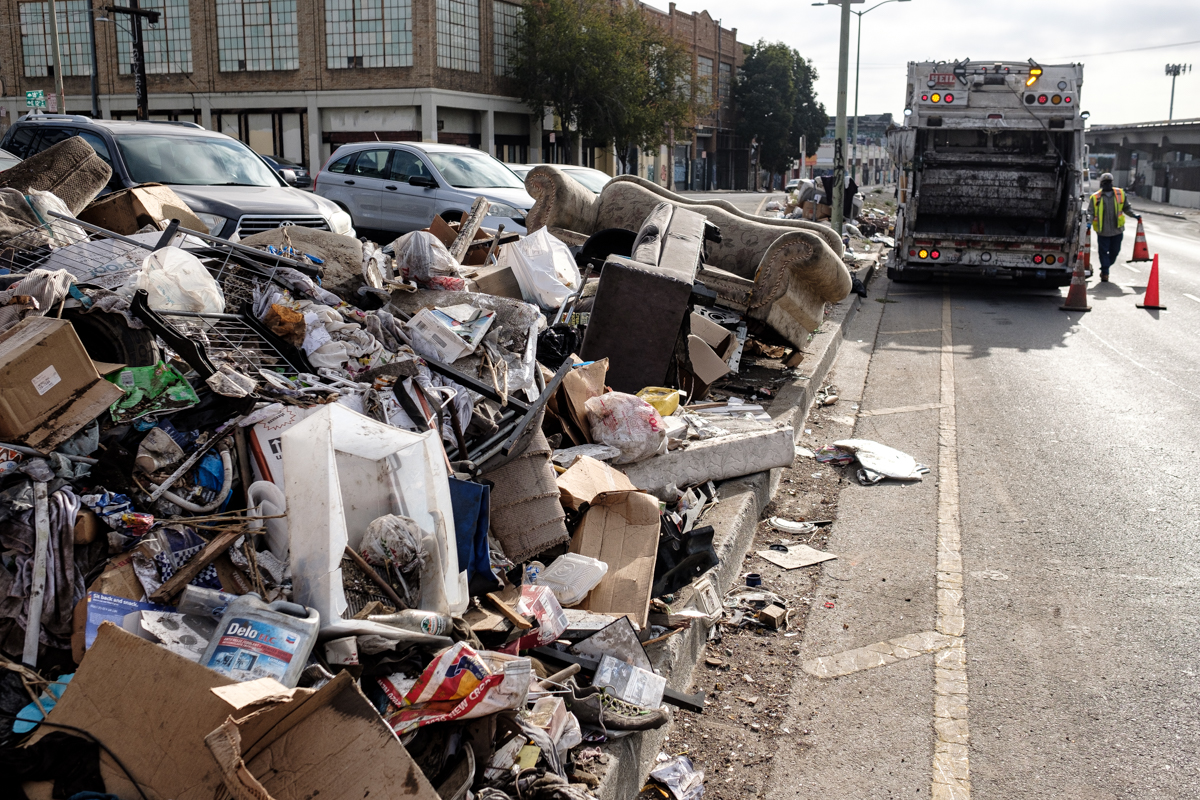
 Garbage piled up at an illegal dumping site on E. 12th Street near High Street on Oct. 2, 2025. Credit: Darwin BondGraham / The Oaklandside.
At a high level, the audit tried to identify why so much waste ends up on city streets. One finding is that Oakland doesn’t make it easy or cheap for residents to legally get rid of their trash.
Oakland residents pay a lot more for trash services than neighboring cities, between 23 to 40% higher, according to the auditor, even though these other cities also contract with Waste Management. The auditor also found that Oakland residents pay more for similar services than people in San Jose and San Francisco who use other waste haulers.
These findings are significant because Oakland homes appear to be the source of most illegally dumped trash in the city. When they were scouring Oakland’s streets, the auditor’s team found diapers, clothing, food scraps, and other household waste in dump piles around the city, and other city staff confirmed this pattern.
The auditor is urging Oakland officials to renegotiate the city’s Waste Management contract or assess options for other haulers after the city’s contract ends.
“As suggested by best practices, if Oakland curbside waste hauling rates are more affordable, the flow of illegal dumping to the streets should slow,” the auditor wrote.
Oakland’s contract with Waste Management ends in 2030.
Other options to lower waste disposal costs
The auditor’s report points out that Oakland currently offers hauling discounts for low-income senior homeowners and people with disabilities, but renters are not eligible.
Oakland used to have a popular service called “bulky block party,” where residents could bring big items to a designated place in the city and drop them off for free. The city ended these parties in 2024 due to budget constraints. Oakland also offers residents free pickups for bulky items, and once a year, people can also drop off their items for free at the Davis Street Transfer Station. In 2025, there were 4,501 residential drop-offs, mostly from single-family residents, according to the auditor.
A lot of waste is found near larger multi-family residential complexes, which the auditor suggested indicates “a potential lack of awareness or accessibility to bulky waste pickup” for those residents. It could also suggest a lack of awareness by property owners about the responsibilities under Oakland law, the audit added.
In 2025, only 21% of bulky waste was picked up from multi-family units. This is striking because multi-family residential accounts made up 84% of the city’s waste accounts last year.
About 72% of single-family units used their bulky pickup appointment in 2024 and 2025, while less than 2% of multi-family units exercised the same service.
The auditor also pointed out that landlords are responsible for garbage service, and they factor those costs into rents for tenants. This may cause low-income renters to avoid asking for higher volumes of services for fear it’ll trigger a rent hike.
The auditor recommends increasing outreach and education about bulky pickup appointments and making these services more accessible for residents, especially those in multi-family buildings.
Oakland leaders have also failed to use dozens of big dumpsters that Waste Management provides as part of its contract with the city. The mayor and each councilmember are provided with 12 big dumpsters, plus another 30 for city events. In 2025, 71 dumpsters were unused. The auditor recommends that city officials fully make use of these bins or turn them over to community organizations that do regular clean-ups.
The auditor also flagged the fact that an unknown number of businesses aren’t signed up for mandatory trash service. According to the report, somewhere between 2,500 and 6,800 businesses in Oakland weren’t subscribed to trash service in 2023 and 2024. As a result, thousands of businesses could be dumping their garbage on the street or relying on unscrupulous haulers who dump.
Police and the DA haven’t played much of a role in tackling illegal dumping
Local law enforcement officials have the power to issue citations for illegal hauling and dumping, but the auditor found they rarely do so.
According to the report, the Alameda County Sheriff’s Office reported three illegal dumping offenses between 2019 and 2025.
The Oakland Police Department has the authority to cite people for illegal dumping and unpermitted hauling. But the auditor found the department is “limited by time constraints and competing priorities.” OPD also doesn’t consider trash hauling to be probable cause for a stop.
The audit points out that a significant proportion of dumping is done by unlicensed haulers. Alameda County is lobbying the state to create a permit system to regulate haulers. Oakland Public Works staff support this idea, but added that it would be difficult to enforce.
When OPD does have sufficient evidence to prove a misdemeanor, the department can refer cases to the Alameda County District Attorney. Six cases were referred to the DA between January 2024 and December 2025, according to the auditor. But these cases don’t appear to interest prosecutors. According to the auditor, prosecutors found the cases “time-consuming, and they created a bottleneck.” Prosecutors diverted illegal dumping cases to the county’s traffic court.
“Limited enforcement may motivate illegal dumping if illegal haulers believe they can avoid prosecution,” the auditor found.
Public Works’ enforcement unit has been plagued by problems
According to the auditor, Oakland’s Environmental Enforcement Unit, which investigates illegal dumping, does not have written policies or procedures, and communication problems also hinder their work.
For example, the auditor found that from late 2024 to the end of March 2025, environmental enforcement officers only patrolled between 80th and 100th Avenues. According to the auditor, this was a strategy adopted by city leaders following communications with a local organization that had been affected by illegal dumping.
As a result, other neighborhoods may not have been getting adequate service because they were relying solely on 311 reports.
Environmental enforcement officers told the auditor’s team that they weren’t given much guidance about this assignment and expressed concern about neglecting other districts in the city. While on patrol, officers report new dump piles to city cleanup crews — a vital service, especially in industrial, less well-trafficked parts of the city. But by having officers concentrate their patrols in a 20-block stretch, the city may have slowed down cleanups elsewhere.
Public Works leaders told the auditor that they were not informed that this 20-block assignment was ongoing, nor that it was impacting patrols around the city. They agreed that communication needs to improve, but argued this example was not representative of how the environmental enforcement unit has been led in recent years.
Another job the unit has is to collect evidence of illegal dumping. Video footage is considered the most valuable evidence. Oakland also has a network of automated license plate reader cameras dedicated to catching vehicles dumping trash. But between November 2024 and March 2025, the cameras only produced 10 citations.
According to the audit, some cameras were placed in areas too dark to catch details of the dumpers; others were located in places where there was no dumping.
The auditor is recommending that Public Works place cameras in known dumping hotspots.
The city spends more money issuing citations than it collects in fines
According to the auditor, the city’s environmental enforcement unit costs Oakland more than $2 million in the fiscal year that ended in 2025, but during that same year, the unit secured only about $16,000 in citation revenue. And when citations were appealed, the cost of an independent hearing officer often exceeded the cost of the citation.
Few people pay their citations: approximately 73% of citations resulted in no response in 2024. The unpaid fines were sent to the Finance Department to begin collections, but “ineffective transfer of citation information” has cost the city revenue, according to the auditor.
In December 2021, Finance staff reported receiving some citations from Public Works that had errors. When the citations were reissued to the department in August 2024, the problems still hadn’t been addressed. At this point, the statute of limitations had expired for some citations, so the city was unable to collect on the tickets. As a result, Oakland lost out on over $4,000.
The auditor is recommending that City Administrator Jestin Johnson spearhead a strategy for departments to collaborate and share information about illegal dumping remediation and enforcement.
One positive finding in the audit is that Oakland cleanup crews are pretty good at quickly eliminating most illegal dumping sites. In 2024, crews resolved 85% of work orders that came in through 311 within three days. The time it takes to clean dump sites spiked in the summer of 2025 after Public Works briefly experimented with a more proactive model of cleaning. OPW has since gone back to the 311 complaint-based system.
The auditor suggested that Oakland should publish before and after pictures of dump sites on 311 so residents can see the effectiveness and timeliness of the city’s response. The audit also says that Oakland should further improve the 311 system by making it available in languages other than English.
“*” indicates required fields