
I open the container on Bigelow Boulevard and the heat rises first from fragrant basmati rice still steaming. There is tamarind chicken in a dark, glossy gravy, oil lifting through in thin lines, curry leaves scattered throughout. The sourness is nuanced, almost like the tang of molasses. Another container holds some rustic palak paneer, the spinach partly puréed, partly coarse, clinging to the paneer. There are crisp samosas and thick parathas, too, folded in foil and still warm to the touch.
In all its rustic deliciousness, it is the antithesis of restaurant-style Indian food. There is no blitzing these gravies into smooth submission, no heavy cream smoothing out their edges. This is homestyle Indian cuisine.
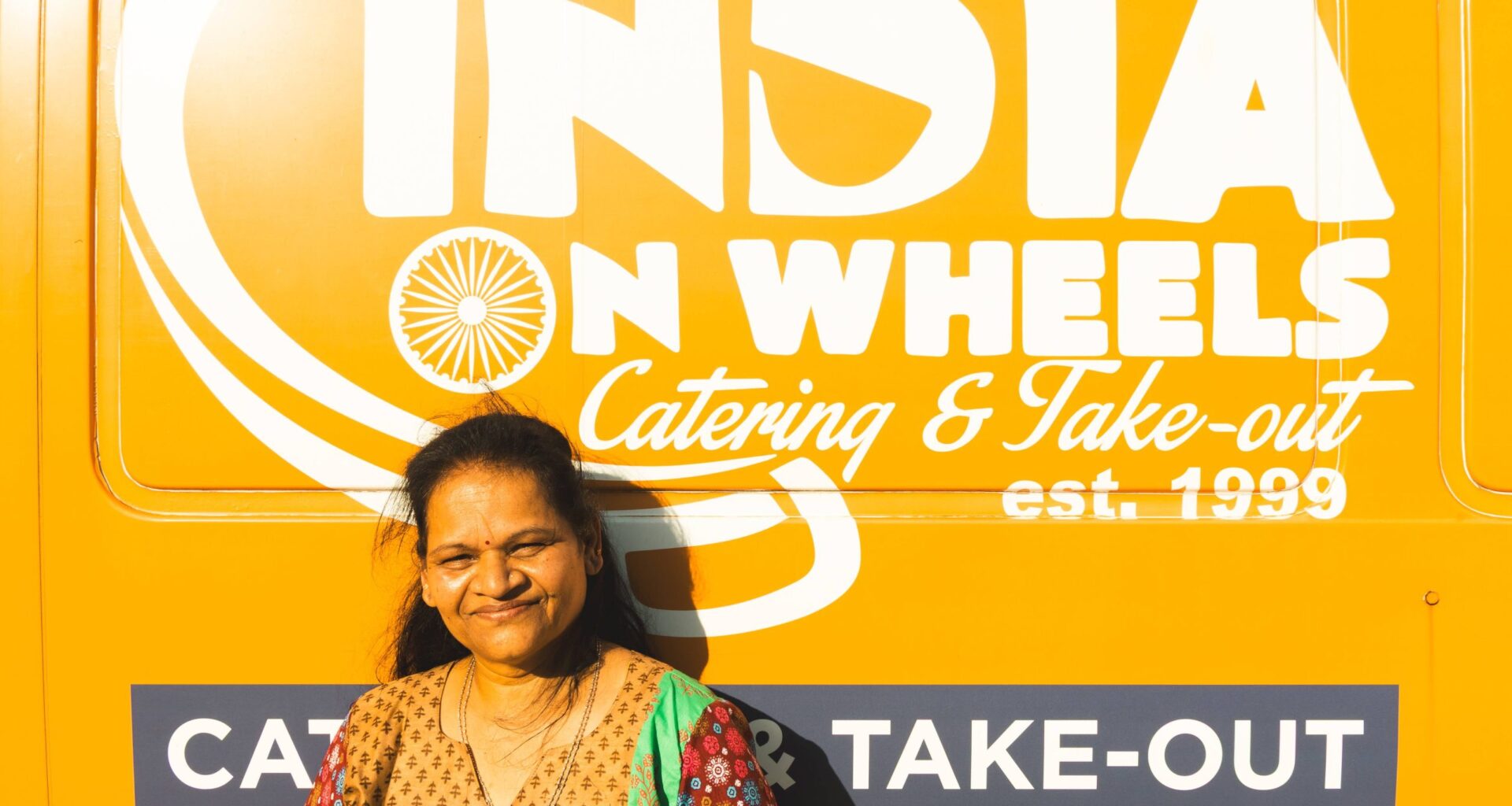
A few steps away, the bright orange India on Wheels truck is parked in the same spot in Oakland where it has sat since 1998, fixed against the curb. Inside, owner Rita Amin preps, anticipating the lunch rush that will arrive soon.
By noon, students from the University of Pittsburgh and Carnegie Mellon University drop by between classes, backpacks still on; a nurse in scrubs waits with a phone in hand as the line builds long behind them. The funny thing is that very few people are actually studying the menu. The orders are notably absent of hesitation. “They don’t have to think about it,” Amin says. “They already know what they want. And I know them too.”
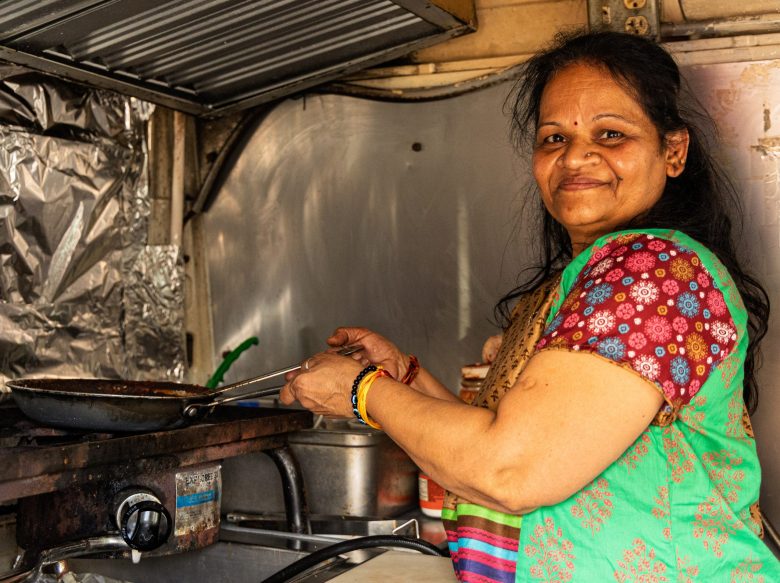 “You have this woman who barely speaks English,” Bhavini Patel says of her mother, Rita Amin, pictured above, “and she’s deciding she’s going to feed people something they don’t understand yet, explain it, build a business from it and raise a family at the same time.” Photo by Rob Liggett.
Amin is everywhere at once, boxing up small containers of chutney, sliding a mango lassi across the counter to someone waiting. She makes the food to order, flame-blistering naans before serving and cooking curries simultaneously in side-by-side kadhais, deep, curved pans set over high heat.
She makes mango chicken curry for JosephAnna Barr, a longtime customer. The sauce turns thick and golden as ripe mango pulp folds into onion, tomato and spices, sweet, spicy and savory all at once.
Barr is a lab secretary who works two blocks away and has been coming here for 15 years for lunch at least a couple of times a week. “I’ve worked in Oakland for all of 15 years. I didn’t find them right away,” they say. “I regret those three years that I lived without the deliciousness that is this mango chicken curry. I am obsessed.”
The mango chicken curry is a beloved staple: one of the dishes people return for, order after order. The menu changes depending on what Amin wants to cook and what her customers ask for. Pakoras and samosas are staples, along with rice, lentils and naan. Around them, curries like chicken tikka masala, mango chicken, lamb curry and palak paneer rotate.
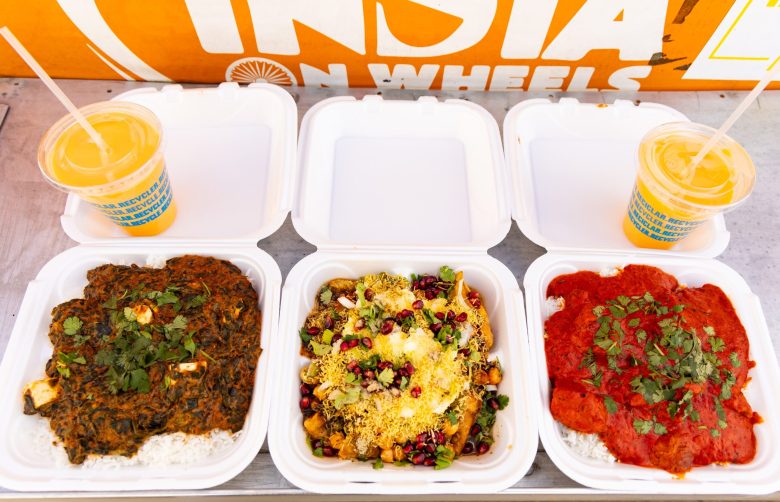 Palak Paneer, Samosas Chaat and Chicken Tikka from India on Wheels with Mango Lassi to drink. Photo by Rob Liggett.
There is also a special item every day. One of those specials came from a butter almond ice cream she once tasted. She turned it into a curry, butter almond chicken. When it did well, a lamb version followed.
Amin says none of this was part of a plan. She learned to cook as a child in the city of Anand, in Gujarat, India, starting at age 9, watching, repeating, cooking alongside her sisters. “You learn by doing,” she says.
She married at 18 and moved to the United States soon after, first to New York, then to New Jersey, where a family friend helped her settle. She then went on to other places — Chicago, Michigan and others — each one temporary. She moved to Pittsburgh in 1997.
The Steel City at night had an undeniable, magnetic pull, she says. “I saw it at night,” she says. “I liked it. A lot. I can’t say exactly what I loved so much, but it was enough to make me stay.”
She found work as a cook at Taj Mahal. In 1997, she was also working out of the back of Patel Brothers in Monroeville, when the store was still small, filling a gap in the offerings. She rolled rotis by hand and prepared trays of samosas in large batches, especially on weekends. It was later that she noticed the food trucks Downtown. It made her curious.
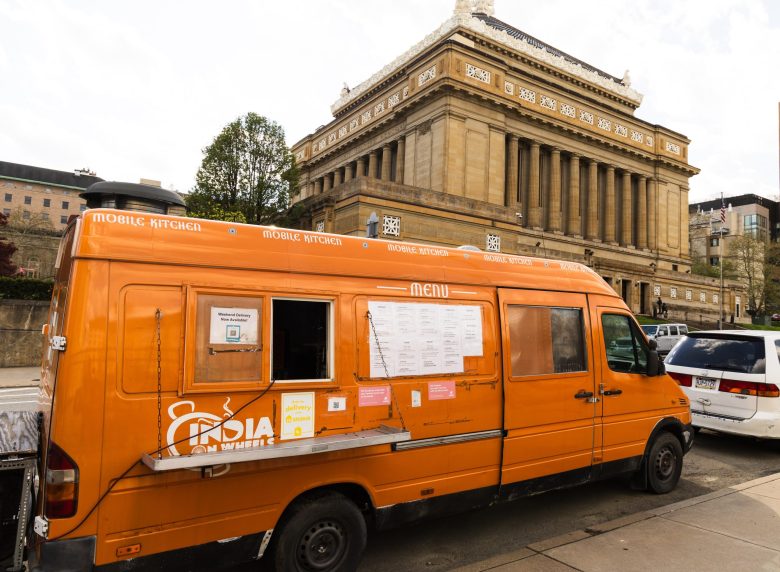 India on Wheels parked across the street from Soldiers & Sailors Memorial Hall & Museum in Oakland. Photo by Rob Liggett.
Amin began asking how to start, and the answer, she says, was practical: Apply with the city, secure the permit, and begin. She launched the first India on Wheels truck in 1998. In those early days, people often passed by. Many weren’t familiar with Indian food and assumed it would be too spicy, she says.
Some came close, asked questions, then left before she could answer. Others kept their distance. So she began offering samples, a spoonful of chicken tikka masala, a piece of samosa.
“I would say, just try it with an open mind,” Amin says.
After about six months, she says, she started building a loyal and consistent customer base.
“My son helped cut chicken in the morning,” she says. “After school, both my kids helped clean. My daughter grew up in the truck.”
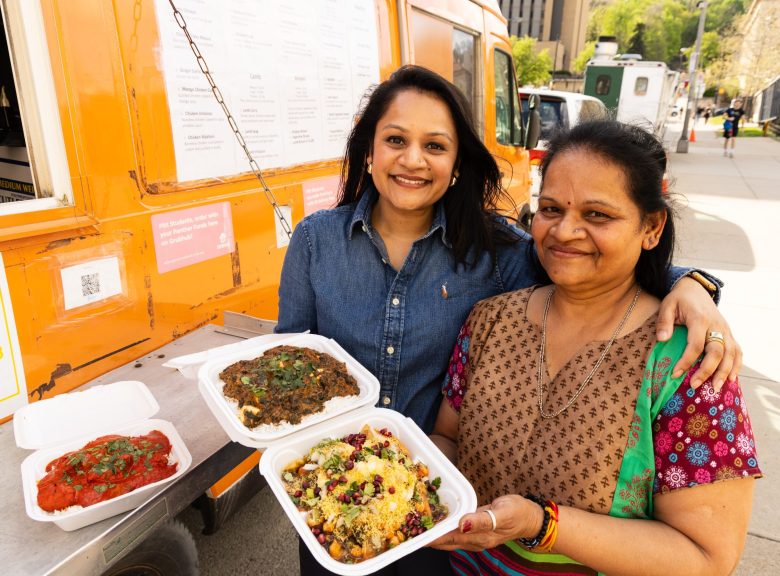 Bhavini Patel, left, and her mother, Rita Amin. Photo by Rob Liggett.
Bhavini Patel, Amin’s daughter, says that period was shaped by the fierce determination of her immigrant mother intent on making it, building a business piece by piece in a way that feels obvious only in hindsight.
“You have this woman who barely speaks English,” Patel says, “and she’s deciding she’s going to feed people something they don’t understand yet, explain it, build a business from it and raise a family at the same time.”
As a child, Patel set up a lemonade stand near the truck, a small table that mirrored what her mother taught by example. “That was my first lesson in entrepreneurship,” she says. “You see it, and then you do it.”
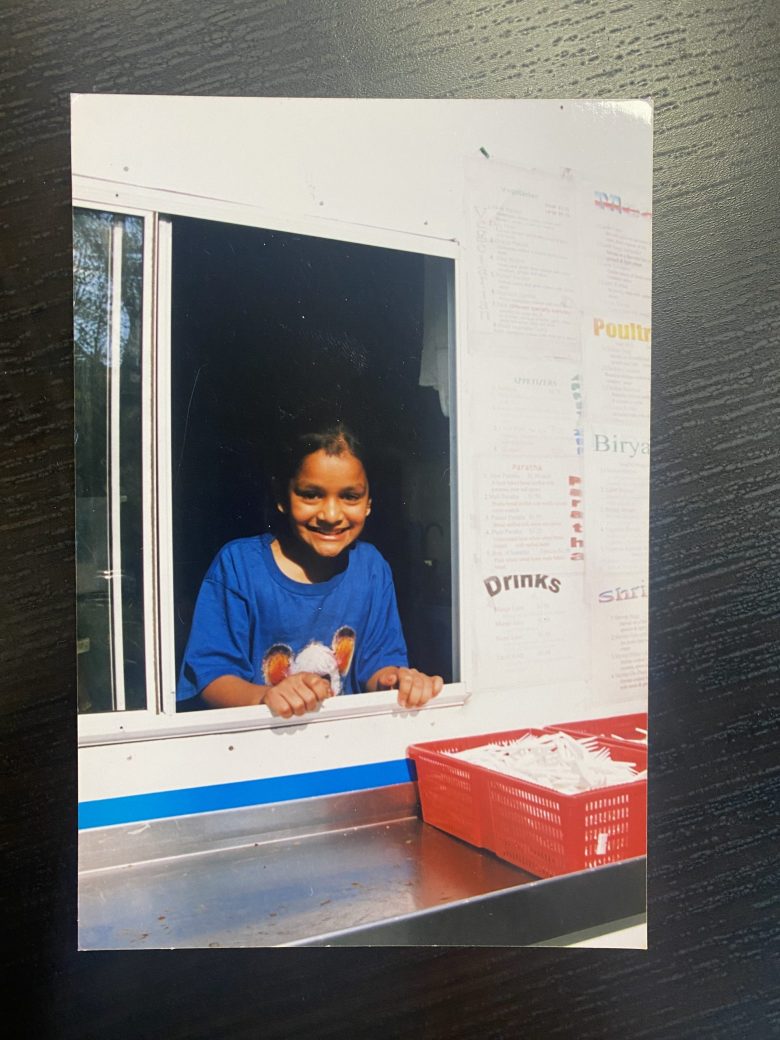 Bhavini Patel working at India on Wheels as a kid. Photo courtesy of Patel.
In 2009, the business expanded to a second truck. Later, after Covid, Amin scaled back to one.
Back in Oakland, the line rebuilds itself each semester with students arriving from Pitt and CMU. Amin says parents often ask her to look out for their children, a role she takes on without hesitation. By the end of the term, many return to thank her.
Patel has watched those early exchanges grow into something more lasting. Students come back, she says, not just for the food, but for what it carried them through: stressful semesters, long nights and unfamiliar routines. “People come back and say thank you for feeding my kid, for being there when they were stressed,” she says.
Over time, some return years later with children of their own. “There’s one who started calling her mom,” Patel says. “Now he’s like my brother.” While the truck is a business, it is also her mother’s expression of community, she says.
Around the truck, Oakland has changed. Gas stations and parking lots have been replaced by new buildings as the universities expanded outward. “Oakland has changed a lot in these years,” Amin says.
But the line is still going steady.
Amin turns 60 this year. “I can’t think of retirement, I don’t know what I’d do,” she says. “This is my place, and these are my people.”