
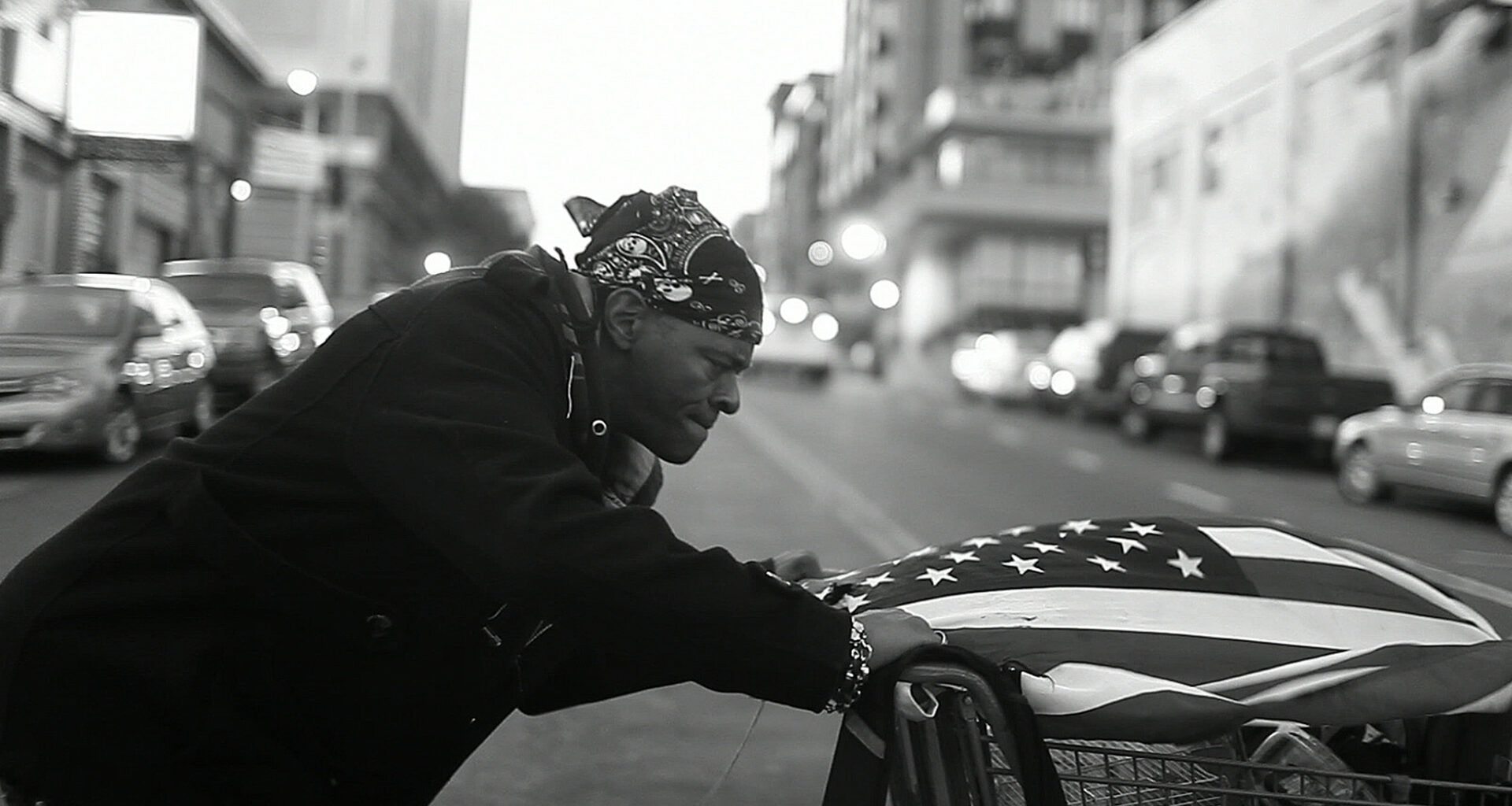
Tim Blevins is singing on the sidewalk outside San Francisco’s War Memorial Opera House. He sways slightly as his low voice swells in volume. A shopping cart crammed with his belongings is pushed off to the side, and he has a cardboard sign propped up at his feet: “Inquire about CDs.”

Most people walk past him, heading straight into the venue. A man stops to buy one of his CDs for $5; a woman pauses to marvel at his talent. “What a voice you have!” she exclaims. “Oh my God.”
Later, after the passersby have filtered through the opera house’s doors, Blevins stares up at the balcony.
Article continues below this ad
“I used to sing in places like this, for real,” he remarks, half to the camera, half to himself.
A screenshot of Tim Blevins from the documentary “Figaro Up, Figaro Down.”
Courtesy of Javid Soriano
A screenshot of Tim Blevins from the documentary “Figaro Up, Figaro Down.”
Courtesy of Javid Soriano
This is a scene from “Figaro Up, Figaro Down,” a new documentary detailing Blevins’ rise to the top of the opera world and his subsequent descent into substance use and homelessness. Produced over the course of 10 years, the film tracks the singer’s struggles, bouncing between single-room occupancies in SoMa and the Tenderloin as he attempts to find stability.
Article continues below this ad
Make SFGATE a preferred source so your search results prioritize writing by actual people, not AI.
Add Preferred Source
Next week “Figaro Up, Figaro Down” is slated to screen at the Marina Theatre and BAMPFA as part of the 2026 San Francisco International Film Festival. Blevins, as well as director Javid Soriano and producer Rob Richert, are expected to appear as guests.
In his prime, Tim Blevins was something of a Broadway rock star. He graduated from Juilliard, and his confident, macho style made him a sought-after opera performer. He played Crown in George Gershwin’s “Porgy and Bess”; he sang at Lincoln Center and Carnegie Hall.
A screenshot of a young Tim Blevins onstage from the documentary “Figaro Up, Figaro Down.”
Courtesy of Javid Soriano
At the same time, the singer had a rebellious streak. He drank and smoked cigarettes before taking the stage. In the documentary, Blevins’ father admits to introducing him to crack cocaine when he was 16 years old. Later on, Blevins got hooked on pain medications. As Blevins’ substance use worsened, his marriage dissolved. His opera career took a nosedive, too; producers began to see him as unreliable, and his work dried up.
Article continues below this ad
Blevins left New York, first heading to Southern California, where he grew up. He eventually landed on the streets of San Francisco. For money, he busked outside the opera house and in BART stations. In SoMa, Blevins earned the nickname “Opera.”
Soriano, the documentary’s director, met Blevins in 2013 or 2014. (Blevins was not available for an interview in time for publication.) At the time, he was a Master of Fine Arts student at the San Francisco Art Institute. Soriano was walking in the Civic Center area when he spotted Blevins selling items on the sidewalk, surrounded by a small crowd. Among the other sidewalk vendors, Blevins stood out, Soriano said.
“You could just feel right away that he was very charismatic,” the director recalled. “He had a lot of interesting things that he was selling, like opera books, Opera America magazine and Mozart sheet music.”
A screenshot of a young Tim Blevins from the documentary “Figaro Up, Figaro Down.”
Courtesy of Javid Soriano
The pair got to talking, and Soriano agreed to film Blevins singing an aria from “The Barber of Seville.” The two men met in an alley after dark. Holding his pet rat, Bella, in his hand, Blevins began to sing. His voice cracked, and he switched to a sadder, more sentimental song, a Wagner aria called “Song to the Evening Star.” He told Soriano about how he missed his children. The director was struck by the singer’s double nature: quick-witted and confident in one moment, fragile and longing in the next.
Article continues below this ad
“At that point, it started to feel almost like an opera, right?” Soriano said. “Like he was the protagonist in his own personal opera, driven by this profound yearning for home.”
This encounter kicked off a yearslong relationship. Soriano began following Blevins around, sometimes with his camera, sometimes without. Occasionally, Soriano helped move Blevins’ shopping carts around. Over the years, the director earned his subject’s trust.
It’s because of that trust that “Figaro Up, Figaro Down” gives such an intimate picture of Blevins’ life. Soriano’s camera tracks Blevins openly discussing drug use, stumbling through an awkward Father’s Day phone call and leaving a San Francisco jail.
“I could’ve chosen my family and my children,” Blevins says in a voiceover. “I had that chance more than once. And I didn’t choose it. For some odd reason, I’ve given up everything good for this.”
Article continues below this ad
A screenshot of Tim Blevins from the documentary “Figaro Up, Figaro Down.”
Courtesy of Javid Soriano
A screenshot of Tim Blevins from the documentary “Figaro Up, Figaro Down.”
Courtesy of Javid Soriano
A screenshot of Tim Blevins from the documentary “Figaro Up, Figaro Down.”
Courtesy of Javid Soriano
“This” refers to substance use. In one scene, the viewer watches Blevins and his then-girlfriend shoot up together in a messy hotel room.
Article continues below this ad
The story is a bittersweet one. By the end of the film, Blevins gets sober, finds stable housing and reconnects with his children. After spending years singing for BART commuters, he gives a 2016 performance at the Greek Theatre, wearing a flat-brim Warriors hat.
Still, the years take their toll. The viewer watches Blevins age 20 years in half as much time. When Soriano started filming him, Blevins had a limp; by the end of the film, he’s had a hip removed and gets around in a wheelchair. He makes it off the streets but lives in Section 8 housing. He doesn’t ever return to Broadway. Today, the 57-year-old Blevins busks outside the Orpheum Theatre.
After spending more than a decade with Blevins, Soriano is most struck by the singer’s “uncanny sense of beauty.” Blevins’ music, Soriano thinks, is what kept him going all these years.
Article continues below this ad
“Even in the hardest moments, he can find something worth holding on to,” the director said. “This sense of beauty, where most people would only see damage — it kind of carries him through this ongoing, almost impossible, struggle with himself.”