
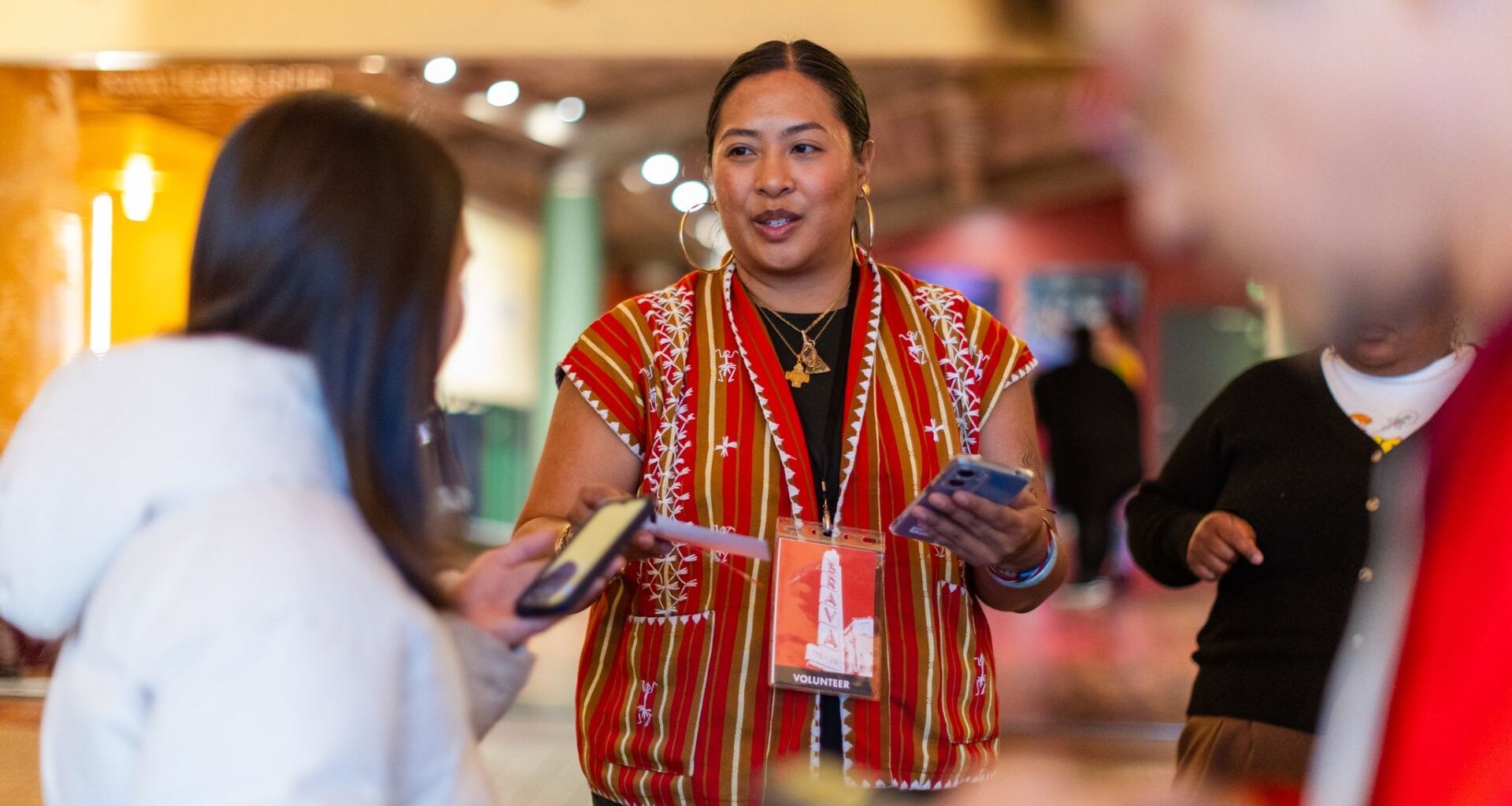
Kim Acebo Arteche, Executive Director of Brava! for Women in the Arts, scans tickets as patrons arrive to “She Kills Monsters” at Brava Theater Center in San Francisco on April 10, 2026.
Estefany Gonzalez/For the S.F. Chronicle
Kim Acebo Arteche did not initially want another permanent position running an arts company.
Previously, as co-executive director at the Berkeley Art Center, “I got burnt out,” they recalled.
“I know so many of my mentors and peers who have developed autoimmune diseases because of the stress of the job.”
Article continues below this ad
So when the nonbinary multimedia artist and career nonprofit arts administrator took the helm at Brava Theater Center in July, it was on an interim basis. “I was trying to preserve myself,” they told the Chronicle.
But over time, Arteche began to see the job differently.
Actors perform in an SFBATCO Young Actors Lab production of “She Kills Monsters” at Brava Theater Center in San Francisco on Friday, April 10, 2026.
Estefany Gonzalez/For the S.F. Chronicle
“This is actually truly a unique opportunity to be in such an aligned organization,” they said, noting that board and staff felt in sync in a way that felt “special.”
San Francisco Chronicle Logo
Make us a Preferred Source to get more of our news when you search.
Add Preferred Source
Arteche thought about all the times they came to Brava as a patron — for the Queer Women of Color Media Arts Project, “Larry the Musical,” “Not My First Pandemic” by César Cadabes — and how “it’s always felt safe.”
Article continues below this ad
In March, Arteche made their position permanent, becoming just the fourth such leader in the 40-year history of the organization dedicated to women, queer people and people of color.
The transition comes at a critical time for the Mission District arts hub. In 2024, it hosted an emergency fundraising drive to keep the lights on. Another campaign last fall used similar language.
Meanwhile, its 24th Street facility, which was originally built as a movie theater, celebrates its 100th anniversary this year. To mark it, the company received a $150,000 Community Challenge Grant from the city, which Brava is hoping to build on with a $100,000 campaign of its own. With the city’s funds, Brava plans to throw a block party on Oct. 17, seeking to “reintroduce ourselves back to the block,” Arteche said.
Patrons arrive at “She Kills Monsters” at Brava Theater Center in San Francisco on April 10, 2026.
Estefany Gonzalez/For the S.F. Chronicle
“We’re literally just trying to bring the things that we do in the theater, even rehearsal-wise, out to the street,” they added.`
Article continues below this ad
Youth dance program Cuicacalli is slated for a performance and demonstration. La Mezcla founder Vanessa Sanchez and San Francisco Bay Area Theatre Company both plan to teach free workshops.
Beyond the anniversary, Arteche sees their top priority as getting Brava out of its deficit, which they have already reduced by nearly two-thirds, to $135,983, since coming aboard. Eliminating it will require maintaining “a very delicate dance,” they said. San Francisco’s wealthiest donors still direct the bulk of their largesse to predominantly white institutions that confer glamour and social cachet in return. Many public and private institutional funders have also changed their priorities in response to shifts under President Donald Trump’s administration. To deal with increased costs, even on goods like toilet paper, Brava could book more rentals and raise prices, but that risks compromising the organization’s mission.
“We are a very accessible theater, and if we increase it too fast, we’re going to lose all of our community members,” Arteche said.
After closing the deficit, they hope to hire an artistic director to oversee programming.
Actors perform in an SFBATCO Young Actors Lab production of “She Kills Monsters” at Brava Theater Center in San Francisco on April 10, 2026.
Estefany Gonzalez/For the S.F. Chronicle
Arteche comes to Brava not just as a seasoned arts administrator who’s worked with Kularts and Kearny Street Workshop, along with co-founding the Filipino American arts company Balay Kreative, but also as a wide-ranging artist in their own right. Their artist page features ritual performance, a textile series and a self-portrait project. There’s also an especially arresting photography series titled “Bodyless,” in which women’s clothes appear to be worn by invisible bodies, a comment on the labor of Filipina workers overseas.
Article continues below this ad
Asked if there’s a medium in which they don’t work, the Washington, D.C. native paused before positing, “I would say sculpture?” But even that hypothesis had a distinct question mark at the end.
Arteche played piano competitively throughout their youth, in addition to studying photography. They have been a professional dancer, with Culture Shock, D.C., and in their live-work space in the Cotton Mill Studios in Oakland, they unwind by quilting and embroidering. Nourishing their creative side, they said, “is not a question. I have to.”
That same eye informs their work as an administrator, said Jason Bayani, co-executive director of Kearny Street Workshop, the oldest multidisciplinary Asian Pacific American arts organization in the U.S.
Arteche, he said, can make richly evocative art out of “the touch of the fabric of the clothes our relatives wore.” They have the kind of long-view insights about heritage and nostalgia that “remind us who we are” and give clarity to dynamics observed in childhood but never fully reckoned with, Bayani explained.
Kim Acebo Arteche, Executive Director of Brava! for Women in the Arts, watches a production of “She Kills Monsters” at Brava Theater Center in San Francisco on April 10, 2026.
Estefany Gonzalez/For the S.F. Chronicle
When Arteche designed the cover for his latest book, “Everyone I Love, Alive,” Bayani was struck by how much of his writing they encapsulated in one jagged image, in which an aerial view of jungle and water is overlaid with markings suggesting both rippling and shattering.
Article continues below this ad
With Arteche, he said, “You can always trust that (they’re) going to be able to see the whole picture and be able to break it down into something that we can work with.”
That outlook is already shaping their leadership at Brava.
“I’m very determined that we’re not going anywhere,” they said, nodding to the determination of Brava’s female founders.
“The matriarchy considers seven generations backwards and forwards, right?” they continued. “I also think about seven generations forward.”