

City Controller Greg Wagner, San Francisco’s chief financial officer and auditor, displayed a stark chart earlier this month during a public presentation about The City’s budget. It showed spending — driven largely by staffing costs — exceeding the relatively slow growth of city income at an increasing rate.
The result is a projected two-year deficit of $643 million that is expected to grow to more than $1 billion — a historically large figure — by fiscal year 2029-30.
Wagner said the situation has been worsened dramatically by enormous federal cutbacks to health, food and other social safety-net programs — but that it’s also attributable in part to San Francisco’s political choices.
“There’s a piece of this, honestly, that has to do with … decisions that have been made at the local level,” said Wagner during his appearance at Manny’s, a Mission-district event space, with Ted Egan, The City’s chief economist.
With COVID-19 pandemic stimulus funds going away and continuing challenges to the local economy, “We’ve known that there’s going to come a point in time where in order to balance the budget, we’re going to have to make changes to expenditures and do so in a kind of structural way to push those two lines together,” Wagner said.
By May 1, Mayor Daniel Lurie must issue a budget for select departments, and he must submit a full proposed budget to the Board of Supervisors by June 1. The board’s budget and legislative analyst will then provide recommendations for adjustments, and the Budget and Appropriations Committee will consider possible changes and take public testimony. In July, the supervisors are expected to finalize the budget for the mayor’s signature.


City Controller Greg Wagner, seen in conversation at Manny’s on April 15: “We’ve known that there’s going to come a point in time where in order to balance the budget, we’re going to have to make changes to expenditures.”
Craig Lee/The Examiner
And given the outpouring of input already coming from citizens and service providers concerned about cuts to numerous kinds of programs they value, the process seems likely to be controversial and emotionally charged.
Lurie has set a goal of slashing the “structural deficit,” and his administration has said he plans to cut $400 million in annual spending, including $100 million to come from eliminating 500 positions. His office has already issued 127 layoff notices.
“The City has to stop spending more money than we have,” Lurie said in an April 14 address to the Board of Supervisors. “Temporary fixes may buy time, but tackling the structural deficit is the best thing we can do to set up our city for a broad-based, durable recovery.”
Cuts and cutback plans from departments in the wake of the mayor’s directives have sparked fear and outrage among consumers and providers of varied services, such as programs for older and disabled people, clinics for seniors and youths, and workforce development. Many people have packed recent hearings at City Hall, pleading with supervisors to stop particular cuts.
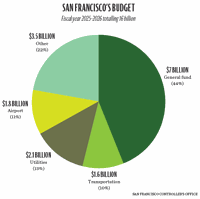
A challenge for The City is the fact that out of its roughly $16 billion budget, more than half is restricted to particular uses, such as the airport, water and sewer, or transit, Wagner said. Only 44% — or about $7 billion — is in the general fund, he said.
And while not all of that is discretionary, that’s where The City’s political leaders must look for savings, he said. About 30% of the general fund has also been earmarked for particular purposes by voters, leaving $3.5 billion to $4 billion of discretionary money.
Wagner said city agencies have sought ways to lower costs and increase revenue. The Department of Public Health, for example, has been developing “sophisticated” strategies to help people enroll in programs even as the government is making it harder to do so, he said.
But Wagner said the size of the deficit is beyond “squeezing efficiency,” and that means The City has to talk about service levels and numbers of positions.
Roughly half of the general fund pays for people’s salaries and benefits, followed by grants and contracts with providers of social services such as housing, he said.
“That’s a very hard conversation, and it probably is going to continue to be part of the approach to balancing the budget, just because that’s so much of what The City spends money on,” Wagner said.
About 80% of the “flexible money” The City has is in just six departments, including the fire, police, and sheriff’s departments as well as the Department of Public Health, the Department of Homelessness and Supportive Housing and the Human Services Agency — all areas that are hard to cut, he said.
Lurie says he wants The City to focus on “core services,” which he said during a recent event include supporting The City’s economic recovery, public safety, keeping streets clean and “getting people who need help off the street and into recovery.”
“Taxpayers deserve to have their dollars spent wisely, and we are going to do that, and we’re just going to be very focused on core services going forward,” Lurie said.
“This is a hard budget, and I’m not going to pretend otherwise, but San Franciscans deserve a government that is honest about the challenge, disciplined about taxpayer dollars, and clear about what we will protect,” Lurie told supervisors. “My job is to close the structural gap, responsibly protecting the essentials and put this city on stronger footing for the coming years.”

The City’s seven-day slate will see award-winning musicals, world-premiere dance productions and a celebration of Dutch culture

The City released a report that includes a detailed timeline of the events leading up to the December stabbing death of a Ward 86 worker

Business interests poured $2 million more into a campaign fighting a labor union ballot measure that would raise San Francisco’s Overpaid Executive Tax
A budget update last month said the two-year deficit forecast was $293.8 million less than projected in December, and the general-fund shortfall for fiscal year 2026-27 was forecast to be $168.5 million, or $127.8 million less than projected in December.
Supervisor Chyanne Chen asked the mayor during his monthly appearance before the supervisors “what is the urgency” to cut jobs, given the improved conditions seen in the update, rather than allowing supervisors “to review the updated budget and consider whether cuts of this scale are still necessary.”
Chen, a former labor organizer whose work has included working with in-home supportive services and health-care workers, also asked about the recent settlement for no money of a $120 million tax claim filed by the company Airbnb. She also cited the potential passage of Proposition D, a hotly contested June ballot measure that could raise an estimated $250 million to $300 million a year by increasing The City’s Overpaid Executive Tax. Lurie has come out in opposition to that measure.
“We are experiencing exigent circumstances between our local budget deficit and uncertainty with funding at the state and federal level,” Chen said. “But we (are) also seeing momentum in a positive … direction.”
Given the improved outlook and the potential for up to $300 million in new revenue from Prop. D, Chen asked, “Why are you still pursuing $100 million in cuts to city workers?”
Chen said Wednesday in a statement to The Examiner that she has “serious concerns” about “balancing the budget on the backs of our most vulnerable communities,” particularly “working families in the southeast corridors of our city.”
She said a top priority of hers will be fighting to protect “the social safety-net programs that have demonstrated their ability to prevent eviction, job loss, displacement and more in culturally competent and language-accessible ways.”
Lurie was firm in his message of fiscal discipline to the supervisors, reiterating that he is against the past practice of using one-time funds to pay for ongoing expenses.
The City cut roughly $300 million from its long-term deficit last year in passing a roughly $15.9 billion two-year spending plan that closed a deficit of about $800 million, only to have federal and state cuts to health care and other safety net programs “set us back,” he said — and the deficit remains on an upward trajectory.
By itself, the two-year estimated revenue impact of funding changes from the One Big Beautiful Bill Act, a federal law championed by President Donald Trump and enacted into law last summer, is $306.3 million, representing just less than half of the total projected $642.8 million shortfall.
“We never want anyone to lose their jobs,” Lurie said. “There is no doubt that these decisions are painful.”
Lurie said the steps his administration has taken “are necessary to continue the work we have been doing to manage taxpayer dollars responsibly, deliver the best possible services and set up our city … for a long, lasting recovery.”
Wagner said The City appears to have “turned a corner” economically but has yet to get over the effects of the COVID-19 pandemic, which led to record-high office-vacancy rates that have been dropping but still topped 30% in the first quarter. Property-tax revenues are lower, and they are The City’s largest source of general-fund income, followed by business taxes, he said. Hotel taxes and sales taxes remain below pre-COVID levels, he said.
“We are not out of the woods,” Lurie said. “Our economic recovery is still extremely fragile. We still have a five-year structural deficit that will rise to $1 billion if we do nothing, alongside potential additional federal and state cuts.”
The City faces a choice, he said: “Take action now or be forced to do twice as much in the coming years.”
But Anya Worley-Ziegman, a coordinator at the San Francisco People’s Budget Coalition — an alliance of more than 150 organizations, including nonprofits, community groups and labor unions — said the mayor could choose to find new revenue, such as through Prop. D.
“When you have a deficit, you have two ways to solve this, and the mayor is trying to pretend as if there’s just one way — we only can make cuts,” Worley-Ziegman said. “We are willing to bet that San Franciscans would rather have tax increases rather than see all of these core services go away.”
Muni is outside of the general fund, but it receives a general-fund subsidy — and it too is facing future deficits.