
A challenge artists continue to fearlessly tackle over time: how to express the inexpressable. April presents a hot season for dance companies around the Bay Area — each attempting to find new ways to explore and push the boundaries of what is possible through movement.
The evening of April 19 marked the closing show of Alonzo King Lines Ballet and their program, a premiere of “Legacy,” a collaboration with Grammy Award-winning bassist and composer Esperanza Spalding and the return of “Ode to Alice Coltrane,” a contemporary work celebrating Alice Coltrane’s legacy. The performances took place at the Yerba Buena Center for the Arts in San Francisco, a moderately intimate venue, over the course of one week.
As the lights dim, heavy royal-blue curtains rise to reveal Spalding standing on the left stage with a heavily structured emerald-green metallic dress — a bold design by Colleen Quen and Robert Rosenwasser. She stands serenely with her bass next to a bare stage, commencing with an eerie hum, plucking single notes.
“Legacy,” in both motion and music, evokes a trance-like feeling. The dancers’ movements are sporadic, random and at times, even awkward, emitting the familiar feeling of dancing alone in your room when no one is watching. Still, the choreography is as technically demanding as it is artistically experimental. By the end of the show, the dancers are slick with sweat.
Though Spalding’s music explores concepts of lineage and inheritance, for audience members who tend to grasp onto narrative or theme, the performance might prove a bit directionless. Regardless, you will find yourself entranced by the dancers themselves. With only 11 dancers, a sense of familiarity grows as the production progresses. Shuaib Elhassan’s execution of numerous turns and extensions is particularly fascinating. Theo Duff-Grant’s lines and full-body expression are captivating, as every nerve in his body appears clearly alight with intent and passion.
In perhaps the most cohesive sequence of the night, Elhassan and Adji Cissoko perform “Through Two Not Two,” a pas de deux that is a clear standout. Illuminated by a warm spotlight and dressed in simple, skintight pieces, the pair executes stunning lifts and imbues a sense of unity.
King’s choreography is predictably unpredictable — the dancers are often in a uniform formation with one dancer in the spotlight, or there are two or three dancers doing entirely separate choreography on the stage simultaneously. His choreography often showcases long limbs and emphasizes muscle, making sure to push an element of flair.
In tandem, Spalding’s vocals are smooth and read as purposely out of tune, showcasing her deeply improvisational style and heavy jazz influences. Near the end of “Legacy,” Spalding characterizes the atmospheric score through a repetition of the word “home,” and through an elegant, yet startling vocal screech.
Transitioning from “Legacy” to “Ode,” the score shifts into something distinctly sweeter, a sultry jazz — Coltrane’s signature slow basslines and rich and passionate piano melody.
The second part of the show brings back King’s cherished “Ode to Alice Coltrane,” which celebrates and is influenced by American jazz icon Alice Coltrane — one of the first female Black American jazz musicians to record her own music in her own studio. To honor her legacy, the work is set to her transformative music. During a sequence in “Ode,” the dancers all lie on the ground and perform a swimming motion on the floor, crawling toward light that creeps in through the edge of the stage — an almost cinematic experience, sure to leave the audience with chills.
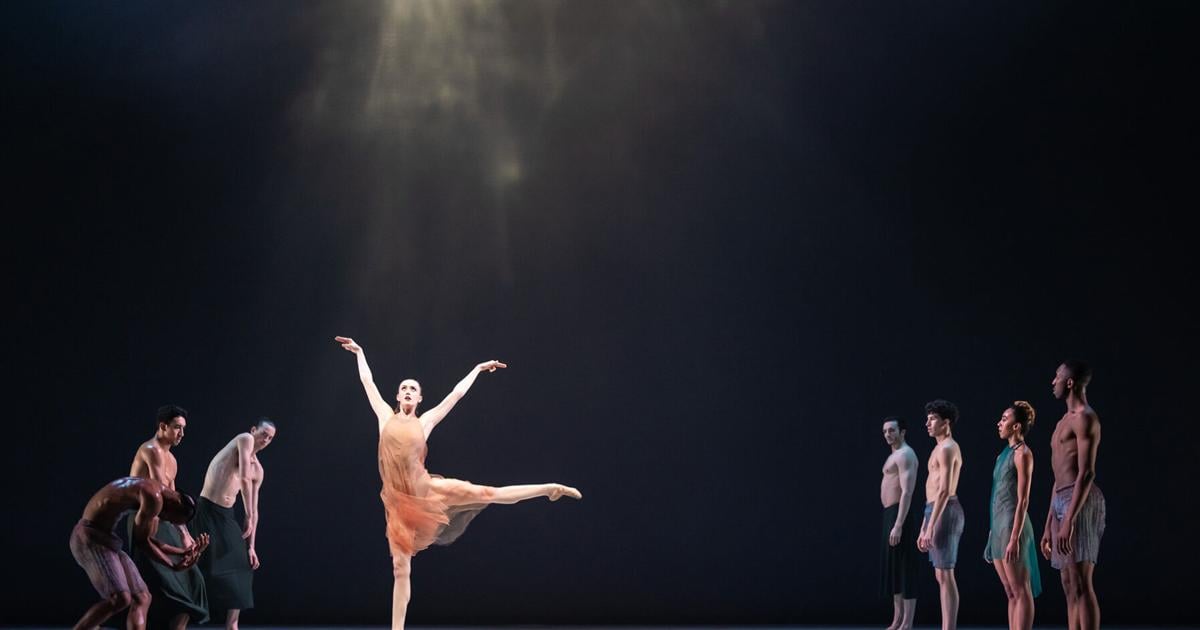
Seah Johnson’s lighting design truly gets its moment to shine in “Ode.” The mostly dark background is illuminated by a star-like light source reaching out in all directions, turning the scenery into a stellar environment. Johnson’s design clearly emphasizes the dancers’ physical presence, with their muscles traced by the light’s beams.
Rosenwasser’s costume designs are visually enchanting — the dancers are clad in a range of colorful outfits, from shimmering sequined dresses in “Legacy,” to birdlike feathery white pants, to sheer flowing earth-toned outfits in “Ode” — complementing the dancers’ vivid routines.
With “Legacy” and “Ode,” King achieves in expressing something inexpressible, bringing a fascinating, restlessly experimental display of movement.