
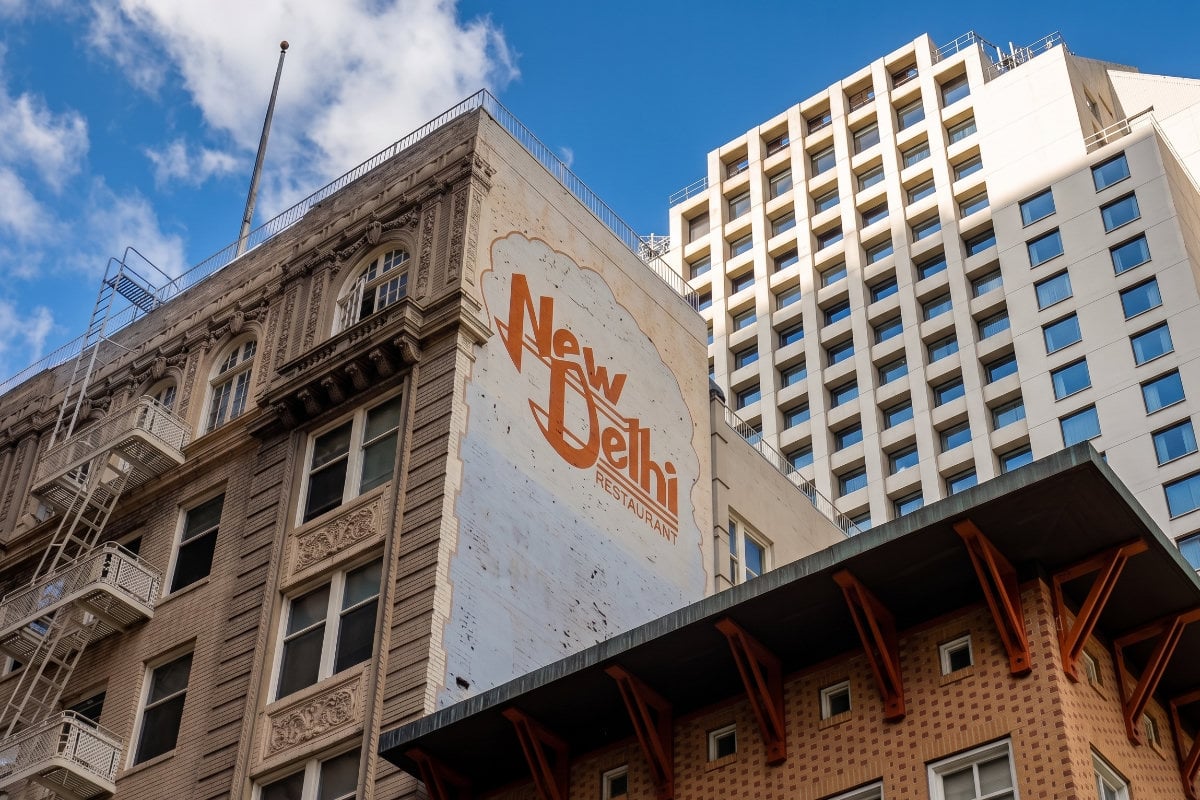
UPDATE — April 22, 2026: A reinspection conducted this morning by the SFDPH found conditions worse than those documented at initial closure two days ago. Ranjan Dey himself was present. The permit suspension continues. A new section at the bottom of this article details the full reinspection findings.
New Delhi Restaurant — San Francisco’s oldest Indian eatery and the city’s only Indian Legacy Business — has been ordered closed following a routine health inspection on April 20, 2026 by the San Francisco Department of Public Health. The closure comes just months after the 38-year-old Union Square institution received a prestigious $50,000 preservation grant and was featured in glowing national press.
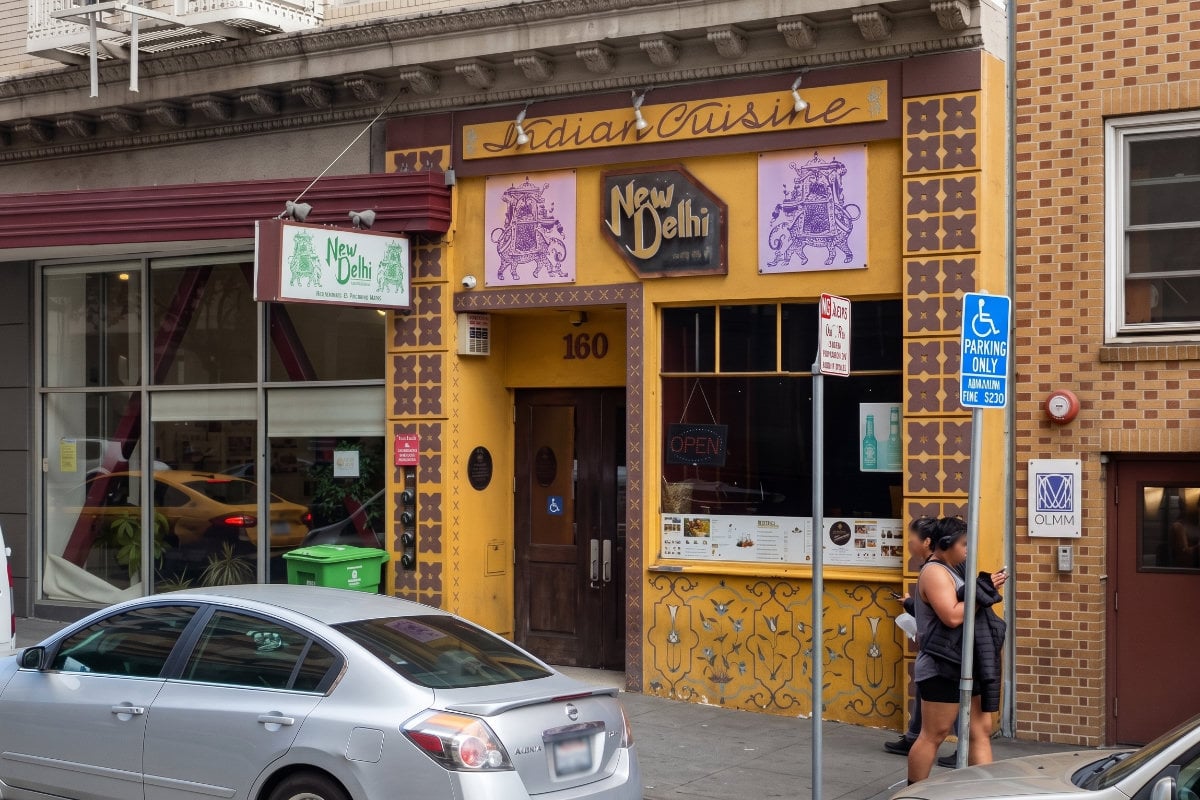
Source: Google Street View
What Inspectors Found
According to the official SFDPH inspection report, inspector Michael Mooney arrived at 160 Ellis Street on the afternoon of April 20 and documented a severe cockroach infestation throughout the kitchen. Live cockroaches were observed inside the dough mixer, on the ware-washing drying rack, and at the cook line; approximately 20 dead cockroaches were found on the floor near a handwashing sink. The person in charge told inspectors the facility had gone four weeks without pest control service.
The contamination extended into food-contact surfaces and sanitation equipment. The report noted a dead cockroach inside an inoperable soap dispenser, a dead cockroach in a sanitizer bucket that contained no actual sanitizer, and a dying cockroach inside a stock pot stored as clean. Inspectors also found a mold-like substance inside the ice machine. A can of Raid was discovered in the kitchen — a violation, as California regulations require all pesticide applications to be performed by a licensed professional.
Among the additional violations cited: hot water at the facility measured only 114°F at the time of inspection, falling short of the 120°F minimum required by the California Retail Food Code. Cockroach droppings were found behind kitchen wall paneling, at ceiling-level shelving above the cook line, and in cracks near door frames. The closure notice specifically references violations #23 (insects/vermin) and #14 (food contact surfaces: clean and sanitized) as the conditions warranting the immediate permit suspension.
The SFDPH posted a closure placard and ordered the facility to cease all food handling immediately. Before requesting a reinspection, the restaurant is required to submit documentation of professional pest control services to eliminate the cockroach infestation. Any live cockroaches observed upon reinspection will result in continuation of the permit suspension. Subsequent reinspections beyond the first are billed at $251 per hour, as reported by the San Francisco Department of Public Health.
A Legend in the Making — and in Jeopardy
The timing is striking. New Delhi Restaurant, founded by chef-owner Ranjan Dey in 1988, was designated an SF Heritage Legacy Business in 2020 — the only Indian restaurant in San Francisco to hold that distinction. The restaurant is housed in the ornate ballroom of the former Hotel Ramona, a Beaux Arts building constructed in 1914, two blocks from Union Square. As SFGATE reported last October, its white-tablecloth dining room — with exposed brick, ornate gold-tipped pillars, and portraits of Indian royalty — quickly gained national acclaim after opening, earning praise from the New York Times in 1990 for its “aristocratic setting.”
The celebrity roster over the decades reads like a who’s who of American public life. According to SFGATE, diners have included Steve Jobs, Bill Clinton, Nancy Pelosi, Dianne Feinstein, Anthony Hopkins, Deepak Chopra, Priyanka Chopra, and Julia Child. Dey has a signature ritual for each one: after a celebrity leaves, staff flip over their chair and write the guest’s name on the underside with a Sharpie marker. “There are so many chairs,” he told SFGATE. “This is like a little secret for us.” When the reporter visited last fall, Dey turned over his own chair to reveal Priyanka Chopra’s name on the bottom cushion.
As recently as February 2026, the restaurant was riding a wave of renewed national attention. According to 7×7, Dey was celebrating an upcoming memoir titled “Freakin Deylicious,” a potential Netflix documentary series, and the launch of SF’s inaugural Indian Restaurant Week. The restaurant had also been selected as one of only 50 eateries nationwide to receive a 2025 “Backing Historic Small Restaurants” grant, according to the National Trust for Historic Preservation — a $50,000 award from the National Trust and American Express, earmarked in part for updating the iconic facade mural by artist Kenneth Cook.
But the road leading here has been bruising. Just over a year ago, Hoodline covered New Delhi’s precarious finances, as Dey warned the restaurant could be forced to close permanently amid the persistent downtown slump. He told CBS News Bay Area at the time that he had drained his personal savings and taken loans to keep the lights on. To stay afloat, as SFGATE later reported, he cut staff and even borrowed against his life insurance. As SFist noted at the time, New Delhi responded by launching “Curry-Oke” karaoke nights and trimming back to dinner-only service. Dey later clarified to SFGATE that he never truly intended to close — but the scare was real, and the outpouring of community support that followed helped stabilize the business. The four-week gap in pest control service documented in Sunday’s inspection report raises pointed questions about whether the financial pressures of recent years left critical maintenance underfunded.
A Pattern of Cockroach Closures Across SF
New Delhi Restaurant’s situation is, unfortunately, part of a broader pattern in San Francisco. Cockroach infestations have been among the most frequently cited reasons for health permit suspensions in recent years. As reported by WhatNow, multiple SF establishments — including Lers Ros Thai and The Willows gastropub — received cockroach-related closure orders in March 2026 alone, though both were able to reopen after addressing violations within days. In August 2025, KTVU reported that two restaurants were shuttered in a single inspection sweep tied to cockroach activity. The SFDPH’s standard requirement — a licensed pest control report before any reinspection can proceed — means that the timeline to reopen depends entirely on how quickly the operator can contract professional services and demonstrate the infestation has been eliminated.
The severity of what inspectors described at New Delhi — live cockroaches in active food-preparation equipment, a dough machine with a roach laying eggs, droppings at multiple ceiling-level locations, and evidence of a larger roach species in a lower level of the facility — goes well beyond what most temporary closures involve. That said, it is worth noting, as the SFDPH standard disclosure states, that this report reflects conditions observed at a single point in time and does not necessarily represent the restaurant’s past or future compliance status.
What Comes Next
To reopen, the restaurant must eliminate the cockroach infestation using only approved, licensed pest control methods — including potentially ULV fogging with an insect growth regulator, crack-and-crevice treatment, and structural repairs to eliminate harborage areas, as outlined in the report. The facility must also deep-clean the kitchen to eliminate grease, sanitize all food-contact surfaces, and ensure hot water reaches the required 120°F minimum. A pest control report documenting completion of these steps must be submitted to the SFDPH before a reinspection can be scheduled.
Hoodline has reached out to New Delhi Restaurant and the SFDPH Environmental Health Branch for comment and will update this story if responses are received. The SFDPH inspector on the case, Michael Mooney, can be reached at [email protected] or (415) 252-3802. General inspection inquiries can be directed to the Environmental Health Branch at (415) 252-3800.
Update: Reinspection on April 22 — Closure Continues, Conditions Worse
Inspector Michael Mooney returned to 160 Ellis Street on the morning of April 22 — just two days after the initial closure — for a reinspection. This time, owner Ranjan Dey himself was present to receive the report. The findings document a situation that has not improved and, in several respects, had worsened since Monday’s inspection. The permit suspension was continued, with the notation that additional time is needed for cleaning and eliminating vermin before another reinspection will be considered.
The most alarming new finding involves direct food contamination. According to the reinspection report, a juvenile cockroach was found inside cooking oil stored on a prep surface, and what appeared to be cockroach pieces were found inside butter. Both items were voluntarily condemned and destroyed on-site. Cockroaches were also found inside prep top shelving, inside a microwave oven, inside a clean mixing bowl stored above the three-basin sink, and inside the tandoori oven — which contained at least 10 dead cockroaches across all life stages. The ice machine, flagged in the initial inspection, had still not been cleaned.
The reinspection documented live cockroaches at no fewer than eight distinct locations throughout the kitchen and prep areas, including: the door frame leading to the ice machine room; behind shelving above the handwashing sinks (1 adult); behind the cooling guide on a column at the end of the cook line (2); inside the microwave oven near the hinges (2 juveniles); inside the bead bar above the prep line where order tickets are placed (at least 4 adults); under the steam table near heaters (1 adult); between the steam table and the floor (1 juvenile); and on a clean pan stored at the steam table — including a nymph and a ruptured egg case. Dead cockroaches were additionally found in the cooking oil, in the clean mixing bowl, throughout the tandoori oven, and on a conduit next to the cook line. Cockroach eggs were found in a bubble of peeling paint behind a sink, and a juvenile was found on the backsplash of the ware-washing sinks. Heavy droppings were documented across shelving, under prep tables, along kitchen walls, on ceiling tiles, and in and around the ice machine room door frames.
A second critical discovery in the reinspection: two blocks of rodent poison — along with bread and bones — were found inside the tandoori oven’s access panel at the base of the unit. The person in charge indicated the oven is not currently in use. Regardless, use of unlicensed rodent bait inside a food facility is a violation of California Retail Food Code; all pest control applications must be administered by a licensed operator. This is the second time unlicensed pest control materials have been found at the restaurant — the initial inspection cited a can of Raid in the kitchen.
A heavy fly infestation was also newly documented throughout the bar area, with multiple flies in direct contact with the nozzle dispensing beverages — a direct contamination pathway to anything served from that system. The inspector also flagged a plumbing backflow issue: a water line in the bar that drains to the floor was found to lack a minimum one-inch air gap as required by code.
Perhaps most significant for the neighborhood is this note from the inspector at the close of the reinspection report: coordinated pest control with surrounding facilities is “highly recommended.” That language is not boilerplate — it signals that inspectors believe the infestation may extend beyond New Delhi’s walls and that neighboring businesses on Ellis Street should be aware and proactive. The permit suspension remains in effect. New Delhi Restaurant must contact Inspector Mooney directly when the facility is ready for a follow-up reinspection and no vermin will be observed.