
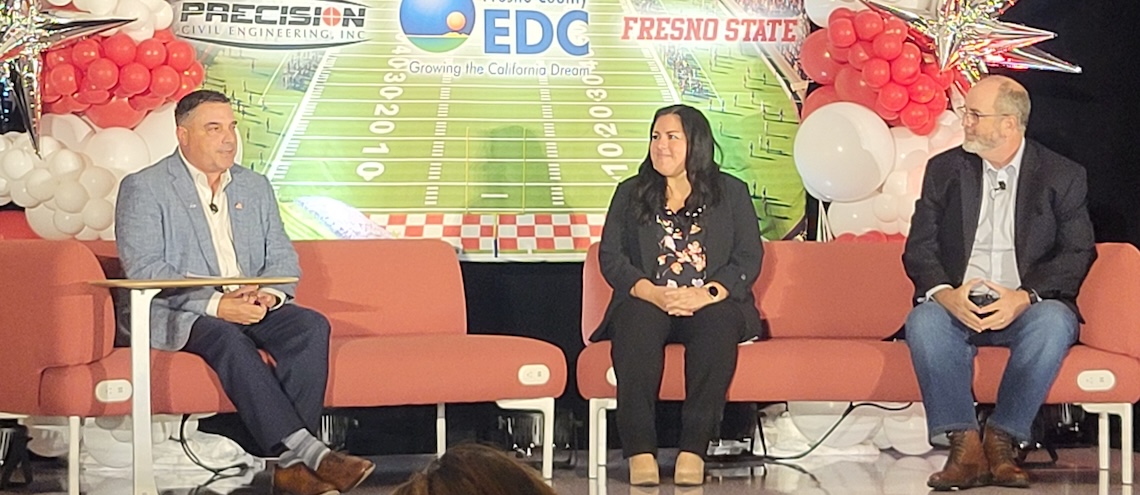
From left, Nick Audino of Newmark Pearson Commercial, Bonique Emerson of Precision Civil Engineering and Matthew Hargrove of the California Business Properties Association discuss real estate policy during the Fresno County Economic Development Corp. Real Estate Forecast on April 16, 2026. Photo by Gabriel Dillard
During the final panel of last week’s Real Estate Forecast, industry leaders took a look at how state policy, permitting timelines and regulatory uncertainty are shaping development across the state, while noting that Fresno and the Central Valley is somewhat of an outlier.
Nick Audino of Newmark Pearson Commercial moderated the two-person panel of Sacramento-based lobbyist Matthew Hargrove, president and CEO of the California Business Properties Association, and Bonique Emerson, vice president of Precision Civil Engineering’s planning division.
Sacramento’s maze
Hargrove described Sacramento as a minefield for developers due to the roughly 2,500 bills that are introduced yearly, with the commercial real estate industry tracking around 400 of them.
“We probably are tracking more pieces of legislation than any other single industry,” Hargrove said. The most common pain points include the California Environmental Quality Act, zoning, greenhouse gas regulations and taxation and fees.
He said many policies indirectly impact real estate. For example, climate goals could require all buildings to move away from natural gas by 2045, which could potentially force developers to rethink infrastructure.
Where are the cranes?
Transfer taxes also drew attention. In Los Angeles, a 5.5% tax — Measure ULA — layered on top of existing fees has slowed development activity, according to Hargrove.
“That’s just a haircut off the top on a project,” he said, pointing to the lack of construction cranes in Downtown Los Angeles compared to other major cities.
Industrial buffers
The panel also discussed Assembly Bill 98, which introduced industrial buffers of up to 900 feet from sensitive receptors such as homes. Audino said that in the Central Valley, where farmland and residential use usually sit near industrial areas, such rules can reduce usable land and compliance site planning.
Hargrove warned that a push toward housing development in areas not traditionally zoned for it — support by many — could put industrial development in conflict with new housing.
“You’re going to get an EJ (environmental justice) group or a neighborhood group or NIMBY group come in and say, ‘you know, we really don’t like that warehouse, and we’ve now got apartments here,” Hargrove said.
CEQA bottlenecks
Emerson spoke on CEQA being a major bottleneck in the entitlement process, which can take 18 months for even simple projects and up to four years for complex or contested developments.
She advocated for expanding ministerial approvals — projects permitted by right without discretionary review, to bypass the slog of environmental analysis.
“If you can bypass that huge hurdle, that saves tons of time — at least a year on most projects,” Emerson said.
Mixed-use opportunities
Despite some statewide challenges, Hargrove pointed to opportunities in mixed-use development, where recent legislation provides CEQA exemptions and other incentives when residential components are included.
However, he warned that new bills are already emerging to roll back those benefits.
Fresno: ‘The Beachhead’
Despite challenges and uncertainty, Audino said Fresno is still the place to be.
“The deal always follows the path of least resistance,” Audino said. “Fresno is where everyone wants to be. It’s the beachhead of the Central Valley. It has the biggest opportunity to grow in every single sector.”
Related story: Fresno Commercial Real Estate 2026: Hard truths — and don’t overdose on AI