
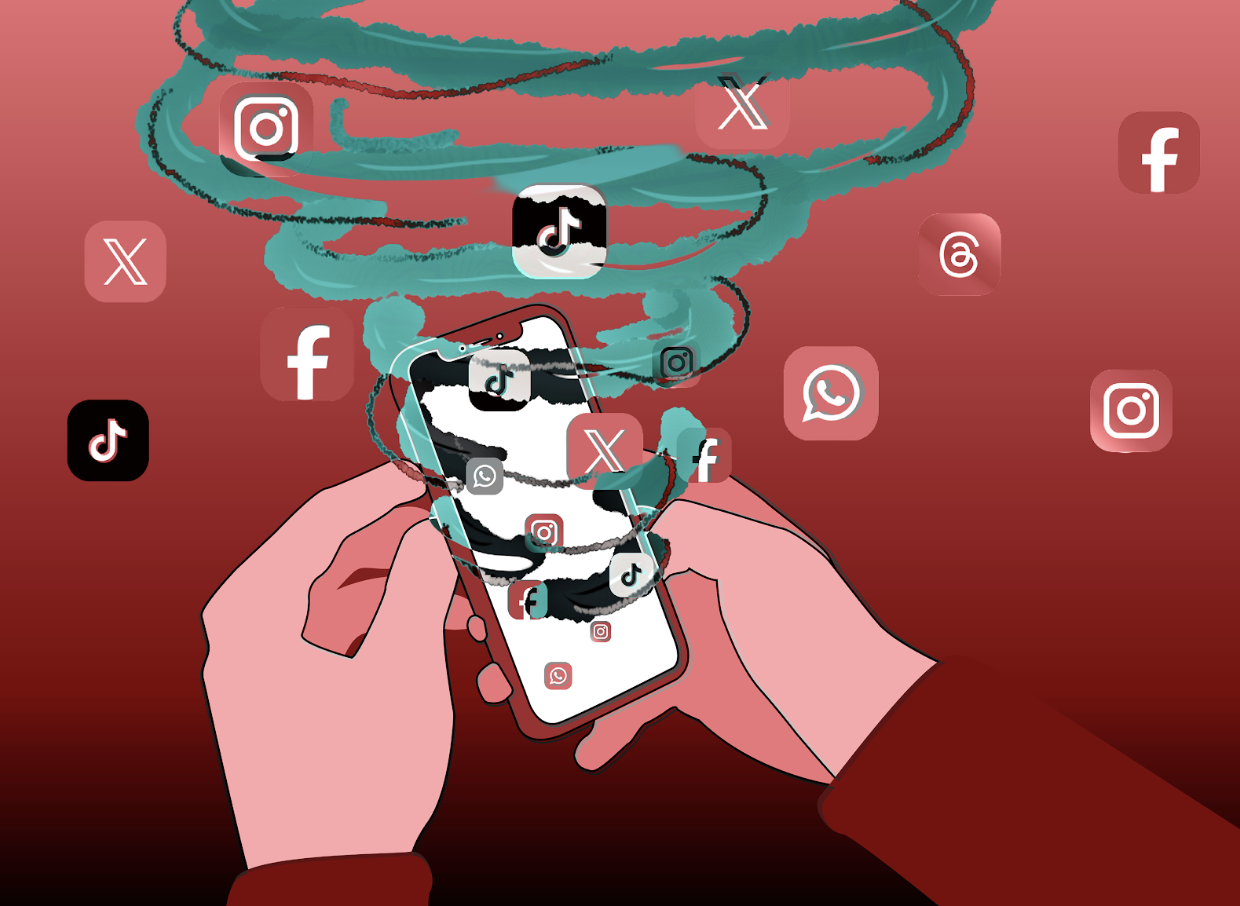
Between classes, workouts at the Aztec Recreation Center and late-night study sessions, many SDSU students stay updated on the world through a quick scroll on their phones. But while students constantly encounter news, that does not necessarily mean they understand the issues affecting their lives.
Across campus, students describe a similar pattern: News appears in their feeds constantly, but deeper engagement often stops at the headline. Some students avoid the news altogether, while others feel overwhelmed by how much information they encounter daily.
Nathian Rodriguez, Ph.D., a journalism and media studies professor at SDSU, said social media has fundamentally changed how students consume news.
“Students primarily rely on social media for their news,” Rodriguez said, noting that many of the sources students encounter are not always professional or vetted.
“For a lot of them, it’s the main — and sometimes the only — source they go to,” he added.
Rodriguez added that social media platforms prioritize short, attention-grabbing content that competes with entertainment, making it less likely for users to engage with in-depth reporting.
“Sometimes people see the headline, and that makes them aware, but they may not read it,” he said.
Rodriguez said there is a clear difference between being aware of an issue and actually understanding it.
“I think they’re aware of what is happening, but I’m not too sure I would say they’re informed,” he said.
He added that being informed requires more than exposure — it involves understanding the context and factual details behind a story.
For many students, news consumption is largely passive.
“I feel like social media is where I get most of my news, like TikTok and Instagram,” student Valerie Cole said. “It’s usually just when it pops up on my feed.”
Cole said that whether she engages with a story often depends on how interesting it appears at first glance.
“Sometimes I scroll past,” she said. “It depends on the headline.”
Researchers in psychology and information science define information overload as a state in which the amount of information exceeds an individual’s cognitive processing capacity, making it difficult to fully understand or evaluate what they are seeing.
That sense of overload is reflected across campus. Some students said the constant stream of information discourages them from engaging deeply — or at all.
“I kinda just see things. I don’t normally look,” said first-year student Kate Berwick.
Berwick added that while she encounters news most days, she often scrolls past it without reading.
Others said they feel only partially informed despite frequent exposure.
Even students who occasionally seek information acknowledge gaps in their understanding.
“I definitely could be more informed,” said third-year Dylan Vaniat.
Vaniat said he sometimes looks up topics after hearing about them from others, but does not consistently engage with news on his own.
“Sometimes I don’t have the energy to give it the attention I think it deserves,” he said.
This contrast highlights a growing divide on campus: students are not all engaging with news in the same way, even if they are exposed to it at similar levels.
Despite these differences, students largely agreed on one point: Scrolling is not the same as understanding.
A report from the Pew Research Center found that many users encounter news incidentally on social media and often engage only briefly rather than seeking out full articles or deeper context.
Scholars in psychology and media studies refer to this behavior as doomscrolling, the repeated consumption of negative information through social media feeds—a habit that research has linked to increased psychological distress. A study published in the International Journal of Environmental Research and Public Health found that frequent doomscrolling is associated with higher levels of anxiety, depression and lower overall well-being among heavy social media users
Rodriguez said doomscrolling often occurs when users try to learn more about a topic but remain within social media feeds instead of turning to full articles or verified sources.
“It’s very easy to go from one video to another,” he said. “That’s different from stopping and actually reading a full article.”