
By Michelle Edgar
In a neighborhood often defined by its challenges, a different story is taking shape with the unveiling of a mural honoring unity, immigrant contributions, and the unseen work that sustains Los Angeles. On Thursday, LA Commons unveiled a new mural in MacArthur Park titled “Roots of our Labor” at the UCLA James Lawson Jr. Worker Justice Center, a project that goes beyond public art to reclaim the story of a community through the people who live and work within it.
Led by LA Commons — a non-profit organization — the project reflects more than two decades of sustained investment in MacArthur Park, where LA Commons has been producing public art projects since 2003, returning year after year to center community voice through creative expression.
Over the course of a year, youth artists worked alongside project leaders to develop questions and conduct more than 75 interviews with people across MacArthur Park, from street vendors and families to soccer players, day laborers, and small business workers whose daily presence defines the neighborhood. Those conversations became the foundation of the mural.
“What people shared wasn’t just what they see here, but what they value, what they carry, and what this place means to them – that’s what guided the work,” said artist Shakir Manners, a Leimert Park-based muralist and journalist. “Murals are one of the most democratic forms of art, When they’re rooted in community, they reflect people back to themselves.”
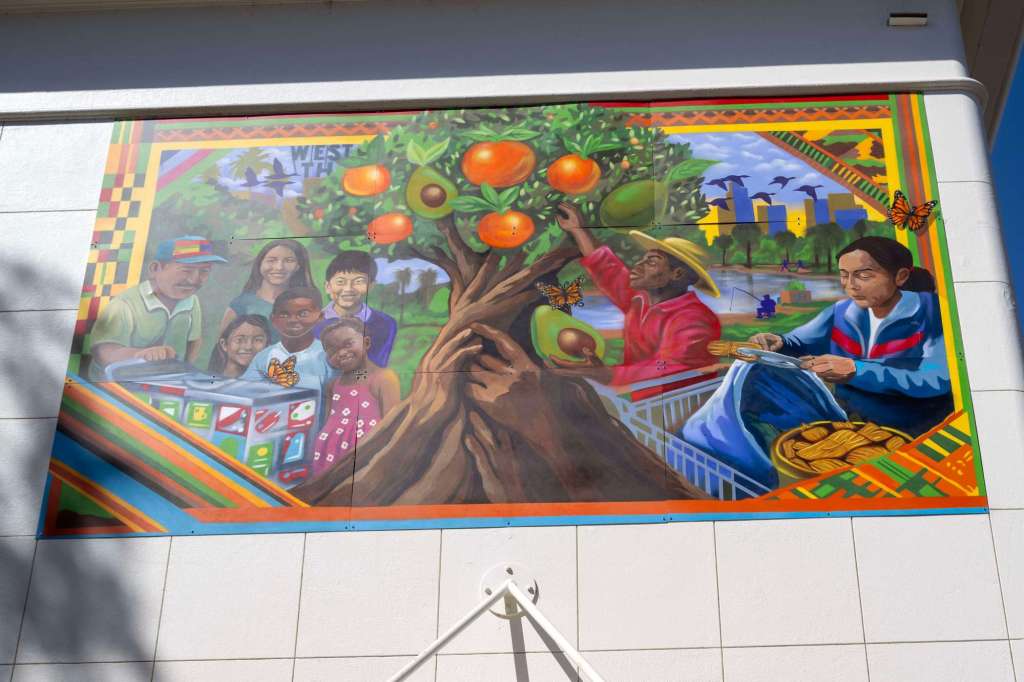
Created by Manners and co-lead artist Luis Mateo, alongside 20 youth artists, the mural is both a visual statement and a social document. At its center is the word “Unity,” surrounded by hands emerging from the earth, cultivating fruit, including avocados and oranges, symbolizing how collective labor sustains both community and city.
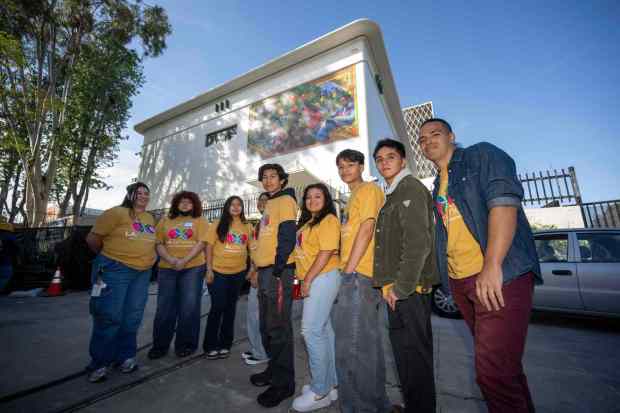 Youth artists with the mural they helped create on the outside of the UCLA James Lawson Jr. Worker Justice Center in Los Angeles on Thursday, April 23, 2026. (Photo by Hans Gutknecht, Los Angeles Daily News/SCNG)
The imagery honors a wide spectrum of workers, from street vendors and farm workers to factory employees and rideshare drivers, many of whom are foundational to Los Angeles but often go unseen. “Unity is not simply an ideal, it’s something that has to be built,” Manners said. “Planting, cultivating, and harvesting reflects how collective effort creates opportunity that can be passed on, especially to the next generation.”
A multi-cultural border representing African, Hispanic, and Indigenous communities reinforces the message that while backgrounds may differ, the community is interconnected. Children are woven throughout the mural, completing what Manners describes as a full circle narrative, where the fruits of labor return to the next generation.
For LA Commons, this mural arrives at a particularly important time. MacArthur Park is home to a diverse population of immigrants from across the world, many of whom have helped build Los Angeles, yet are navigating a period marked by fear, uncertainty, and division. This project is designed as an affirmation at a time when the neighborhood is often reduced to headlines. It honors the essential workers and everyday individuals whose contributions often go unseen, but whose work keeps the neighborhood, and the city, vital and alive.
Beyond its visual impact, Roots of Our Labor reflects a broader model for how public art can be built and sustained. The project was made possible through a coalition of partners, including LA Commons, the UCLA Labor Center, MacArthur Park Recreation Center, Koreatown Youth and Community Center, Homies Unidos, MAC LA, and CARECEN, alongside support from California’s Stop the Hate initiative — a statewide effort focused on addressing hate incidents and building cross cultural understanding. Together, these partners supported not only the mural, but a series of workshops, story gathering sessions, and community driven art activations.
“Public private partnerships are what make projects like this possible,” Manners said. “LA Commons and the UCLA Labor Center created the platform, the funding, and the support so artists and young people could actually do this work in a real way.”
Equally important, he noted, is that both artists and youth participants were compensated, reinforcing the idea that creative work is not only valuable, but viable. “Too often artists are asked to give their work away,” Manners said. “When you invest in artists and young people, you’re investing in the future of the community itself.”
Beth Peterson, Community Arts Program Director at LA Commons, said, “During this trying time, there is so much beauty, creativity, and care in MacArthur Park that often goes unrecognized. Through this work, we’re honoring the stories, relationships, and everyday moments that bring this community to life. This mural is not just a reflection of the neighborhood, it’s a collaboration shaped by the voices of residents, youth, and artists who continue to lift up the people and hope in this area.”
The unveiling marks the second Stop the Hate funded mural in the area, following a project installed roughly a year and a half ago at MacArthur Park Elementary School, continuing a sustained commitment to the neighborhood. It also coincides with the reopening of the UCLA James Lawson Jr. Worker Justice Center, a site with more than 60 years of history tied to labor and immigrant rights organizing. “It acts as a symbol of strength and solidarity, centering the voices that matter and uplifting the community,” said Saba Waheed, director of the UCLA Labor Center.
For those involved, success will not be defined by the unveiling alone, but by whether the mural becomes a lasting reflection of the community it represents, something residents recognize as their own. In a city increasingly focused on how it rebuilds, reconnects, and prepares for the world stage, Roots of Our Labor offers a clear reminder that the future of Los Angeles will not be shaped solely by what is built, but by whose stories are seen.