
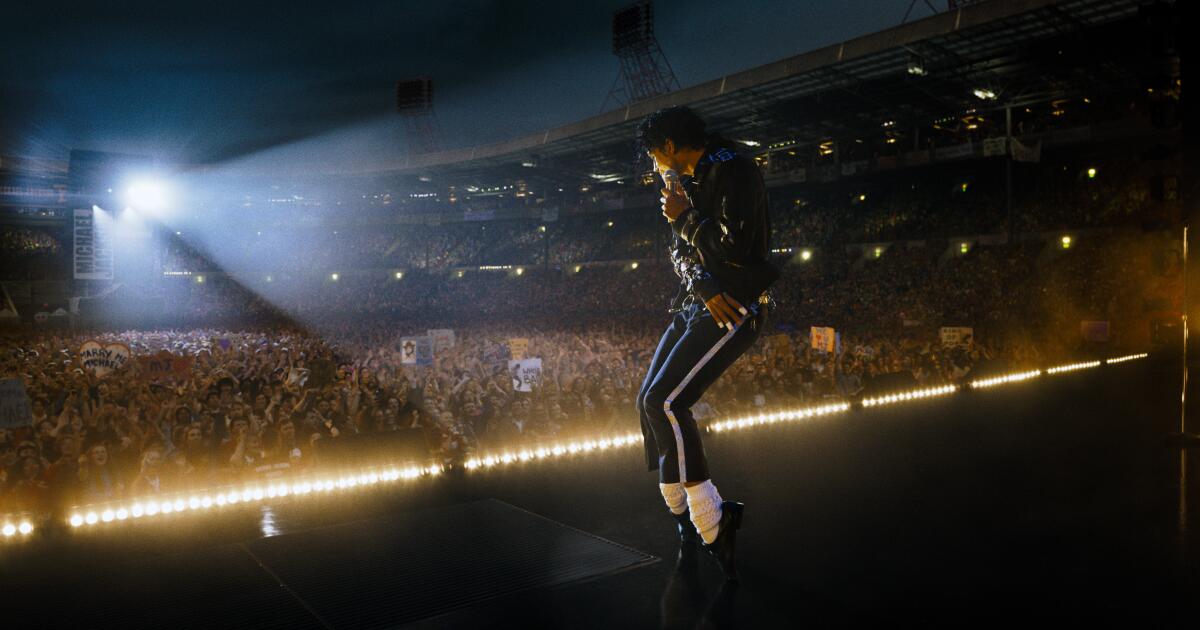
Lionsgate’s “Michael” is on track to unseat “Straight Outta Compton” as the king of musical biopics.
Early returns suggest the Antoine Fuqua-directed film will surpass the $60-million opening weekend box office record set by the N.W.A biopic in 2015, with the studio expecting an opening that could reach $70 million.
“Michael Jackson is one of the most influential artists in human history. His impact on music, fashion, dance, film and business has withstood the test of time,” said Adam Fogelson, the chair of the Lionsgate Motion Picture Group.
“All of those things together seem to have created a profound response from audiences of all ages,” he added.
“Michael,” starring the legendary pop star’s nephew Jaafar Jackson, hits 3,900 screens nationwide on Friday.
The film marks the first time the story of Michael Jackson’s life and career are back in movie theaters since 2009’s “This Is It.” That posthumous documentary followed the rehearsals for his London residency, which was canceled after he died, just 18 days before the first of 50 scheduled shows.
That film remains the highest-grossing documentary of all time with nearly $270 million in global ticket sales.
The stakes may be higher for “Michael,” not just because of its roughly $200-million cost, but also its circuitous journey to the big screen.
Early development on the motion picture began in 2019, but frequent changes — both in the storyline and production — forced delays. The original idea was to encapsulate Jackson’s life from childhood fame with the Jackson 5 to his solo commercial peak during the ’80s and end with the child sex abuse allegations he faced in 1993.
That version of the film was well underway when the production was forced to go back to the drawing board due to a legal issue. The Jackson estate, which is in support of the project, reportedly discovered the early draft of “Michael” violated a $15-million settlement with the accuser in that case. Part of the agreement stipulated that the alleged victim would never be pictured or mentioned in a dramatization of Jackson’s life.
Production reconvened for 22 additional days and the Jackson estate took on tens of millions of dollars in additional reshoot costs.
The current version of “Michael,” hitting theaters this weekend, is set between the 1960s and 1988. It closely follows the controlling relationship between Jackson and his father, Joe Jackson, played by Colman Domingo, and tracks the king of pop’s peak stardom. Janet Jackson is notably absent from the storyline.
Depending on how the movie performs, there are plans for a potential sequel. The follow-up would tell the second half of Jackson’s career, where much of the scrapped footage could be used. Lionsgate has done advanced work to ensure that a significant amount of the previously captured footage could be included.
So far, the movie is receiving mixed reviews. As of Friday morning, the critic’s consensus on Rotten Tomatoes was less than favorable, with a score of 40%. But Lionsgate remains confident the film will resonate positively with average moviegoers and Jackson fans, both domestically and globally.
“The audiences that are now starting to watch the movie in early previews have been euphoric,” Fogelson said. “Audiences are speaking loudly and clearly about how much they appreciate the final product.”
Even outside of theaters, Jackson’s story continues to find success. “MJ,” the jukebox musical based on his life, is in its fourth year on Broadway and has had both national and international showings. Michael Jackon’s estate has also collaborated with Cirque du Soleil for several acrobatic productions since 2011. The “Michael Jackson ONE” show, which first premiered in 2013, recently extended its run on the Las Vegas Strip until 2030.
Tiffany Naiman, the director of music industry programs at UCLA, said the sustained interest in the pop icon speaks to his loyal fan base and place in American cultural history.
“He represents not only extraordinary artistic achievement, but also the contradictions of fame at its most amplified,” Naiman said in a statement. “That tension — between brilliance and controversy, innovation and scrutiny — is precisely what continues to draw audiences back, and what will likely shape both the film’s reception and its broader cultural impact.”