
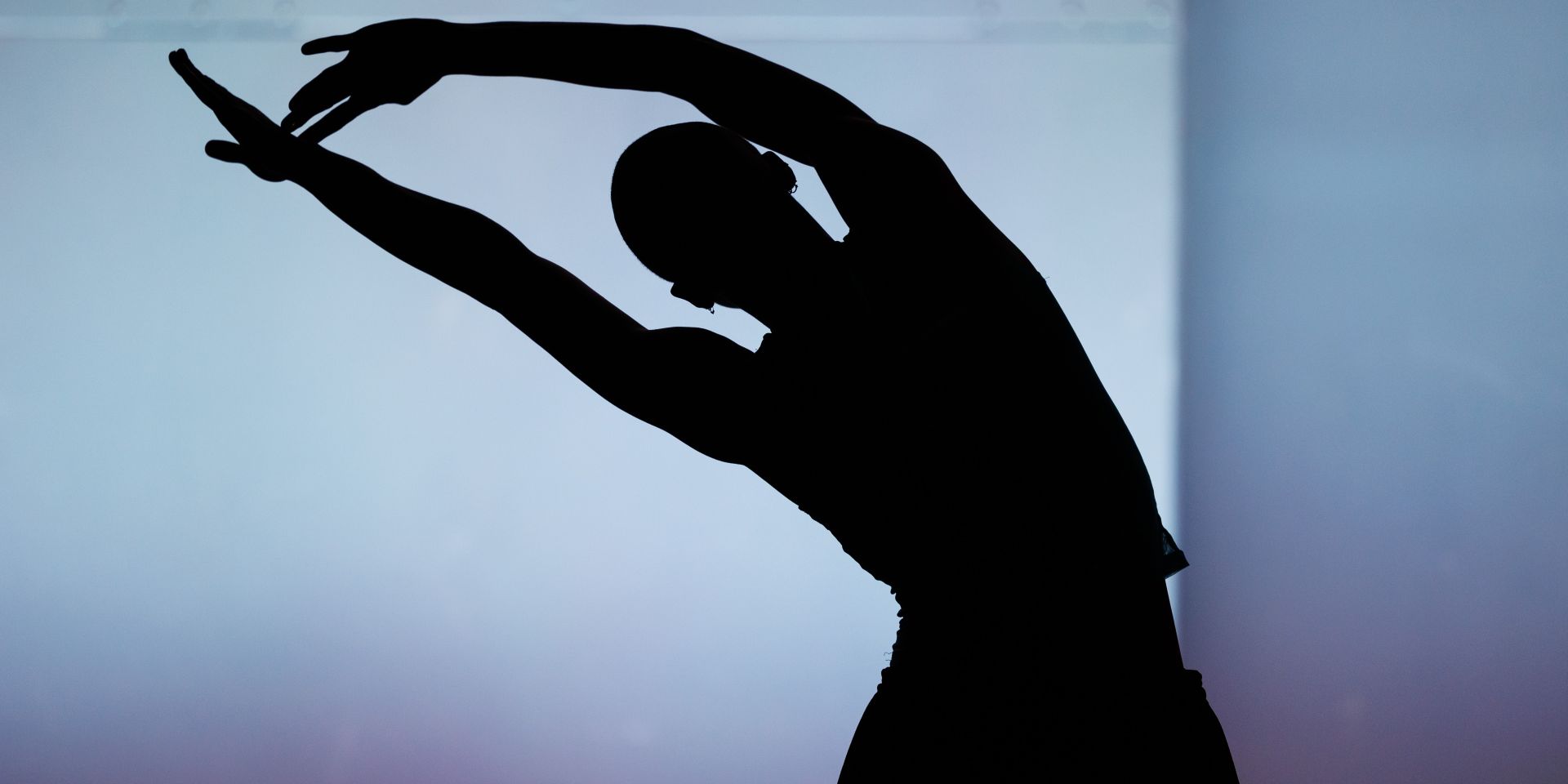
I’ve never felt more human than when I’m touching my own skin. I’m reminded of the flesh, blood and nerves that make touch tender and real. Kalliope Piersol inhales sharply before moving through a movement phrase with precision. Despite her intention, she feels each step deeply, as if moving through them for the first time. She pauses, rubbing the palm of her hand against the top of her other arm and hand. A look crosses her face, one that acknowledges the sensation. It is a reminder that she is human.

“Open Machine” by Rashaun Mitchell and Silas Riener – Photo by Angel Origgi, courtesy of REDCAT.
Artificial Intelligence is a hot topic that tends to surface to the top of the news cycle every day. Most discussions focus on its ethics, whether it is appropriate to use it at work, or how it is affecting our retention of information. In Rashaun Mitchell + Silas Riener’s “Open Machine,” which made its LA premiere at REDCAT on April 17, 2026, the choreographic duo flips the script. Rather than unpacking what it means for humans to be reliant on automated technology, the work questions what it would look like if technology were reliant on humans. The work frames the body in a series of seemingly robotic tasks. The movement is exact, with some wiggle room to problem-solve as AI might. As “Open Machine” seeks to view technology through experimental dance, it reveals the intricacies of humanity that prove no machine is as complex as the body.

“Open Machine” by Rashaun Mitchell and Silas Riener – Photo by Angel Origgi, courtesy of REDCAT.
The piece begins mechanically. The ensemble of dancers (Morgan Amirah Burns, Savannah Gaillard, Jennifer Gonzalez, Michael Greenberg, Claude CJ Johnson, Catherin Kirk, Cori Kresge and Piersol) break out of a line and cycle through movement motifs. Greenberg shuffles to the side, shifting from heel to toe and shimmying. Kresge takes deep strides with arms following the momentum. The work is an amalgamation of the performers’ own styles and personalities, as they contributed to the creation of the work, with Mitchell and Riener serving as the directors.

“Open Machine” by Rashaun Mitchell and Silas Riener – Photo by Angel Origgi, courtesy of REDCAT.
The space is open and available for their exploration while three large screens hang above them. On the screens, a program takes in the dancer’s movement and speech to create body-mapped projections and written speech-to-text. The program may misinterpret words and bodies, meshing two bodies into one. The inaccuracies blur the lines between expectation and reality.
When three dancers move in a triangle, they state things about the others in the triad that seem obvious, but the dialogue that ensues reflects similar patterns to technology. “Catherine is not a sandcastle,” one dancer says. “Cori is not a soap dispenser,” another dancer says. This pattern is interrupted with, “Are you sure?” In one moment, they remark that Kirk is barefoot. She clearly is. A dancer asks, “Are you sure?” It’s comical. I’m reminded of CAPTCHA quizzes asking which photos contain a car. Technology’s constant verification feels rudimentary compared to something we can identify in seconds with our own eyes. The gap between human and machine widens.

“Open Machine” by Rashaun Mitchell and Silas Riener – Photo by Angel Origgi, courtesy of REDCAT.
The work evolves with the dancers giving each other instructions in pairs. Johnson instructs Greenberg to make a table. Wrangling in fellow performers, they clump to the middle and balance on one another. It isn’t quite a table, but it doesn’t matter. The audience can imagine how this human structure can represent a table. This comes up again in the work’s finale. Mitchell, Riener and media designer Jesse Stiles use AI imagery on the screens that alters a live video of the stage. As the dancers speak, the words captured become inputs for the imagery. A dancer may say, “book,” and the video projection of the stage evolves into bookshelves. The image is constantly moving, outputting something new every second. Dancers clump in the middle again, and in the AI imagery, the table returns. The technology’s interpretation, however, is more literal.

“Open Machine” by Rashaun Mitchell and Silas Riener – Photo by Angel Origgi, courtesy of REDCAT.
“Open Machine” bridges the thought processes of the human brain with the algorithms of AI. There’s an uncanny connection that surfaces. The truth is constantly under debate. You begin to question whether you heard one of the performers correctly or if the speech-to-text is more accurate. Is Kirk really barefoot? Watching, I become part of the machine seeking constant verification that my eyes aren’t deceiving me. Mitchell and Riener’s creation smartly manipulates our expectations. Their curation of the work eases the viewer into the tensions between humanity and technology, without being heavy-handed on the technical side. They let the story unfold with the senses.

“Open Machine” by Rashaun Mitchell and Silas Riener – Photo by Angel Origgi, courtesy of REDCAT.
Piersol, along with a few other dancers, takes the stage one by one. In solitude, with the screens frozen on a single distorted image, all attention is on the human body. Their details are highlighted, including facial expressions and deep breaths. The performers’ emotions are palpable. They offer profound ripples in the mechanical motif that had been explored up to this moment. A voiceover shares what it means to be human. Just like technology, there are inaccuracies, but we, as humans, feel them. We feel confusion, frustration, happiness, sadness, confidence, and everything in between. As the dancers finally reach a moment of stillness, returning to the same positions they started the piece in, the screens become obsolete in the presence of the human body.
To see what else is appearing at REDCAT, please visit their website.
Written by Steven Vargas for LA Dance Chronicle.
Featured image: Open Machine by Rashaun Mitchell and Silas Riener – Photo by Angel Origgi, courtesy of REDCAT.
Please follow us on Facebook, Instagram, BlueSky, and LinkedIn.