
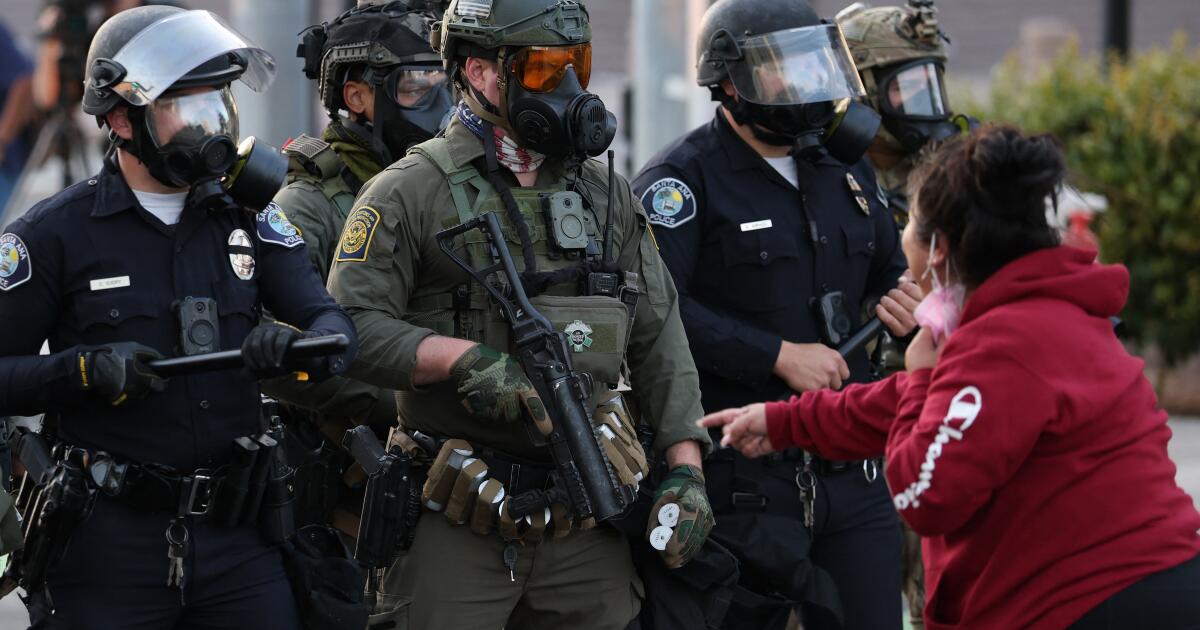
With the smoke long having cleared from tear gas canisters fired on anti-ICE protests last June, the Santa Ana Police Department offered a public review of its enforcement actions.
Spurred by masked federal agents carrying out immigration sweeps in Santa Ana, four protests swelled the city’s streets between June 9 and June 14.
According to a report submitted on Tuesday by Santa Ana Police Chief Robert Rodriguez, his department fired more than 200 less-lethal 40mm projectiles, about 60 bean bags and 35 chemical agent munitions during the protests.
Twenty-seven protesters were arrested, including four felony arrests. Five arrestees reported injuries. Three Santa Ana police officers and seven assisting officers from outside agencies also reported injuries.
The police response, which protesters flooded council chambers last year to denounce, cost the city nearly $400,000.
From the onset, Rodriguez acknowledged at the April 22 Santa Ana City Council meeting that the high-level review was limited in scope due to pending civil litigation and internal affairs investigations.
“The department is constrained in the level of detail we can provide at this time,” he said. “These limitations are necessary to preserve the integrity of the investigative process, ensure compliance with applicable laws, including personnel confidentiality, but more importantly, to protect the city’s legal position.”
In addition to one lawsuit, Santa Ana has received four tort claims that could turn into lawsuits.
Councilmembers Jessie Lopez, Johnathan Ryan Hernandez and Ben Vazquez were on scene at the June 9 protest, which began with demonstrators gathering outside of the U.S. Citizenship and Immigration Services federal building in downtown Santa Ana before Santa Ana PD declared an unlawful assembly around 8:30 p.m.
Rodriguez acknowledged that Santa Ana PD responded to the federal building at the request of the U.S. Attorney’s Office, a detail City Atty. Sonia Carvalho expanded on later in the council meeting.
She recounted being told on the second of two phone calls that if Santa Ana PD did not provide security, federal resources would be brought in.
“We had a discussion about what that might look like in terms of safety for our community and what that would mean to people in our community,” Carvalho said. “A decision was made at that point.”
President Donald Trump ultimately deployed the National Guard to downtown Santa Ana the day after the June 9 protest.
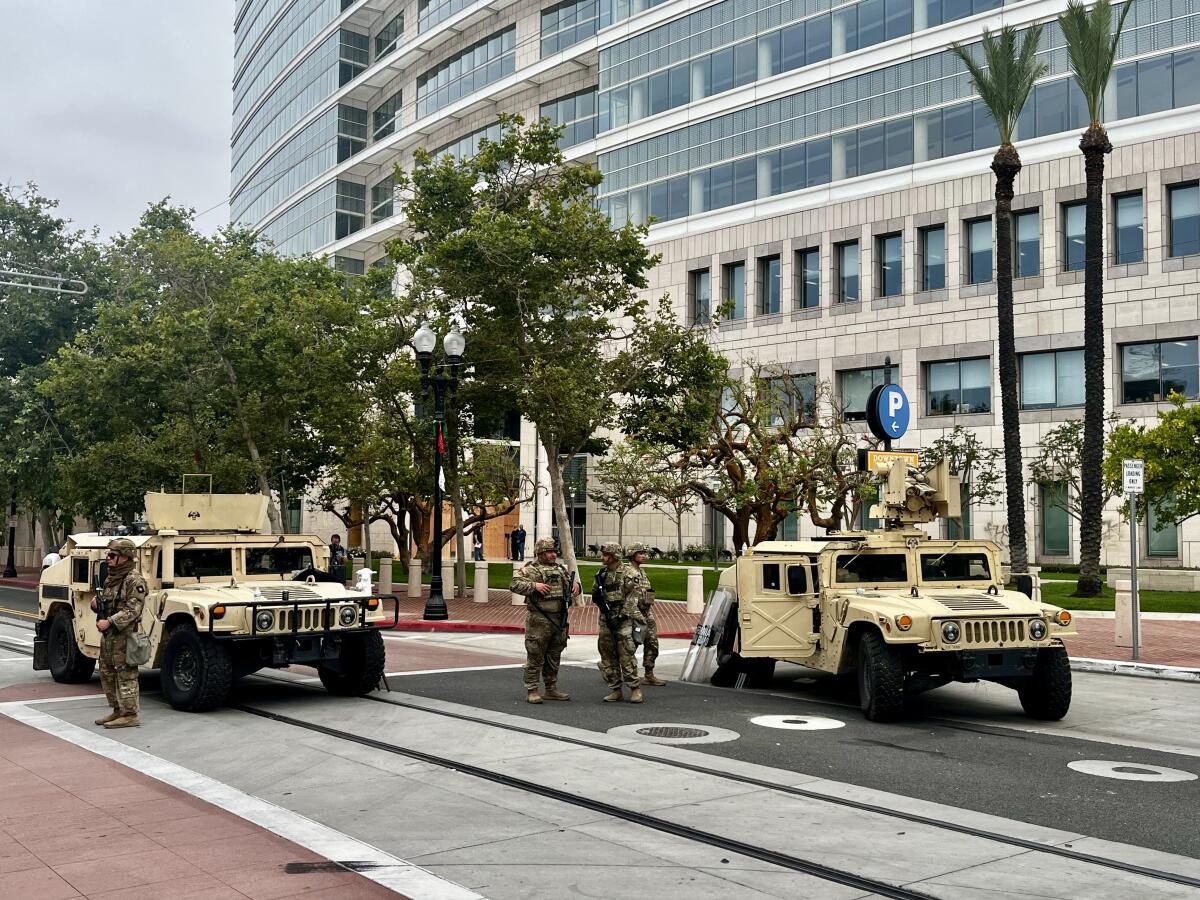
National Guardsmen stationed in front of the Ronald Reagan Federal Building and U.S. Courthouse in Santa Ana last year.
(Gabriel San Román)
Cmdr. Jorge Lopez, who presented the report to council, said Santa Ana PD did not fire chemical agents into the crowd during the daytime protest, but did use such munitions later at night.
Councilmember Jessie Lopez asked tough questions about a “line of control” formed by Santa Ana police officers during the protest.
“I’m trying to understand what … level of threat … you perceived from people like myself that were there that day in order for them to move forward towards us,” she asked.
Rodriguez responded that his department tried to create distance between the community and federal officers — a move aimed at ensuring public safety.
“Whose public safety are we centering if you’re coming towards the crowd and you’re creating a line to protect the other agents?” Lopez asked.
Rodriguez argued that if his department didn’t respond to the call, the federal government would have sent another law enforcement agency to take over the scene.
“It’s also for the safety of our community,” he said, “because if they’re in middle of an engagement with federal officers, the best thing is distance.”
He recounted an incident earlier this year where Santa Ana PD was not on scene at a federal building protest and a protester lost an eye after a federal agent fired a projectile from a few feet away.
Hernandez, who said eight pepper balls struck him in the earlier fray, posed a number of critical questions.
“Do we have a de-escalation policy?” he asked. “I looked at our policies and I didn’t see a section on de-escalation, but de-escalation is listed here as the first bullet point. I’d like to know, what are these officers referencing in terms of de-escalation?”
Hernandez then asked why no evidence showed protesters throwing water bottles or bricks at law enforcement.
Rodriguez said that officers de-escalate based on a threshold of what actions protesters engage in.
A presentation by Cmdr. Jorge Lopez included video of a person doing burnouts on a mini bike while another man climbed a traffic light pole. The video was labeled “Freedom of Speech?”
Rodriguez held back on showing any more evidence to council.
“We have plenty of videos of actual law violations that we also didn’t include, also because of … ongoing civil litigation,” he said. “Our officers take into consideration the totality of the circumstances [and] public safety also.”
Vazquez wound the discussion down by asking the chief if the department could learn any lessons from the extraordinary circumstances Santa Ana faced last June — a question Carvalho urged caution in responding to, as the city faces a litigation.
“We can always look at what we did [well], what we could have done better, and what we did wrong,” Rodriguez said generally of policing. “We’ll evaluate once all these processes have been completed and I’m sure there will be some takeaways.”