
Six decades after the Free Speech Movement erupted at UC Berkeley in protest of university-imposed restrictions on political speech and student activism on campus, the Trump administration’s crackdown on the independence of the nation’s higher education system has again thrust First Amendment questions into the limelight.
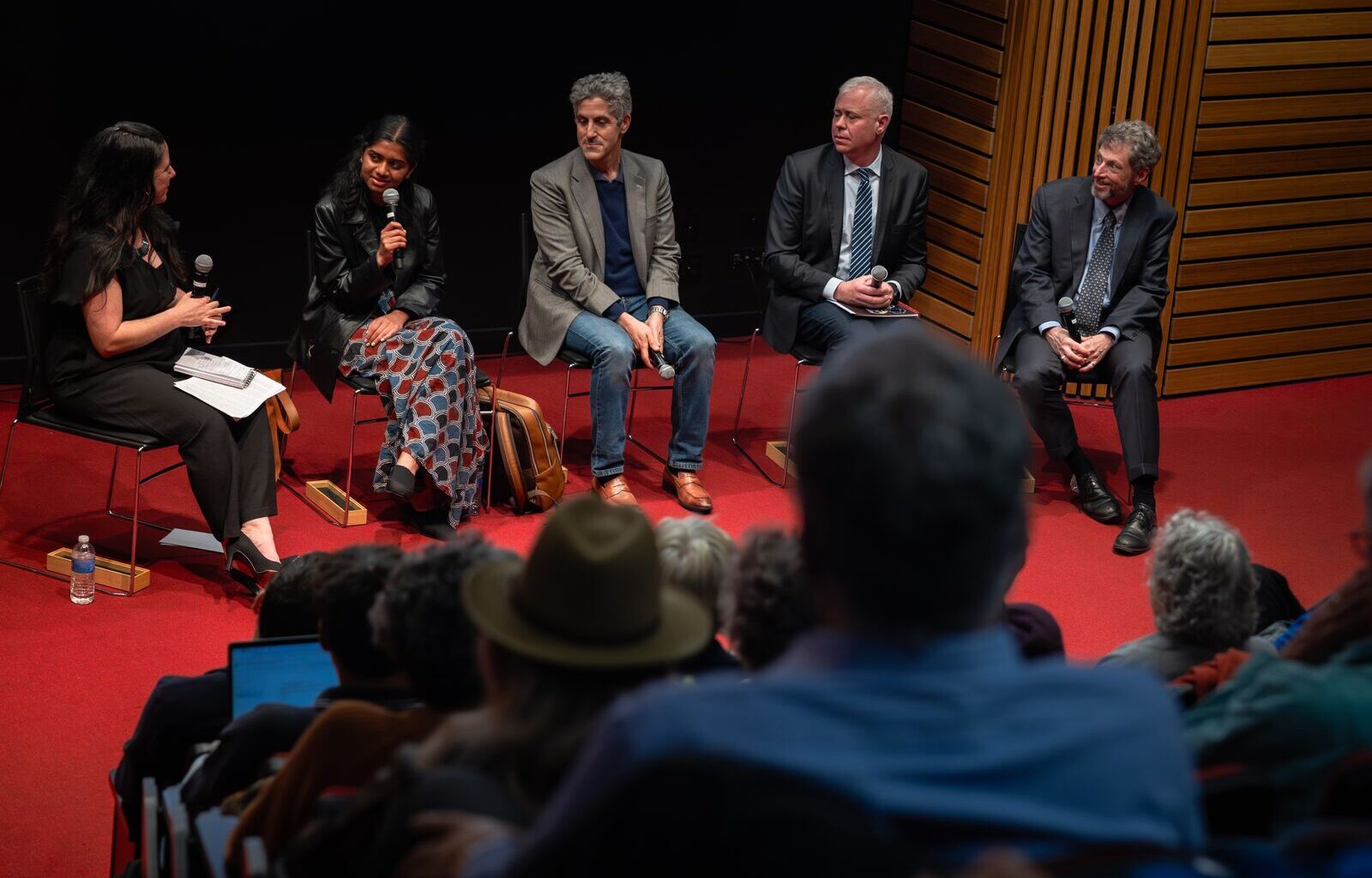
Last week, the state of free speech and academic freedom at UC Berkeley was fiercely debated in a panel discussion Berkeleyside hosted between Ananya Rupanagunta, editor-in-chief of the Daily Californian student newspaper; Benjamin Hermalin, Cal’s provost; and a pair of professors — Chris Hoofnagle, a law professor and secretary of the Berkeley Initiative for the Freedom of Inquiry, and Ussama Makdisi, a history professor and inaugural chair of Cal’s program in Palestinian and Arab Studies, who came under fire from Congressional Republicans last summer during a Capitol Hill grilling of Chancellor Rich Lyons over antisemitism.
About 100 people — including many old enough to have lived through the free speech battles of the 1960s — attended the 90-minute April 14 talk at the Brower Center in downtown Berkeley, moderated by Berkeleyside higher education reporter Felicia Mello.
Watch the 90-minute panel discussion on our YouTube channel. Video: Jason Maze/Maze Productions. Thumbnail photo: Richard H. Grant for Berkeleyside.
Universities have been under intense scrutiny by the federal government since President Donald Trump’s return to power last January. The administration has threatened and followed through on freezing billions in federal contracts and research grants to schools that the president deems ideologically unaligned. The ongoing federal crackdown on immigration has spread fear among international students and scholars. And a federal taskforce was created to investigate claims of antisemitism and hate speech on college campuses, singling out individuals and groups espousing pro-Palestinian views. UC Berkeley alone has been investigated over half a dozen times by the administration and congressional Republicans since 2024, and lost out on at least $50 million in federal research grants.
“This is not an abstract discussion,” Mello said in her opening remarks. “Within the United States, the basic norms of democracy and rule of law are increasingly under attack. At the same time, we have a federal government that has shown interest in applying pressure on universities to comply with its political vision.”
It’s a climate in which UC Berkeley’s leaders have had to walk a fine line. Lyons has affirmed the university’s commitment to free speech, while also condemning antisemitism on campus. In March, the school reached a $1 million settlement with a Jewish legal advocacy group over complaints that law student organizations were excluding Zionist speakers and a protest had stopped a pro-Israel speaker from addressing students.
At times, the university’s response to the political moment has been met with concern by members of the public and campus community who view the institution’s actions as acquiescing to the Trump administration.
In September, university officials acting at the behest of the UC Office of the President handed over names and personal information of 160 students, faculty members and staff to the federal government, in response to its probe into antisemitism on campus. Several months later, the school suspended a computer science lecturer named Peyrin Kao, who’d staged a hunger strike to protest the war in Gaza, after some students complained he’d expressed his political views in the classroom. A student multicultural center was abruptly closed in November 2025, with university officials later citing complaints about pro-Palestinian signs; the space was allowed to reopen in February after strong student outcry but all political art was stripped from the walls and new restrictions imposed on hosting events. And UC Berkeley was among 31 colleges to recently cut ties with a nonprofit focused on increasing faculty diversity in business schools, after the organization was investigated by the U.S. Department of Education.
UC Berkeley gets mixed reviews on its handling of free speech issues
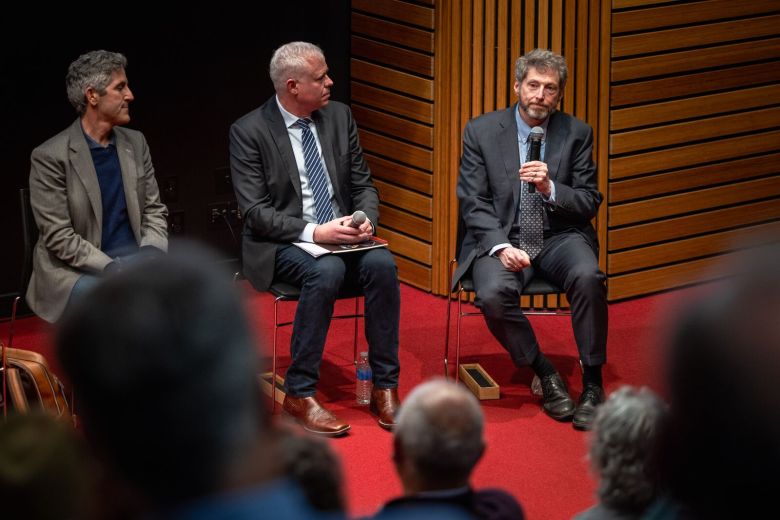 Makdisi and Hoofnagle listen to Hermalin during the panel. Hermalin said Cal has been “working very hard to defend academic freedom and free speech,” but has failed to convince the community. Credit: Richard H. Grant for Berkeleyside
Mello began the discussion by asking each panelist to give the university a letter grade for the job it’s done promoting the values of academic freedom and free speech over the past year, beginning with Hermalin. The provost gave the school an “A minus.”
“We’ve been really working very hard to defend academic freedom and free speech,” he said. “But where I think we have failed to do it perfectly is we have not convinced our constituents that we’re doing it. We have not provided them that kind of confidence that we are out there protecting free speech and academic freedom.”
Hoofnagle also gave UC Berkeley a high mark, and lauded the institution’s “deep free speech and academic culture.” But the law professor said he worries about an anonymous complaint system that he believes is being weaponized, and bemoaned what he referred to as the “heckler’s veto” to shut down dialogue on campus.
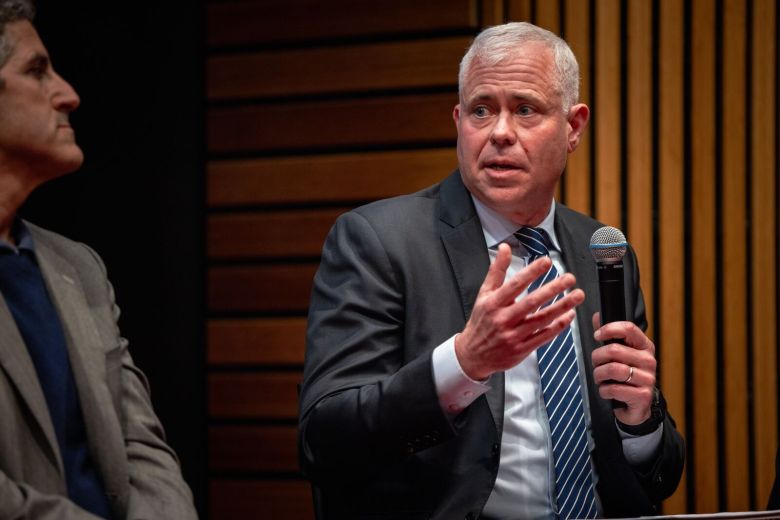 Hoofnagle bemoaned what he referred to as the “heckler’s veto” to shut down dialogue on campus. Credit: Richard H. Grant for Berkeleyside
“We’ve had a number of incidents, despite taking many precautions,” he said. “Situations where people have been shouted down by intolerant people. And it tends to be a certain type of speaker who’s shouting down.”
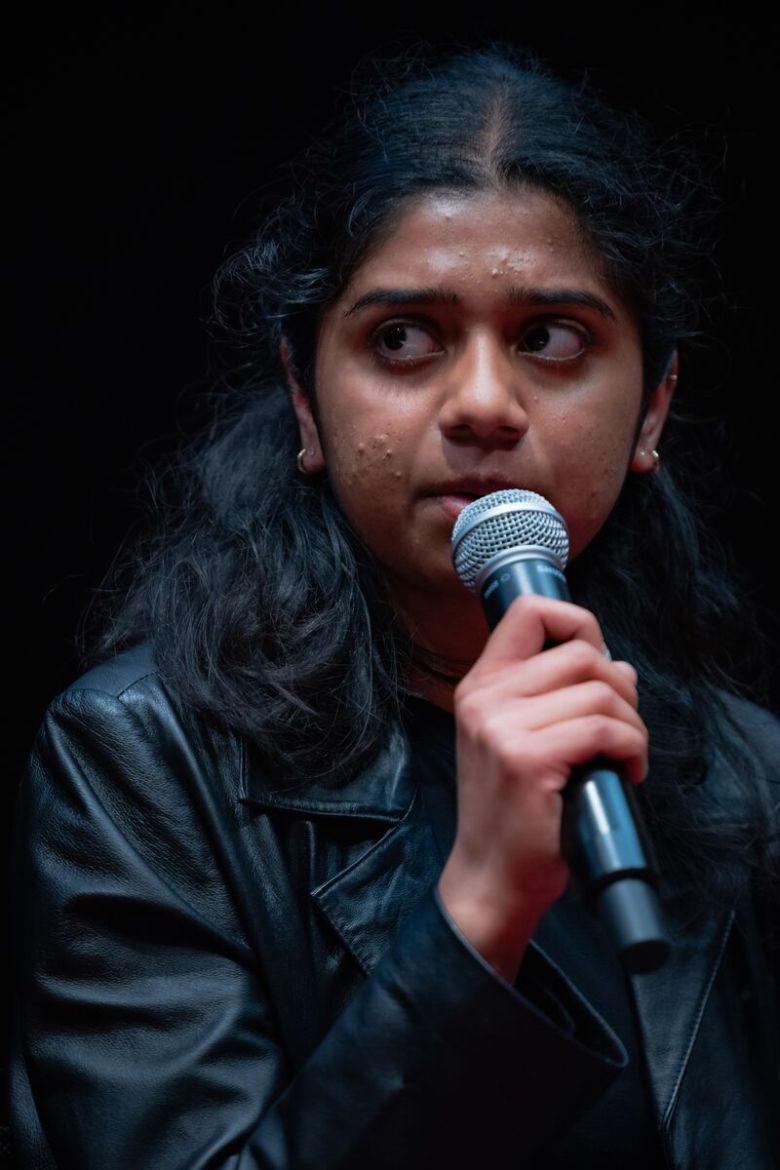 Rupanagunta said she’s seen students more afraid to express their political views openly. Credit: Richard H. Grant for Berkeleyside
Hoofnagle described one experience he had on campus at an event last November hosted by Turning Point USA, the conservative student-focused advocacy organization co-founded by Charlie Kirk. Hoofnagle said he went there as a curious bystander, but felt intimidated by masked protesters who he believed had assumed he was there supporting the controversial group. He said students and others leaving the event at Zellerbach Hall were met with profanity-laced chants of “fascist” by the protesters waiting outside.
“There is a heap of liberalism at the heart of this willingness to cancel people who you disagree with, and it’s costing [the university] millions of dollars,” said Hoofnagle. “We should be willing to listen to the other side.”
Rupanagunta said that as a reporter, she’s observed a growing reticence among people on campus to openly express their political views. She gave the school a “B or B minus.”
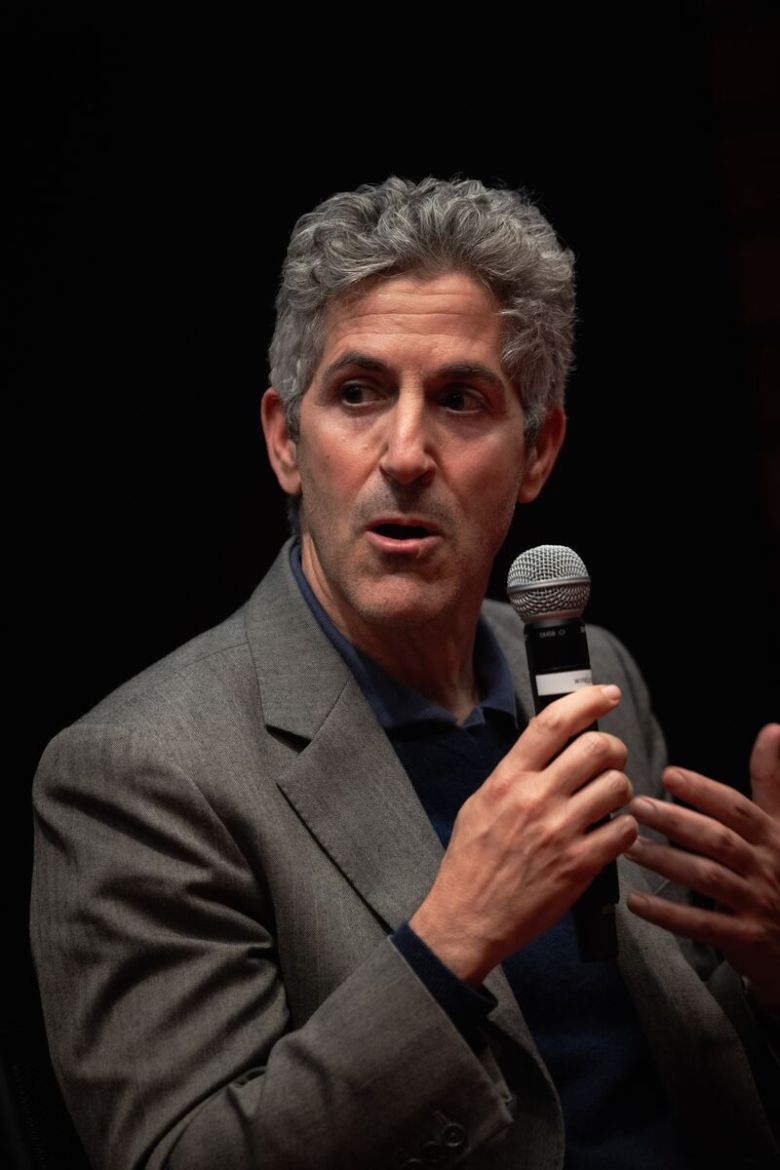 Makdisi said UC Berkeley should be viewed favorably in comparison to other campuses but decried the suspension of a lecturer who criticized Israel’s war in Gaza after class. Credit: Richard H. Grant
“Are students really feeling that their free speech is protected when it’s been incredibly hard to get people to speak on the record out of fear of retaliation?” she said. “When at almost every protest, you feel the need to wear masks because you know you have to hide your identity to speak up for what you believe is right?”
Makdisi said UC Berkeley’s suppression of speech on campus hasn’t gone as far as some other schools — he cited UCLA, NYU and Columbia — but that its performance is a matter of perspective. The professor of Arab and Middle Eastern history, who has been an outspoken critic of Israel’s war in Gaza, was among those included on the list of 160 names given by the university to the federal government.
“If you are a lecturer who is disciplined for fasting for Gaza, to protest the Gaza genocide, well, that’s a very different grade,” he said, referencing the university’s suspension of Kao. “Any student who’s protesting what they think of as depravity [and] they are being intimidated and punished or threatened with punishment, that’s a very different grade.”
When does academic freedom cross the line?
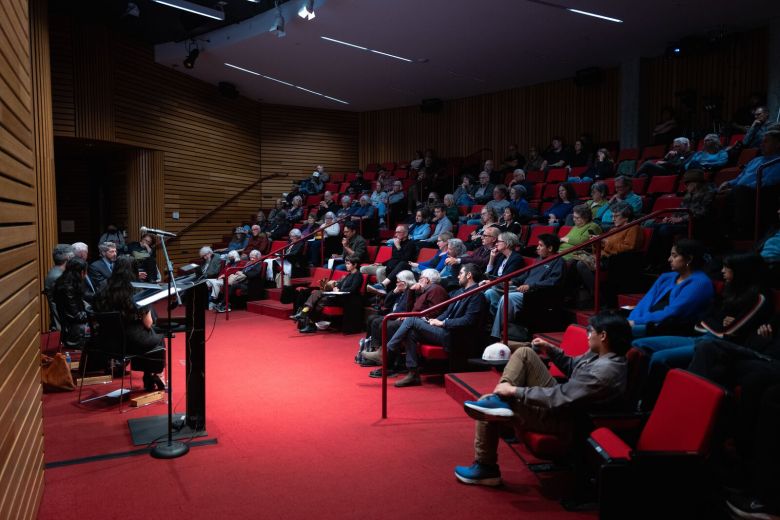 A crowd of about 100 came to watch the discussion. Credit: Richard H. Grant for Berkeleyside
All of the panelists said they believe universities should be places where the values of free speech and academic freedom are valued and protected. But opinions differed on how the First Amendment can and should be applied in classroom settings.
Referring to the Kao case, Hoofnagle said the school was acting within its rights when it suspended the computer science lecturer.
“He talked about a topic that had nothing to do with his class, just as I could be fired if I gave a lecture on physics instead of law,” said Hoofnagle. “The whole idea is that professors have power over their students, and we have an obligation not to politicize our classroom.”
Hermalin agreed that professors cross the line when their in-class speech veers into political advocacy.
“If I was a professor of, say, biology, and I start talking about President Trump’s tariffs, that would not be okay, because that’s not part of what we normally think about as biology,” he said. “So again, that might cause some consequences for the professor.”
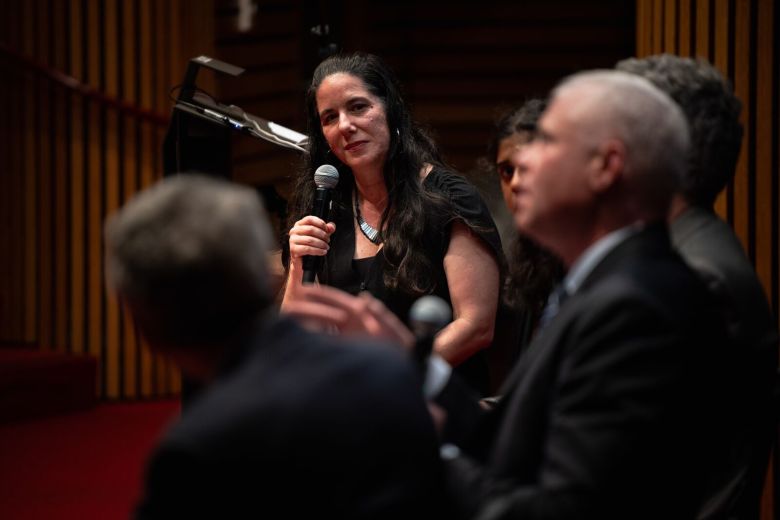 Berkeleyside higher education reporter Felicia Mello moderated the event. Credit: Richard H. Grant for Berkeleyside
For many students who’ve spoken to The Daily Cal, said Rupanaguntra, the idea that Kao’s suspension for expressing his views on Gaza at the end of class had nothing to do with his political activism outside of it, is a tough sell. She said many see the decision as contributing to an overall “culture of fear and intimidation” on campus.
“It sends a message that when you are specifically discussing certain topics, certain conflicts, and certain politics is when it feels like there is an attack on academic freedom and an attack on free speech,” she said.
Makdisi said political indoctrination should have no place at the university. But he urged others to consider these questions of academic freedom within the moral context of a war in Gaza that a United Nations independent commission has deemed a genocide.
In such a context, “Who makes a decision about what is indoctrination and what is proper academic teaching?” said Makdisi. “On what basis does somebody determine this is indoctrination and this has crossed the line, [or] this hasn’t crossed the line? That’s a huge question, and I’m not sure we have a clear answer.”
“*” indicates required fields