
A recent 60 Minutes piece recounted the woes of California’s delayed high-speed rail project currently under construction between Los Angeles and San Francisco. And while Alan Fisher, who runs the YouTube channel the Armchair Urbanist, said it was factually correct, it also had a big problem. “The framing only focuses on a problem with high-speed rail, but it doesn’t put it in the broader context.”
He said that during TrainTubers: A Panel of Creators United by Transit, a talk on Friday hosted by the High Speed Rail Alliance’s Jordan Pokorney. In addition to Fisher, the panel included Thom de Boo of the channel Trains Are Awesome and Keith Davis of Car Free Keith.
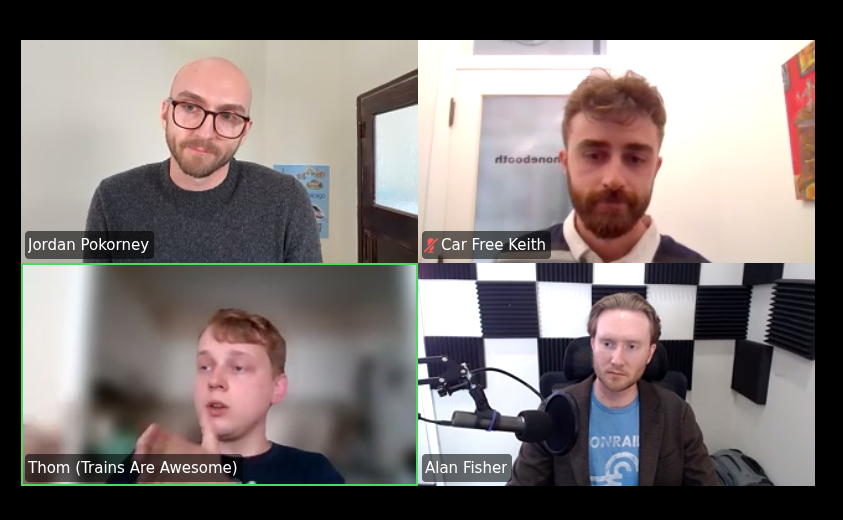
The three YouTubers have hundreds of thousands of followers and have become a potent voice in urbanist and transit advocacy spaces. They’ve done extensive video content on San Francisco transit as well as cities throughout North America and the world.
But how did they end up doing what they’re doing? And how do they continue to put out relevant content? “It’s still pretty niche,” explained Davis. “The Biggest creator, Not Just Bikes, has about a million subscribers.” (Compare that to 60 minutes, which gets over 8 million viewers). To grow the influence of urbanist, pro-transit channels, ways have to be found to broaden the audience, opined the creators.
“The problem with this content,” explained Fisher, is that most people aren’t that interested in the details of rail planning. “You have to make it appealing for the average person… even if they know a commute is a big part of their lives, most people don’t think about it in a historical or logistical way.”
They just know, said the influencers, that the trains don’t run frequently, or that it’s impossible to get around without a car in their neighborhoods. “Part of our filming style is traveling and blogging,” explained Thom. He said his channel shoots from an “on the ground, first-person perspective. You use the camera to be your eyes, and to show why something is a good thing or a bad thing.”
That’s done, in large part, through their personal experiences. Thom, who lives in D.C., is from the Netherlands and grew up partially in Japan. He grew up experiencing excellent bike lanes and rail services, only to see the contrast in the U.S. That, of course, informs his videos. “Because I moved from another country, I missed the trains,” he explained. “For the first few years [of the channel] we were just posting pictures of the trains I saw.” That started him blogging and then creating a channel documenting the contrasts.
One of Fisher’s video collaborations, this one called “Suburbs that don’t Suck.”
“I grew up in South Jersey, in a Philly suburb with a car-free neighborhood,” said Fisher. “As a kid, I thought that was a normal thing.” But as he got older and traveled around the country, he realized how special and rare that is in the U.S. That set him on a research obsession with why the rest of the country became so car-centered. “My early videos are essentially just a synthesis of those thoughts.”
People may not be as interested as Thom, Fisher, or Davis in how American cities grew towards car dependency. They may not be especially interested in light-versus-heavy rail or the Roger Rabbit Conspiracy. However, they do understand that they want to live in pleasant, safe, affordable, and walkable neighborhoods with cool things to do. That sometimes requires a bit of slight of hand. Fisher explained that he made a video about electric cars that starts out more like a piece about gas vs. electric to draw people in who might be interested in cars, but not necessarily urbanist issues. It then pivots to remind people about the effect that all cars have on cities. Another way to broaden the audience is to collaborate with people in related spaces. “There are plenty of TikTokers who make videos about cities,” said Davis. “They do very closely related stuff to what we talk about, just presented in a different way.”
Fisher agreed and talked about his collaborations with Cities by Diana, for example. “Other content creators might not be a white dude like me,” he said. “When you collaborate, you cross-pollinate, which brings in more people through the algorithm.”
And broader audiences just help these content creators correct the framing set by the mainstream media.
“When something goes wrong, like the DC streetcar or High-Speed Rail, the narrative is that the mode is the problem,” said Thom. “I agree the DC streetcar wasn’t built well. But there are also lots of examples of streetcars being successful. On high-speed rail, there are examples all over the world. The train is not the problem.”
Fisher talked about a highway interchange in Jersey that, as with California’s high-speed rail project, was started in 2008 and still isn’t open. But that’s rarely, if ever, mentioned on 60 Minutes or any other television program. “80 percent of DOT funding goes into highways, so the framing is always the issue.”
For more, be sure to check out Trains Are Awesome, Car Free Keith, and The Armchair Urbanist if you don’t know them already. And post about your favorite urbanist YouTube channels in the comments below.