
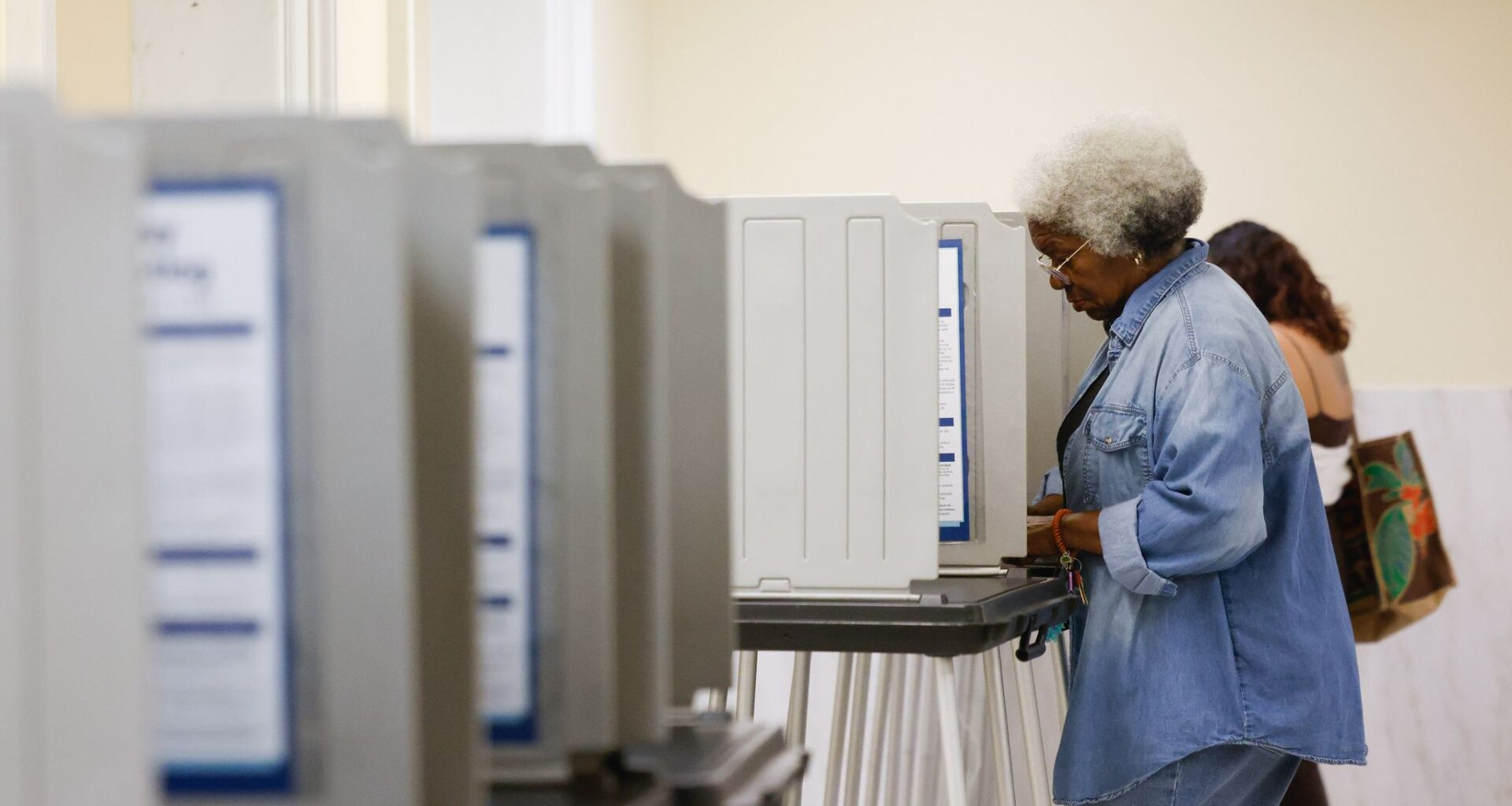
Patricia Smith fills out her ballot in a voting booth at City Hall for California Special Election on Nov. 4, 2025, in San Francisco.
Lea Suzuki/S.F. Chronicle
Californians will decide in November whether to impose new identification requirements for voting in person or by mail in the state, California Secretary of State Shirley Weber confirmed Friday in a memo sent to local elections officials.
A proposed state constitutional amendment by Assembly Member Carl DeMaio, R-San Diego, and state Sen. Tony Strickland, D-Huntington Beach, would require voters to bring a government identifying document — such as a driver’s license, a passport, a Social Security card or a birth certificate — to a polling place if they vote in person, the same document they now need for voter registration. If, like most Californians, they cast their ballots by mail, they would have to print the last four digits of that identification document on the outside of their ballot envelope.
The measure needed 874,461 signatures from registered voters to qualify for the ballot. Weber said the sponsors had submitted more than 962,000 valid signatures.
Article continues below this ad
The push to enact voter ID requirements in California comes as President Donald Trump pursues longshot legislation to restrict voter registration in the United States. Trump previously said he’d make billions of dollars in wildfire aid to California contingent on the state passing voter ID requirements. Those mandates are needed because “public trust and confidence in our elections has hit an all-time low,” DeMaio told the Chronicle.
He did not allege widespread voter fraud — unlike Trump, who wants to ban mail-in voting, even though he voted by mail in a recent Florida election — but said his ballot measure would “hold government officials accountable.”
San Francisco Chronicle Logo
Make us a Preferred Source to get more of our news when you search.
Add Preferred Source
What it would actually do, said one opponent, Jenny Farrell, executive director of the League of Women Voters of California, is “make voting harder for eligible Californians, compromise their privacy and force taxpayers to spend money to solve a problem that doesn’t exist.”
DeMaio’s ballot measure is also opposed by the American Civil Liberties Union of Northern California, whose democracy program director, Angelica Salceda, said it would impact students, the disabled, the elderly and others who are eligible to vote but “disproportionately don’t have current IDs.”
Article continues below this ad
But DeMaio said Friday that Democrats and independents made up nearly half of those who signed petitions to put the measure on the ballot, information he said came from the state’s voter files. He said the campaign spent between $6 million and $8 million collecting signatures and expects to be outspent by opponents in November.
“The voters want voter ID,” he told the Chronicle, calling it a “David vs. Goliath fight.”
Opinion polls reflect DeMaio’s contention that public confidence in elections has been declining. A nationwide survey by the Center for Transparent and Trusted Elections at UC San Diego, conducted in December and January, found that 60% of respondents believe votes would be counted accurately in this year’s midterm elections, down from 77% after the 2024 presidential election.
Doubts were somewhat higher among Republicans, whose party leaders support DeMaio’s measure, than among Democrats, whose leaders oppose it.
But party politics are not necessarily a predictor of ballot measure outcomes even in a deep-blue state like California, whose voters have supported prosecution-backed initiatives increasing criminal sentences, rejected proposals to repeal the death penalty in 2012 and 2016 and have twice endorsed bans on affirmative action for minority students.
Article continues below this ad
Trump, meanwhile, has repeatedly alleged rampant voter fraud in Democratic-led states — on March 16 he claimed, without citing any evidence, that election officials in California were mailing seven or eight ballots to individual Democrats, and one or none to Republicans. He has used those assertions to demand passage of the SAVE America Act.
It would require Americans to present a citizenship document, such as a passport or birth certificate — papers lacked by millions of U.S. citizens — when they register to vote. One version of the bill would also prohibit states from counting mailed ballots that are received after Election Day, a prohibition the Supreme Court may impose on its own in a case the court heard on March 23.
While the legislation won passage in the House, it appears unlikely to clear the Senate, where Republicans, with a 53-47 majority, would need 60 votes to overcome a Democratic filibuster. With several other Trump-supported measures stalled in the Senate, the president has called for repeal of the filibuster, but Republican leaders have refused.
Florida’s Republican-controlled Legislature recently approved a similar voter registration law that would take effect for state elections next year. An Arizona law in 2022 required residents to show proof of U.S. citizenship when they registered to vote, but the U.S. Supreme Court ruled in 2024 that the law applied only to state elections and that voters who swear they are citizens could still take part in federal elections, without having to provide any documents.
The SAVE America Act would go further than DeMaio’s initiative, which would not impose new requirements for voter registration. But the ballot measure would require state election officials to examine counties’ election records and report each year on the percentage of registered voters whose citizenship had been confirmed.
Article continues below this ad
“Voter rolls are woefully out of date,” DeMaio told the Chronicle. “Voters receive ballots at their homes for people who are no longer there. Citizenship verification has not been done in our state. … The only verification is, we take people at their word.”
But the Associated Press has reported that a group of states including North Carolina, Georgia, Arizona, California, and Texas reviewed their voter rolls between 2016 and 2022 and found fewer than 50 noncitizens in each state had voted in recent elections, out of at least 23 million votes per state.
And the Brennan Center at New York University said it examined records of the 2016 election from 42 localities in 12 states and — out of 23.5 million votes cast — found a total of 30 cases of suspected voting by noncitizens.