
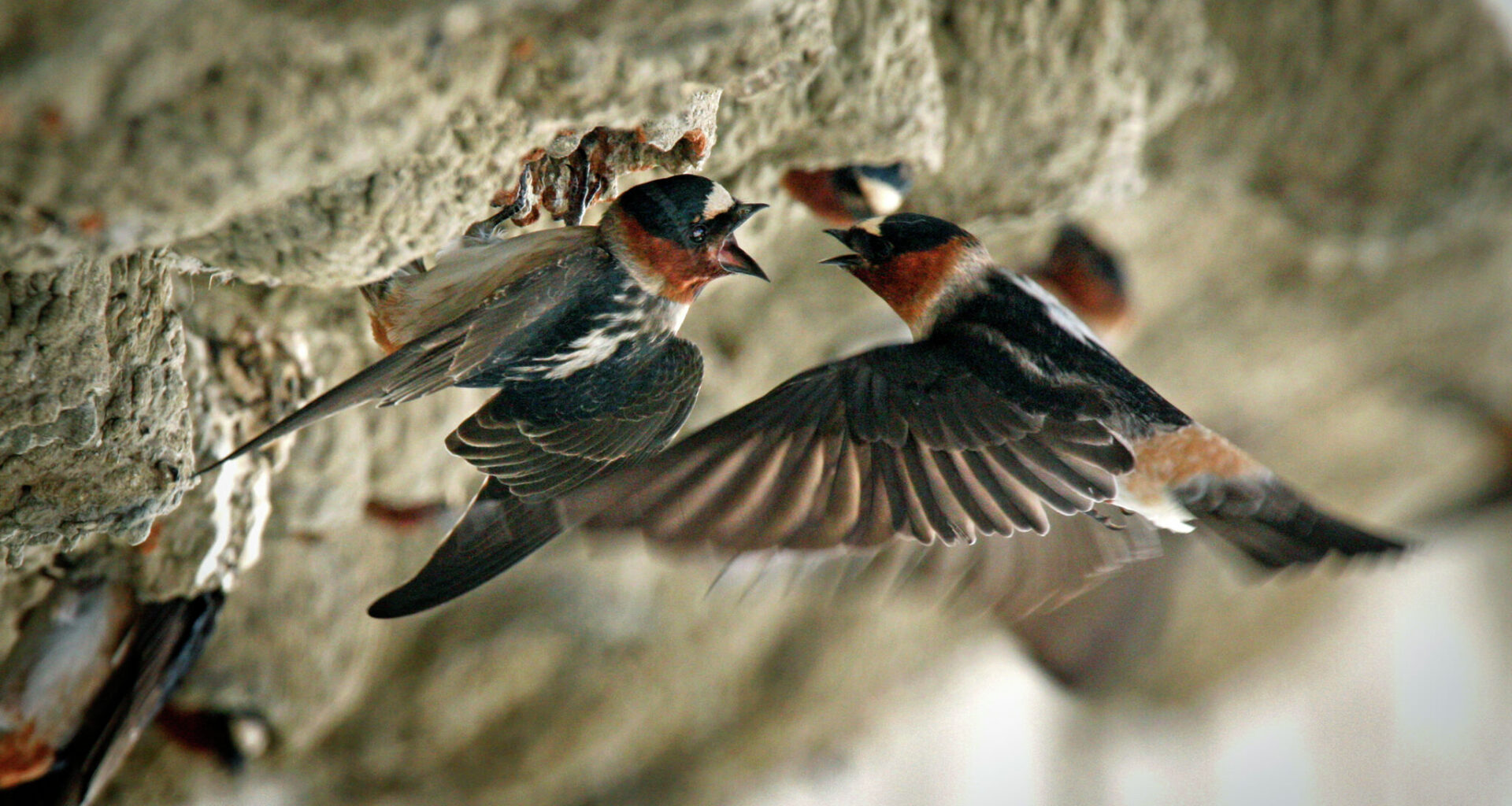
A pair of cliff swallows bring food to hatchlings hidden in a mud nest beneath a bridge in Oceanside (San Diego County), as seen in April 2008.
Don Bartletti/Getty ImagesCliff swallows migrate from South America to California each spring, building mud nests on bridges and underpasses across the state.The birds arrive in early March, construct nests in April and typically raise up to three broods before leaving by September.Several Bay Area bridges, especially in the North Bay, are well-known nesting sites where groups of swallows can be seen gathering mud and building nests.
Each spring, certain bridges and underpasses across California sprout brown, muddy barnacles.
Who’s responsible? Scour a nearby riverbank, and you might catch a glimpse.
Article continues below this ad
Colonies of small, chirping birds known as cliff swallows travel all the way from Argentina and Brazil each spring to make their nests in these particular patches of real estate.
When they arrive, they put on a show.
A row of mud nests made by cliff swallows are visible under the Third Street Bridge in Napa on April 15.
Brontë Wittpenn/S.F. Chronicle
In groups of 15 to 20, the swallows — brown with white bellies and orange chins — descend on exposed riverbanks to scoop up mud in their bills or on top of their noses. Like bricklayers, they pack one small pellet atop another until it forms a hollow softball-sized nest. Sometimes they’ll find a surviving nest from a previous year and simply refurbish it with new mud.
San Francisco Chronicle Logo
Make us a Preferred Source to get more of our news when you search.
Add Preferred Source
Once, these nests mainly clung to California’s natural rocky cliffsides. But undeterred by human development, cliff swallows now often find their perfect spot on the underhang of a bridge or the eaves of a building — meaning it’s hard to avoid these migratory birds while they’re in town.
Article continues below this ad
April is the perfect time to see them as they architect their nests and get ready to lay eggs, said Murray Berner, a longtime field trip leader with the Audubon Society who’s co-written several bird atlases for Napa and Solano counties.
Cliff swallows make mud nests under bridges each spring. This is a close-up of the underside of the Third Street Bridge in Napa.
Brontë Wittpenn/S.F. Chronicle
The birds arrive in early March and begin building nests in April. Once laid, cliff swallow eggs take about two weeks to hatch, after which the nestlings will stay in the nest for about 23 days. The adult swallows will raise anywhere from one to three broods of young before wrapping up in late July, according to Berner. They’ll be gone by September, headed back to South America for the winter.
A few key factors make for the perfect nesting ground: a 90-degree overhang, a textured surface and a nearby source of mud. Several cement bridges in California meet this criteria, but there are a few particularly well-known for cliff swallow nesting, including the Third Street Bridge in downtown Napa and Maxwell Bridge to the south, Berner said.
He recommended Napa’s Veterans Memorial Park, which sits just along the river and underneath the Third Street Bridge, as a good location to spot the swallows.
Article continues below this ad
A row of mud nests made by swallows can be seen as a gondola passes under the Third Street Bridge in Napa.
Brontë Wittpenn/S.F. Chronicle
“Look closely at the mud,” Berner advised. Once you spot a group of mud-collecting birds, you can follow their path back to the bridge in order to watch the nest-building in action.
Not every bird you spot will be a cliff swallow. House sparrows like to squat in cliff swallow nests when they’re away, and white-throated swifts also occasionally nest in crevices and holes on bridges, Berner said.
Cliff swallows nest across the state. In 1930, Father St. John O’Sullivan, pastor of Mission San Juan Capistrano near Laguna Beach (Orange County), recorded the swallows’ behavior in the book “Capistrano Nights.” Sometimes they would chip away at the crumbling adobe walls of the mission in order to source building material for their nests, O’Sullivan wrote. One of the mission’s residents claimed the birds would cease building their nests on Sundays to observe a day of rest.
O’Sullivan noted that the cliff swallows’ arrival seemed to regularly coincide with the feast day of St. Joseph, March 19. Today, Mission San Juan Capistrano celebrates March 19 as both St. Joseph’s Day and the Return of the Swallows with live performances and educational lectures.
Article continues below this ad
A male house sparrow can be seen near a row of mud nests under the Third Street Bridge in Napa on April 15.
Brontë Wittpenn/S.F. Chronicle
Cliff swallows are one of the rare species of birds whose population has grown even as human development has covered up the cliffs where they once nested, Berner noted. The International Union for Conservation of Nature classifies the swallows as a species of least concern of extinction.
And so Californians for decades to come can continue to admire the cliff swallows’ unique nest building and listen out for the “unmistakable squeaking cry” that O’Sullivan documented nearly a century ago.