
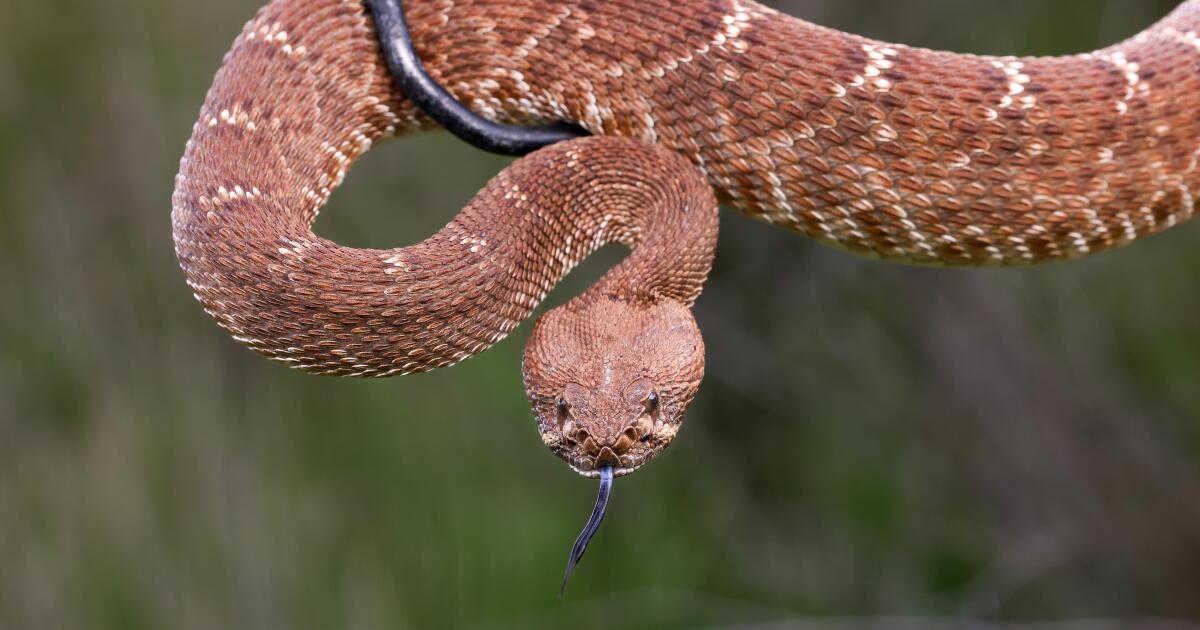
When hiking, I don’t usually carry a walking stick or weapon, but reading about the increasing number of deaths due to the snakebites this spring has given me reason to reconsider.
My colleagues Karen Garcia and Clara Harter have been documenting the rise in snakebite fatalities, including a Northern California woman who died earlier this week from the venom of a suspected rattlesnake.
You’re reading the Essential California newsletter
Sign up to start every day with California’s most important stories.
By continuing, you agree to our Terms of Service, which include arbitration and a class action waiver. You agree that we and our third-party vendors may collect and use your information, including through cookies, pixels and similar technologies, for the purposes set forth in our Privacy Policy such as personalizing your experience and ads.
In March, two other snake-related fatalities and several snakebites were reported across the state.
Three deaths in the span of two months in one state is significant, considering that the Centers for Disease Control and Prevention reports an average of five snakebite deaths per year across the entire country.
Garcia wrote about the potential reasons for the increase in attacks and how best to react when confronted with a rattler.
Given what appears to be an increased risk of getting bitten, I wondered why we can’t hike with a lifesaving snakebite antidote in our pockets.
One company has been diligently working on something like that and claims to be inching ever closer.
Work on anti-venom pill
Ophirex, a Bay Area-based public benefit corporation, is working on such a solution.
Former Los Angeles Times scribe Louis Sahagun wrote about the company’s effort to bring its anti-venom antidote, Varespladib, to the market in 2023.
Dr. Timothy Platts-Mills, Ophirex’s chief medical officer and an emergency room physician who was trained at UCLA, provided Essential California with an update on this potentially game-changing drug.
Ophirex is one of the few entities worldwide working on anti-venom pill. The United Kingdom’s Liverpool School of Tropical Medicine’s Centre is also developing a set of two pills for trial in Brazil and Ghana next year, according to the London Times.
What does the treatment do?
Varespladib is a rescue treatment for snakebites that works by neutralizing a key toxin in 95% of snake species, according to the company. The pill is meant to be taken immediately after a bite in conjunction with anti-venom treatments at a hospital. The pill is not meant to replace a hospital visit, Platts-Mills said.
For those hours or miles before any professional medical treatment, the pill increases a bite victim’s chances of survival.
How does it help?
Varespladib is particularly effective for American users as recent animal testing has shown a “substantive, large improvement” in survival odds against some of the most common continental snakes, Platts-Mills said. Those serpents include six rattlesnake species and non-rattlers, such as the Copperhead, Water Moccasin (or Cottonmouth) and Eastern Coral snakes.
Testing and beyond
Platts-Mills said Varespladib was given clearance by the FDA to test its effectiveness on animals.
“The FDA recognized that really the thing that is needed is the treatment in the field, but that’s actually quite difficult to study,” Platts-Mills said, pointing to the randomness of when and where snakebites occur.
“It’s unethical to withhold antivenom (a life-saving drug) to test Varespladib” on a human, he wrote in a follow-up email. “It’s not feasible to have trial enrollment in places where people might get bitten by a snake, to consent them before they reach a hospital or clinic.”
Ophirex’s next goal is to get FDA approval for a treatement for humans and dogs. As many as 100,000 dogs are bitten by snake each year, according to the American Society of the Prevention of Cruelty to Animals.
The company plans to seek FDA approval for both human and dog treatments by late next year.
The short-term goal is to have backpackers and emergency personnel with easy access to these treatments.
The longer-term goal is to help save some of the roughly 81,000 people who die annually around the world from snakebites, according to the FDA.
“This is a major public health problem, globally,” Platts-Mills said.
The week’s biggest stories 
(Robert Gauthier/Robert Gauthier/Los Angeles Times)
Air quality and the environmentCrime, courts and policingEducationEntertainment and media newsWhat else is going onMust readsOther meaty readsFor your downtime 
(Ron De Angelis/For The Times)
Going outStaying inL.A. Timeless
A selection of the very best reads from The Times’ 143-year archive.
Have a great day, from the Essential California team
Jim Rainey, staff reporter
Hugo Martín, assistant editor, fast break desk
Kevinisha Walker, multiplatform editor
Andrew J. Campa, weekend writer
Karim Doumar, head of newsletters
How can we make this newsletter more useful? Send comments to essentialcalifornia@latimes.com. Check our top stories, topics and the latest articles on latimes.com.