
Saturday April 18, 2026 marked the 2nd evening of the twelfth annual Los Angeles Dance Festival, hosted and produced by Deborah Brockus at Brockus Project Studios, located in the sprawling Brewery Arts Complex. The program featured ten contemporary dance works in diverse stages of creative development by the following choreographers: Ken Morris, Santiago Rivera, Corina Kinnear, Deborah Brockus, Nancy Dobbs Owen, Vanessa Hernández Cuz, Eliezer Rabelo and Natalya Janay Shoaf.

“Banned” Choreographed and Performed by Ken Morris – Photo by Denise Leitner.
While Banned by Ken Morris was listed as a “work-in-progress – sneak-peak,” Sylvie, choreographed by Deborah Brockus, Terri Best and Shari Nice, premiered over thirty years ago with its original cast, according to an archival review from the Los Angeles Times. A program that combines work in the early stages of creation with repertory from established choreographers makes for an uneven viewing experience. Many of the dances shared on Saturday evening need development time to complicate and deepen. About half of the works however – described below in the order in which they were performed – succeeded in compositional coherence and strong performances.

“La Paralisis del Sueño” choreographed by Santiago Rivera – Dancer: Alondra Zitlaly Perez – Photo by Denise Leitner.
La Paralisis del Sueño choreographed by Santiago Rivera and danced by Alondra Zitlaly Perez effectively conjured a tense theatrical tone. The seven-minute solo was contained within the upstage left corner and underscored with music by Bernard Herrmann, Kronos Quartet and Clint Mansell. Perez moved with muscular resistance and a sense of psychological struggle as she embodied grounded, and sometimes trembling shapes. Moments of this piece evoked circus-art contortion, but – as the title suggests – the extreme positions communicated an emotional knot more than flexibility for its own sake.

“Objects in mirror are closer than they appear” choreographed by Corina Kinnear – Photo by Denise Leitner.
Corina Kinnear’s work Objects in mirror are closer than they appear made good use of the venue, both its assets and limitations. Dancers (Mia Moraru, Anna Long, Stephanie Baer, Jax Neal, and Maiko Okajim)a dressed in white placed flood lights on the ground and moved them to create shadows across their bodies and the projection screen upstage. Although some of Kinnear’s dancers were stronger than others, motif and repetition were well used, as was a driving momentum that responded to the rhythmic soundscore by John Lamm. Of all the works on the program this was the best suited to the venue. The frame matters as much as the dance.

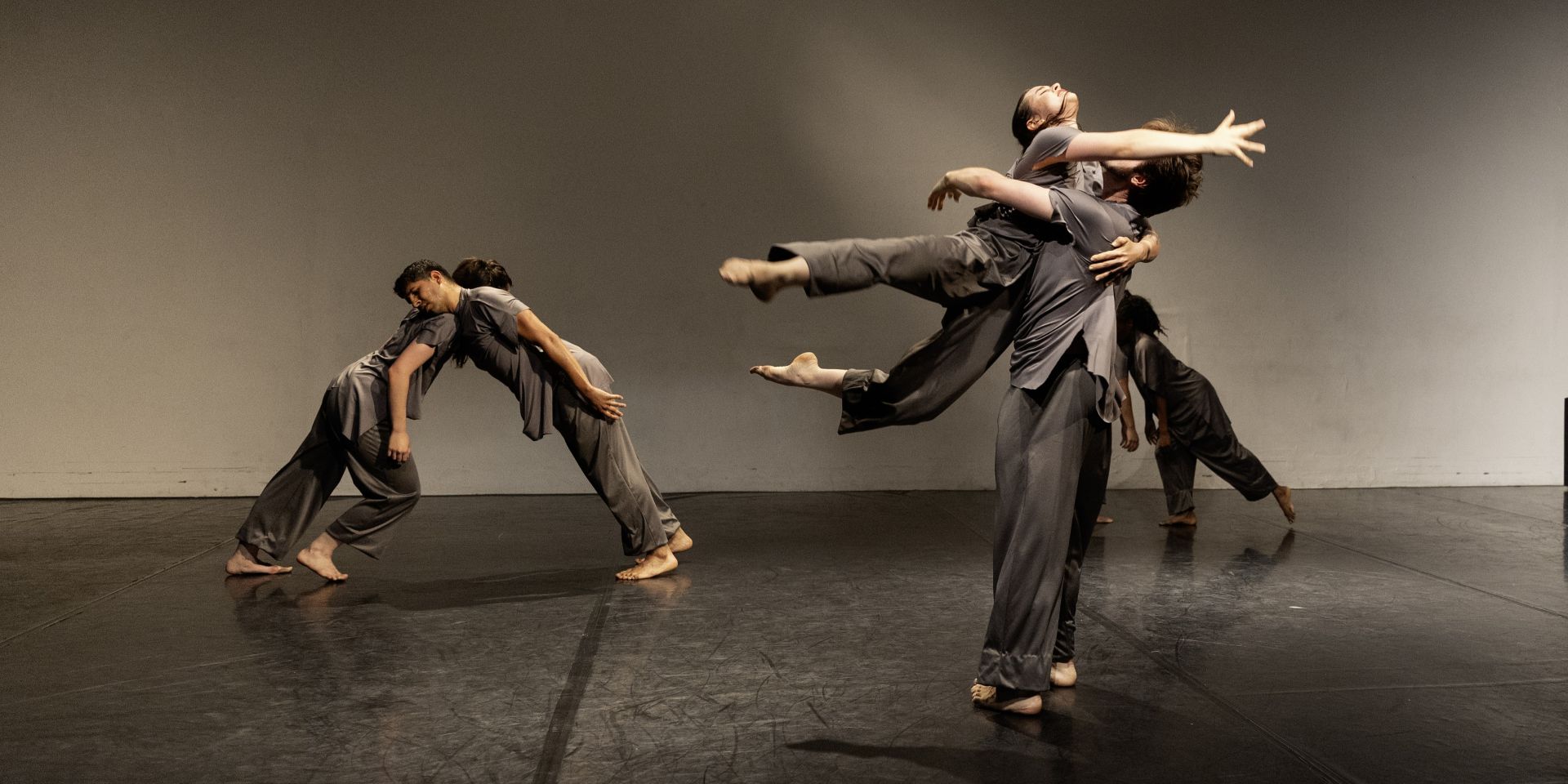
Bryan Burns, Arturo Gonzales, Denali Huff, Rebecca Lee, Beth Huelsenbeck, and Raven Smith in “Black Ice” Choreographed by Deborah Brockus – Photo by Denise Leitner.
Black Ice, choreographed by Deborah Brockus and performed by her company BrockusRed, premiered at last year’s LADF and was reprised for this year’s festival. Black Ice was by far the most athletic work on the program and featured a cast of six confident dancers who handled vigorous partnering, floorwork and high-legged extension with ease. Dancer Raven Smith popped in this work, expertly throwing and catching her weight with soft joints, both on her own and while partnering others. In spite of the dancers’ athleticism, the emotional world remained unclear. Some dancers appeared concerned with furrowed brows while others held their faces with more neutrality. Most importantly, this piece belongs in a larger space where the audience is seated farther from the stage, so that we can see the spatial pathways from a distance. A better equipped lighting grid and nuanced lighting design would also amplify its ebb and flow.
The dancers were: Bryan Burns, Arturo Gonzales, Denali Huff, Rebecca Lee, Beth Huelsenbeck, and Raven Smith.

“Endings” Choreographed by Nancy Dobbs Owen – Performed by Kate Coleman – Photo by Denise Leitner.
In an entirely different aesthetic, Endings, choreographed by Nancy Dobbs Owen and performed by Kate Coleman opened the second half of the program. Set to Brahms’ Hungarian Dance No. 4 in F Minor, the work seemed to meditate on grief through the dancer’s ever-morphing relationship to a woven shawl. In narrative ballet, story is often communicated through presentational acting or pantomime, but in Endings Owen allows the steps themselves to drive her storytelling. The reach of a long arabesque leg or a pass of jolly petits jetés act as emotional punctuation, rather than simply opportunities to showcase a dancer’s feet or line. Kate Coleman’s technical ability was surprisingly matched by her acting chops. The solo ended with Coleman audibly (and believably) weeping into her shawl, head in her forearms as she leaned against a bench upstage right.
In Uey Kómo Kómo choreographer Natalya Janay Shoaf obviously embraced a collaborative development process. As the performers (Anna Domenica and Bernard Gomes) moved through relational movement vignettes in close proximity to each other, their earnest responses to the prompt ”How to move forward in a more intentional way” played as voiceover. Legible and relatable, this project seems rooted in the performance of self-discovery. Curatorially this presented a problem however, because Shoaf’s process-oriented aesthetic felt out of place among the other, more formalist works on the program.

“Metallic Taste of the Sky” Choreographed by Vanessa Hernández Cruz – Performed by Cruz and Angelica MondolViaña – Performed by Kate Coleman – Photo by Denise Leitner.
The final highlight of the evening was Metallic Taste of the Sky by disabled Choreographer & Dance Artist Vanessa Hernández Cruz, who performed in the work alongside Angelica Mondol Viaña. In this emotionally affecting dance, Cruz’s walker (named Pluto, according to her Instagram Account) becomes not only a support for her as she walks or sits, but also a scenic/prop element that both dancers handle, sending it through space on wheels, and placing it on top of Cruz’s body. Having seen Cruz’s work before, this felt very much in keeping with her creative voice – dreamy and full of pathos.
A framed poster in the lobby of Brockus Studios commemorated the longevity of this festival, listing dozens of reputable LA based dance artists who have participated over the years. In spite of this history however, it is clear that this event has been hit hard by the current climate for arts funding in Los Angeles County and nationwide. Brockus shared as much in her introductory remarks, explaining that grant funding for the festival had been cut and asking us for our patience, because “Due to funding” she would be running the lighting, sound and video elements for the evening’s performance herself. At times this meant seeing the home screen of a personal laptop projected behind the Marley floor, as Brockus switched between video files. While this lent a charming DIY feeling that matched the homey lobby space of Brockus Studios, some of the works we saw on Saturday asked to be seen in a more polished frame.
For more information about LA Dance Festival, please visit their website.
Written by Annie Kahane for LA Dance Chronicle.
Featured image: Bryan Burns, Arturo Gonzales, Denali Huff, Rebecca Lee, Beth Huelsenbeck, and Raven Smith in Black Ice Choreographed by Deborah Brockus