
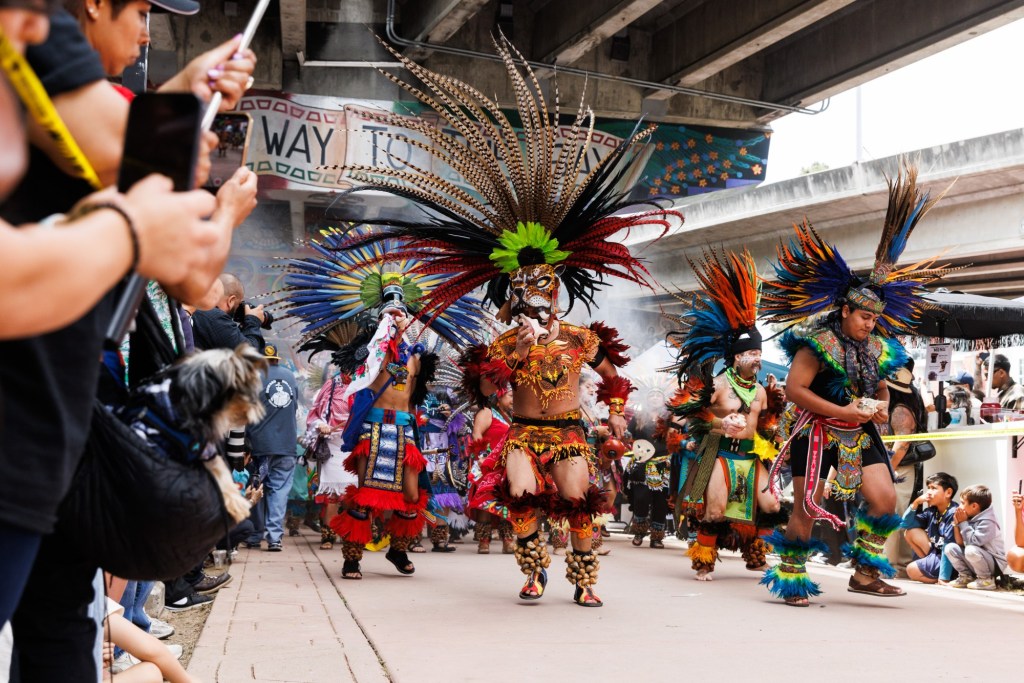
During a time not unlike the one that ignited the historic founding of Chicano Park, thousands of people turned out Saturday at the iconic gathering space to celebrate their culture, stoke their heritage and press forward in their struggle.
They ate, danced and traded stories at the 56th annual Chicano Park Day celebration, on the same venerated ground where residents of Barrio Logan generations ago rose up and pushed back against an unremitting government.
The smell of grilled corn and carne asada filled the air while spectators admired scores of vintage lowriders amid the now world-famous murals depicting Chicano struggles and triumphs.
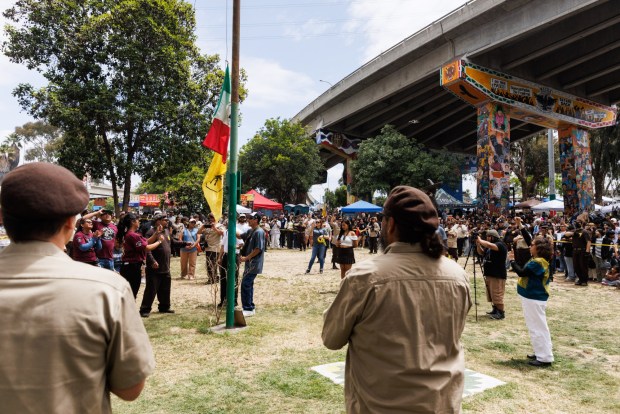 Flags are raised in honor of Chicano Park Day, the 56th anniversary of the park, in Barrio Logan on Saturday. (Kristian Carreon / The San Diego Union-Tribune)
And while organizers of the yearly tradition welcomed visitors at the morning kickoff, they implored people to keep engaging their neighbors and challenging their elected leaders to do more to better the community.
“We are not simply historic relics, but living entities,” Maria Figueroa, a MiraCosta College professor and president of Centro Cultural de la Raza, a San Diego nonprofit that promotes arts and culture across the border region, told the crowd.
“We must resist and fight back,” she said. “Our art is a powerful weapon expressing our discontent with racism.”
The celebration came also as San Diego Mayor Todd Gloria has proposed cutting millions of dollars from arts and cultural programs across the city, including the Chicano Park Museum and Cultural Center that might be among the groups affected by the proposed budget cuts.
“The mayor has stated that one of his priorities is public safety,” said Monica Hernandez, the museum’s executive director. “For us, what brings us closer and keeps us safe is being in community, particularly through the arts.”
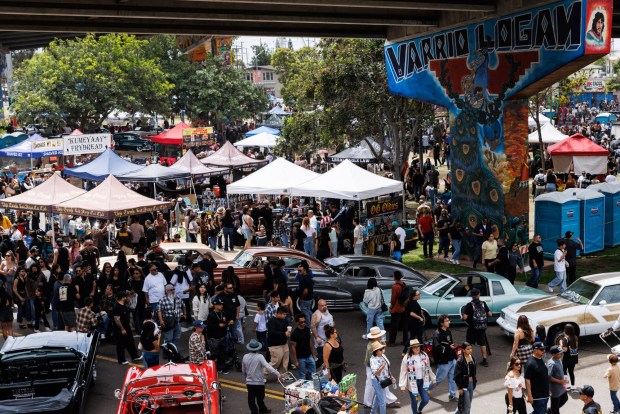 Thousands gather for Chicano Park Day, the 56th anniversary of the park, in Barrio Logan on Saturday. (Kristian Carreon / The San Diego Union-Tribune)
Chicano Park Day honors the brave students and residents who began occupying the area underneath the San Diego-Coronado Bridge in April 1970 to stop the California Highway Patrol from using the space for a new station.
The protest, which became a flashpoint of the Chicano Movement, came at a time when war was raging overseas, when racism was rampant and government officials too often dismissed lower-income and immigrant communities.
The standoff beneath the bridge, where whole neighborhoods were dislocated by construction and residents had long been promised a park, quickly attracted national attention.
After nearly two weeks, state and local officials agreed to the demands.
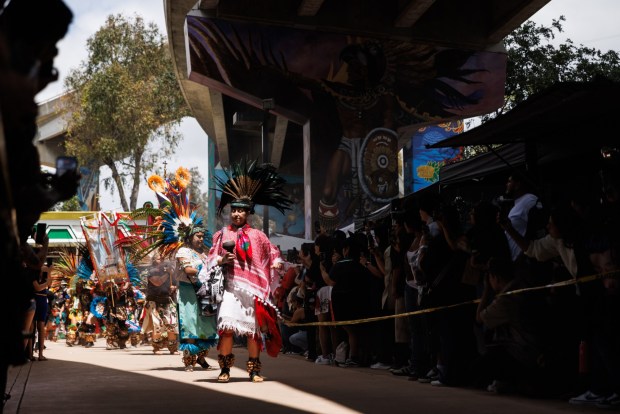 Aztec dancers from multiple danza Azteca groups perform for a blessing. (Kristian Carreon / The San Diego Union-Tribune)
Michelle Sanchez, a youth worker from Orange County, traveled south to attend the festival.
She said it was important to honor the difficult work of generations past, especially under the mass deportations and other policies being pushed by the Trump administration.
“It aligns with what’s happening right now with immigration and the amount of injustices taking place without accountability,” Sanchez said. “It’s important to center yourself with your culture and advocate for what you believe in.”
Jose Ramirez said he has been attending Chicano Park Day celebrations since he was a boy. On Saturday, he brought his three children with him so they too could sample their heritage.
“This is culture — people coming together,” said Ramirez, a construction worker from Logan Heights. “That’s the most important thing. Whatever’s going on in the world, today is a day of peace.”