
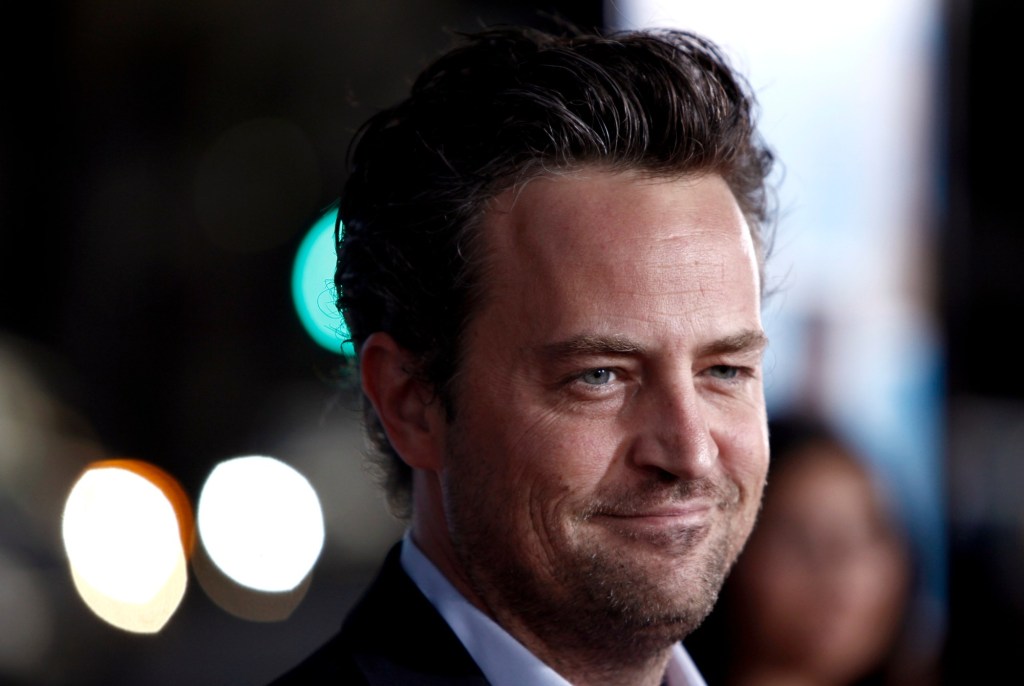
Tuesday marked the second anniversary of the death of “Friends” actor Matthew Perry, on Oct. 28, 2023, due to a ketamine overdose. This anniversary, combined with the current tensions with Venezuela over its alleged role in the drug trade, serves as a reminder that the U.S. needs to address drug addiction as a public health crisis, not a national security one.
The Matthew Perry Foundation, established in his name, addresses these issues, including the illicit fentanyl crisis that has affected border cities like San Diego. The foundation describes this crisis as an “epidemic.” I would argue it is an endemic epidemic, accepted as a daily reality that leads to apathy.
On Oct. 23, U.S. border czar Tom Homan said illicit fentanyl should be classified as a weapon of mass destruction. When politicians describe drugs like fentanyl as weapons of mass destruction, they blame the problem on the supply routes from foreign countries, like Mexico, Venezuela or China. Ultimately, this is a domestic public health crisis and will not be resolved unless the root problem of addiction is addressed. Second, we must be proactive, as artificial intelligence will enable new methods for producing this drug synthetically.
The coincidence of Perry’s death coming just before Halloween is also emblematic, as on days like today, we often see sensationalist news reports stoke fear about Halloween candy laced with fentanyl. These reports often lead to the “securitization” of the drug problem. Calling a drug a weapon of mass destruction, like the term “war on drugs,” introduced during the Nixon administration, is an example of securitization. The words that policymakers and news outlets choose to describe an issue are often used to mobilize military resources as a solution.
For example, during the COVID-19 pandemic, leaders like Israel’s Benjamin Netanyahu declared “war” against an “unseen enemy.” Yet COVID is a mutating virus. There is no Covidistan to invade, no capital Covidia to conquer and no Gen. Virus to surrender to invading forces.
I have spent my career studying weapons of mass destruction, and calling fentanyl one is not only misleading but also dangerous, as that term often justifies American militarism against Iraq in 2003, Iran earlier this year, and, now, possibly Venezuela.
However, fentanyl is a weapon of mass addiction. When fentanyl was invented in the 1950s, it was an innovation in a medical setting, a synthetic opiate that could be administered in smaller doses than morphine during surgery.
By the 21st century, fentanyl became a weapon of mass addiction spreading beyond the operating floor, enabled by social media apps allowing its distribution. Just as social media became a haven for terrorists to recruit teenagers for ISIS, so too can drug dealers sell their narcotics without the consumer realizing that what they think is a pain reliever is made up of the much more potent fentanyl. Social media companies must conduct both counterterrorism and counternarcotics in this age, and AI algorithms can help detect them.
Innovations in technology further complicate the matter. While I argue that labeling fentanyl a weapon of mass destruction is misleading, they do bear some similarities. AI can help generate ideas for shortcuts in producing chemical weapons like sarin. This nerve agent was once released by the apocalyptic cult Aum Shinrikyo on the Tokyo subway in March 1995. If AI can help anyone in their basement produce sarin, it can also offer innovative ways to produce fentanyl. The threat from fentanyl is not a foreign nation, but someone in a basement lab who can prompt AI properly to generate the synthetic opiate.
If this problem is to be solved, it will not be solved through labels, wars or AI. It ultimately comes back to understanding the roots of America’s addiction problem, and the need to invest in old-fashioned education and research into this matter at a time when university budgets are being slashed.
Perry called himself a “seeker” of knowledge, and he sought in his lifetime the answer to the affliction of addiction. The foundation in his name will hopefully ensure that Perry is remembered for more than just “Friends.”
Al-Marashi is an associate history professor at California State University San Marcos and visiting lecturer in the School of Public Health at San Diego State University. He lives in Encinitas.