
On the first Sunday of every month at 10 a.m., St. Matthew’s Church in National City, California, holds a bilingual service that brings together parishioners from its two weekly services. On a regular Sunday, the 9:30 a.m. English service is attended mainly by Filipinos, while the 11:30 a.m. Spanish service comprises Latinos and Spanish-speaking members.
Six out of 10 residents of San Diego County’s second largest city are Latino or Hispanic. Twenty percent of the populace are Filipinos, making it an area of the country with one of the highest concentrations of Filipino Americans.
Ana Garcia, the parish administrator for the past three years, said the monthly gathering is a reminder that “we are one community.” What follows after the service has been essential in conveying that reminder.
“It’s very important to us…because we are multicultural that we find and focus on the things that we have in common. And both our Filipino community and our Latino community have found that hospitality and food are both very important factors to the community.”
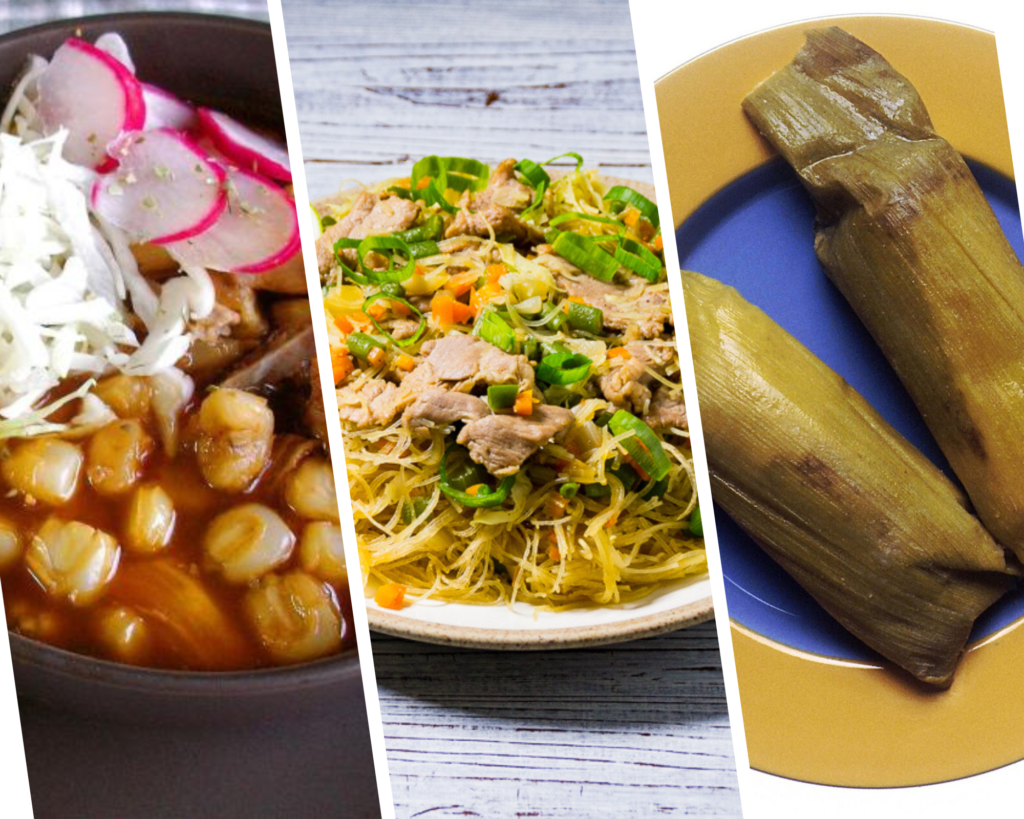
A potluck lunch is served buffet-style after the service. Volunteers set up a large table with trays of food featuring dishes that honor parishioners’ cultural heritage. Regular items on the menu include Filipino dishes like pancit (stir-fried noodles with chicken or shrimp) and lumpia (vegetable spring rolls served in fresh egg wrappers or deep-fried), and Mexican dishes like pozole (a traditional stew), tamales, enchiladas, and gelatina de mosaico, a classic Mexican dessert.
Pancit is a favorite of the Rev. Dr. Willy Crespo, who was assigned by Bishop Susan Brown Snook of San Diego to lead St. Matthew’s in November 2025 because he “couldn’t stand being retired.”
“Over food and with food, people can talk and people can share and…feel at home,” Crespo said, noting that food is “where we got our sacraments from.” He described the fellowship as a sacred time for both communities, who have their own unique challenges, to come together and feel welcomed, supported, and loved. “It really helps the entire church, so we [can] feel unified and not separated,” he said.
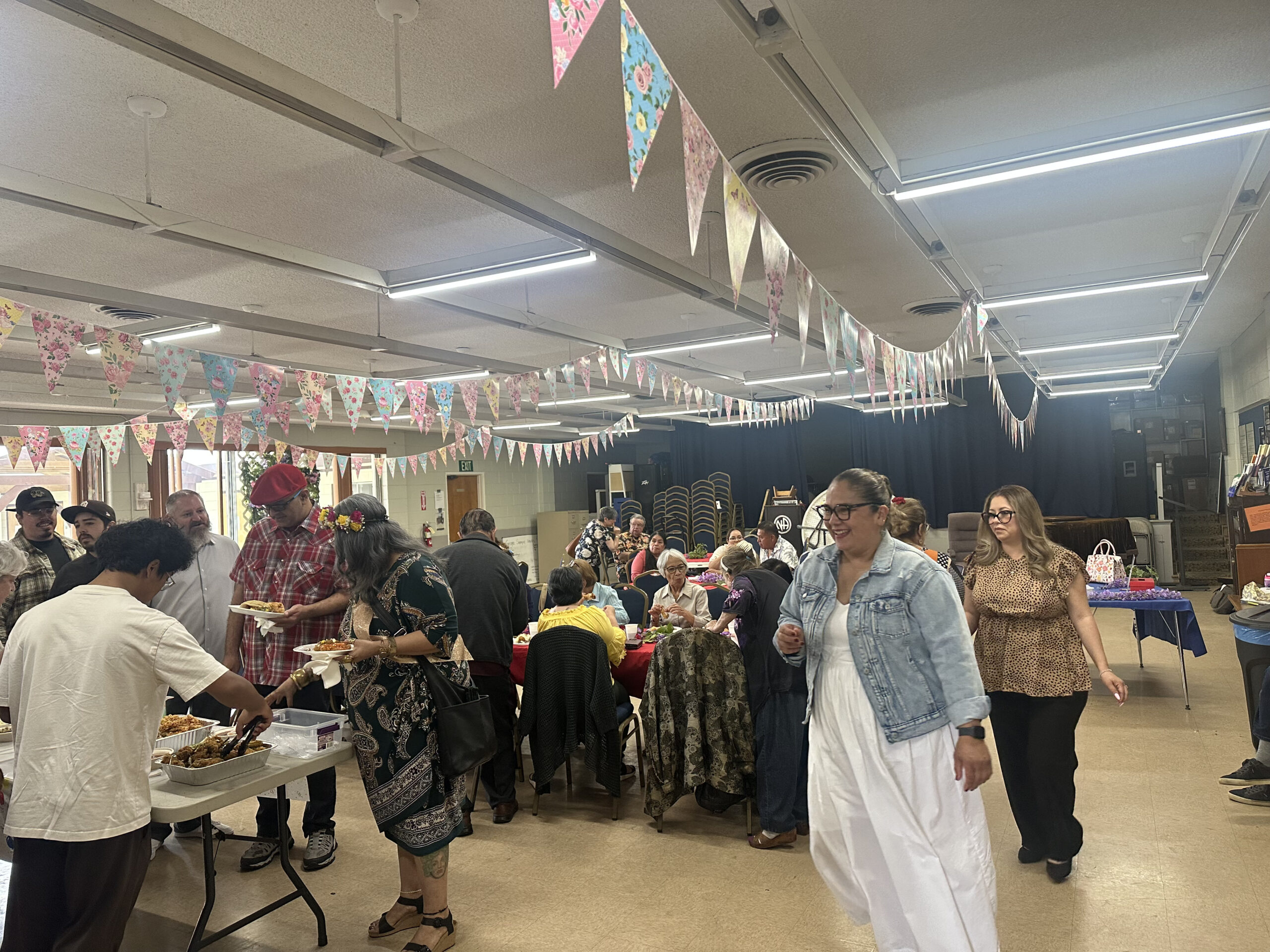 Parishioners of St. Matthews Church at National City enjoy a potluck lunch after their monthly bilingual service | Silvia Camacho
Silvia Camacho, a Latino parishioner who attends the English service and has worshiped at St. Matthew’s for eight years, appreciates both the food and the time spent getting to know fellow parishioners during the bilingual gatherings. Unlike regular Sundays, when conversation is often limited to a brief coffee hour before the next service begins, a shared meal allows for deeper connections.
“You have more chance to learn about the other person,” Camacho said. You can ask more questions like, “How’s your family?” or learn about a person’s favorite movie or food. “When you start a conversation, it goes to expand more questions and you learn more about that person.”
In May 2025, the parish organized a cooking lesson where a longtime Filipino parishioner taught participants how to make pancit. Camacho took part in the event.
“It was so cute because everybody was trying to cut vegetables,” she said, initially using the methods she learned when preparing Latino dishes. “But no, since this was pancit, it has a specific cutting.” Garcia said the cooking lesson was a natural step in nurturing community through food.
“I know my cooking the way my mother taught me to cook, but learning ingredients and recipes and methods of cooking from someone else who also learned from their family,” is what the cooking lesson affords, she said. It also serves as a means to invite the wider community to participate in the life of the church.
During another cooking lesson, focused on making tamales, Garcia told friends in an artists’ group she belongs to that they could learn to make them at the parish. “We want to use this to open up the community and say, ‘come spend time with us’…‘we want to break bread with you.’”
The cooking lessons have also become a fundraiser. The pancit and tamales prepared by participants are packaged for sale to parishioners attending Sunday services. And because all ingredients are brought and donated by parishioners—even the utensils at times—there is no cost for the parish to produce the food.
Although the cooking lessons have been postponed as the parish is renovating its kitchen, it hopes to restart the program again this summer.
There is also the goal of encouraging more members to attend the service in person. According to Crespo, fears caused by immigration enforcement activities across the nation have affected attendance at the Spanish service. “We’re trying to get them to come back,” he said. On average, around 20 people attend the Spanish service. A key challenge is helping members feel safe enough to come to church.
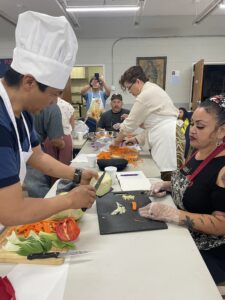 Participants learn how to make pancit at St. Matthew’s kitchen | St. Matthew’s National City
One of Crespo’s prayers for the faith community he leads is for a United States government that is inclusive, diverse, and respectful of people who are trying to establish their lives in America but are now gripped with fear. “But they work hard, they’re open and they want to learn and love, and they care just like everybody else.”
Frank Kimball is considered the founding father of National City. He and his brothers constructed the first roads and railroads in the area during the 19th century. According to the National City Historical Society, he hired many Filipinos, Chinese, and Japanese to work on the railroads.
Kimball also helped establish the parish as its benefactor. Those who attended its first service on July 3, 1887, are described in a contemporary article as “representing many different denomination[s],” who “gathered together …in the one common feeling that all are brethren who enroll themselves beneath the banner of the Cross.”
More than a century later, that call to unity remains present at St. Matthew’s.

Caleb Maglaya Galaraga is The Living Church’s Episcopal Church reporter. His work has also appeared in Christianity Today, Broadview Magazine, and Presbyterian Outlook, among other publications.