
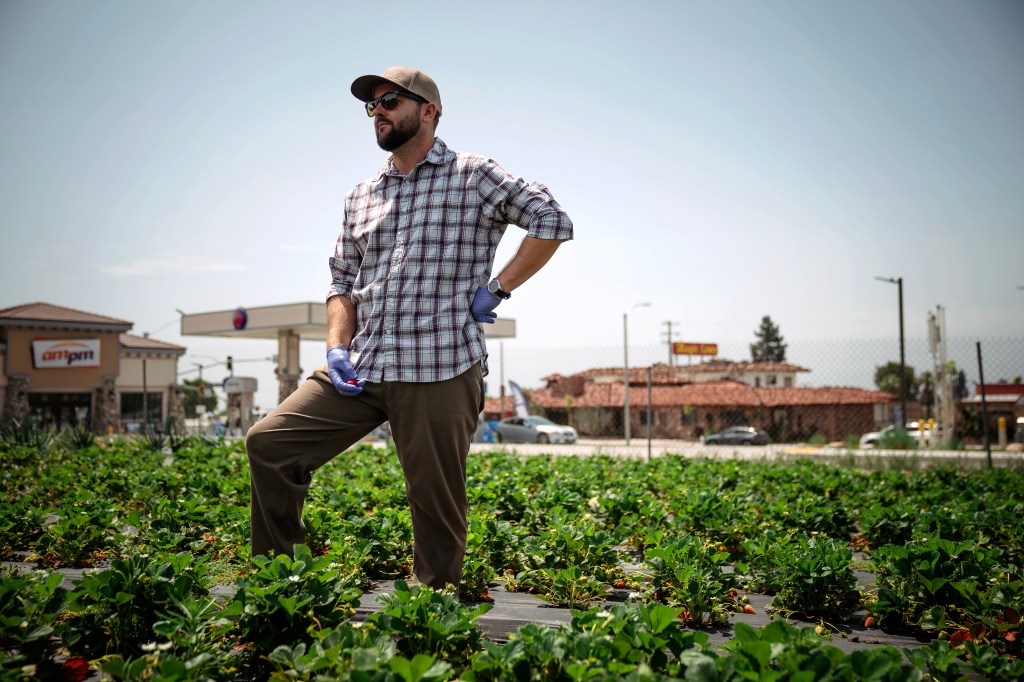
RANCHO CUCAMONGA, Calif. — The tank weighing down the back of Kyle Nicolson’s truck holds a mixture of water, nutrients and fertilizer concocted through years of tinkering, first by his grandfather, then his dad, his uncle and his cousins.
Kyle, too, has had a hand in the recipe. The specifics are a secret, he says, a quick grin breaking over his face on a sunny Tuesday morning last June. But suffice to say, he thinks it’s why the strawberries on his family farm taste so sweet.
Three generations of Nicolsons have grown strawberries on this roughly 9-acre patch of land along Route 66, nestled in the shadows of Southern California’s San Gabriel Mountains and tucked between a gas station, a golf course and a Walmart.
Kyle might be the last.
Follow our road trip: Route 66, ‘The Main Street of America,’ turns 100
Nicolson Farms leases the land from San Antonio Regional Hospital in nearby Upland. Three years ago, it agreed to sell it to a developer. Some of the proceeds will go toward a new maternity unit that meets the state’s earthquake building safety requirements.
The land is in escrow, a hospital spokesperson said. State records show the developer plans to build a 308-unit apartment building with retail space.
That means Kyle and his farm will have to move. The where and the when remain unknown.
Kyle’s strawberries don’t have to go far to reach the consumer. A sign facing Route 66 — called Foothill Boulevard here — tells passing motorists that strawberries are “picked fresh daily!” A small parking lot leads to a farmstand, 100 feet from the first row of plants, where the bright red berries are piled in baskets and flat boxes: $6 for one basket; $53 for a full box.
Finding a similar plot of usable farmland is nearly impossible, Kyle says, with development increasingly gobbling up space in the region and state.
California’s fertile farm fields once enticed thousands of Dust Bowl refugees fleeing along Route 66 during the Great Depression. While still the nation’s leader in agricultural production, it lost more than 330,000 acres of agricultural land between 2017 and 2022, according to the nonprofit American Farmland Trust’s analysis of federal data. That number could climb to nearly 800,000 acres by 2040, the trust estimates.
“In California, we’re losing farms and ranches at an alarming rate, in the face of challenging business viability and climate affects with development and water scarcity on track to consume more,” says Tom Stein, AFT’s California regional director, on the trust’s website.
The same year San Antonio Regional Hospital was agreeing to sell the land Nicolson Farms occupies, two other farms in nearby Ontario were lost to developers, the Inland Valley Daily Bulletin reported. Kyle says he knows two farmers in Chino whose land is being eyed for apartments.
“It’s been tough to deal with it,” he says, standing between rows of strawberry plants peaking out from holes in the black tarp that covers the ground.
In five to 10 years, he estimates, “there probably won’t be any of these, unless the grower owns the land. It’s gonna be hard to continue this business.”
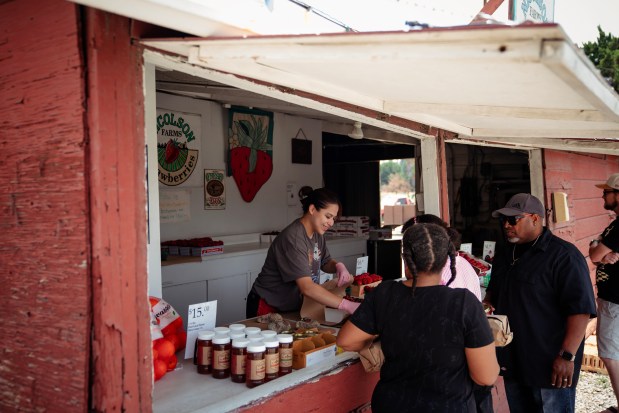 Rachel Argulles helps customers at Nicholson Strawberries on Route 66 in Rancho Cucamonga, California, June 3, 2025. (E. Jason Wambsgans/Chicago Tribune)
Kyle tells us this will likely be his last harvest. But then, something unexpected happens. The hospital keeps extending his lease on a month-to-month basis. In October, he rushes to start planting for another season.
It’s a gamble, one his family advises him not to make. If the hospital doesn’t renew his lease, the work will be for nothing.
“I sometimes go to the casino, but not like this,” he says.
He plants only a few acres, in part to mitigate the risk, in part because he can only find three members of his longtime crew who were willing to help. The rest, he says, are afraid of being swept up in federal immigration enforcement raids.
Four days into the new year, a post on the farm’s Instagram page excitedly announces the start of its 2026 season.