
A member of Inyo County Search and Rescue is lowered from the California Highway Patrol helicopter toward the rocky slope where the climbers were stranded.
California Highway Patrol
It was a high-stakes rescue — one of the most challenging the helicopter aircrew had ever performed in the High Sierra.
A mountain climber trekking along the snowy Sierra crest suddenly lost his footing and tumbled 500 feet down a rugged slope, landing hard on a granite ledge and suffering multiple broken bones. His brother, who was hiking with him, rushed down the mountainside, but with the climber’s injuries there would be no hiking out to safety.
“This was high-altitude, unforgiving terrain,” Ryan Reuther, deputy sheriff with the Inyo County Sheriff’s Office, told the Chronicle by email. The area was “extremely steep,” he said, and treacherous with loose rock and snow.
Article continues below this ad
The incident occurred on April 16. The brothers had embarked on a multiday excursion with bulky overnight packs and were hiking on the remote western flank of Mount Baxter, a 13,141-foot peak at the easternmost edge of Sequoia National Park. Though they weren’t far from the John Muir Trail, the backside of Baxter has no marked hiking paths, according to local mountain guide Howie Schwartz. “It’s just wild mountains,” he said.
“It’s not too technical in there, but if you go off the wrong side of the mountain, you can for sure get hurt,” said Schwartz, lead guide and owner of Sierra Mountain Guides in Bishop.
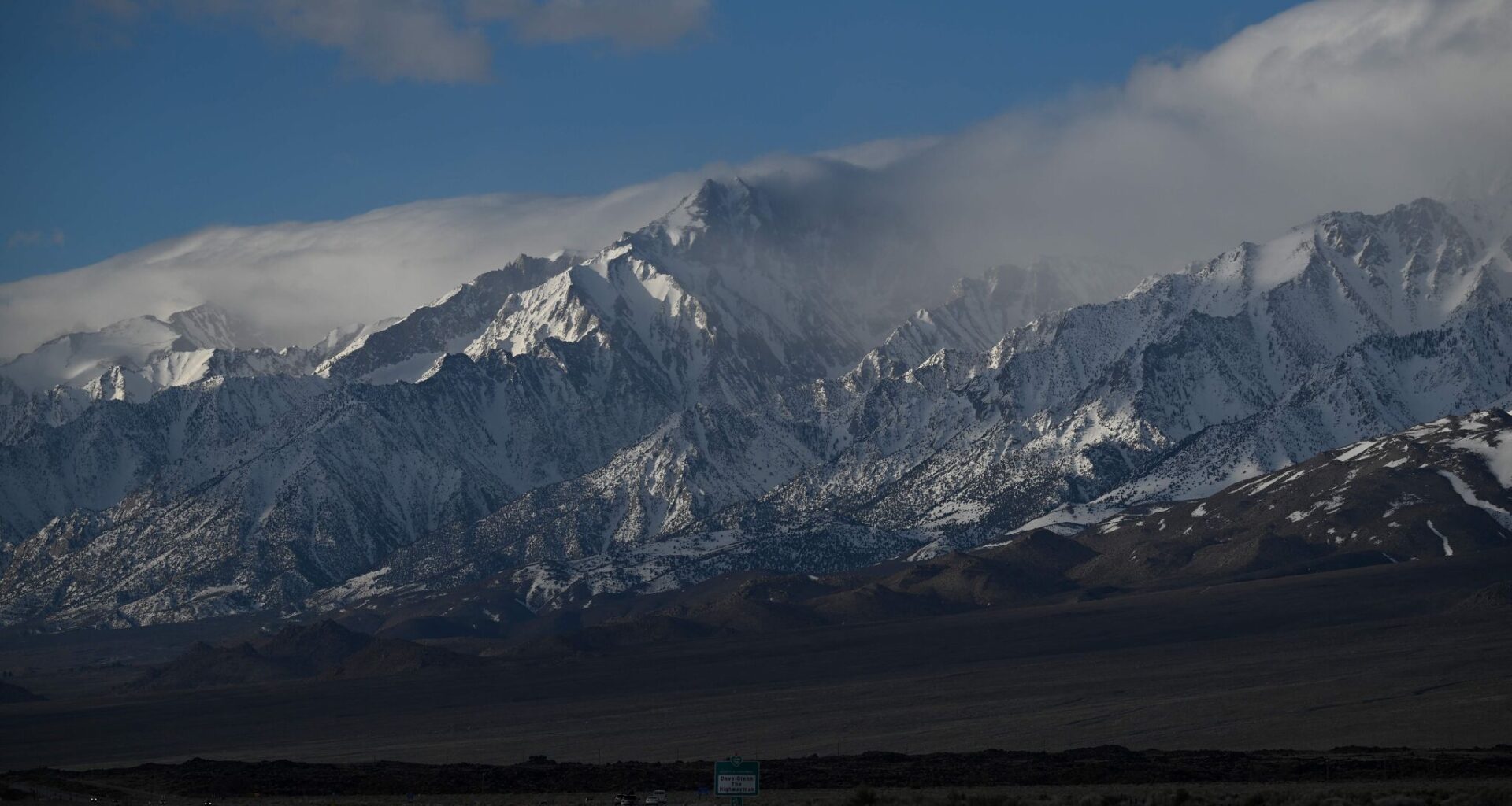
Mount Baxter is part of this imposing massif in the Eastern Sierra, visible from the town of Independence.
Patrick T. Fallon/AFP via Getty Images
A warm and dry end to winter had given way to an unusually cold and stormy April in the Eastern Sierra, with bursts of fresh snow blanketing the range’s upper reaches. While making their way along a high escarpment, one of the climbers stepped into a patch of snow that gave way beneath his foot, sending him careening downhill, according to the California Highway Patrol.
Article continues below this ad
San Francisco Chronicle Logo
Make us a Preferred Source to get more of our news when you search.
Add Preferred Source
The climber tumbled into a narrow gully before coming to rest on a small rock ledge. With bone breaks in his limbs and facing a 30-foot drop, he couldn’t much move or attempt to self-rescue, authorities said. His brother eventually picked his way down from the ridge and found him.
Unable to safely extricate themselves from the tiny outcropping, the two were effectively stranded on the mountainside at 12,400 feet. They called for an emergency rescue using their Garmin InReach, a satellite texting device carried by wilderness hikers.
The emergency call came in the late afternoon, but the circumstances were such that an attempt to reach the men on foot would be impossible, authorities said. “The area would have prompted a several-hour ground team response across avalanche-prone areas in the dark,” Reuther wrote.
Article continues below this ad
The climbers had to bivouac on the freezing ledge, an exposed perch where overnight temperatures dropped into the teens.
The following morning, a CHP helicopter with the agency’s Apple Valley Air Unit deployed from Southern California to attempt a hoist rescue — a procedure used to extract wounded people from rough terrain using a long steel cable outfitted with a latching hook. CHP air crews are frequently enlisted to help hoist injured hikers off of Mount Whitney but rarely called to Baxter, a less traveled peak to the north.
The two-person crew flew over the mountains to Lone Pine and picked up a pair of rescuers with the Inyo County Sheriff’s Office Search and Rescue team, a volunteer group of wilderness experts who respond to all kinds of life-threatening backcountry calamities.
The California Highway Patrol helicopter spotted the stranded climbers — circled in red — on the small rock perch where they survived the night.
California Highway Patrol
Cruising over Baxter’s rocky contours, the helicopter crew was able to spot the stranded climbers, who were waving brightly colored fabrics to signal for help.
Article continues below this ad
Maneuvering into position above the climbers was difficult, according to the CHP crewmen. The slope was sheer and morning winds were gusting from the north, forcing the helicopter pilot, Wesley Cline, to point the aircraft’s nose away from the mountainside and skate sideways to get directly over the climbers.
Flight officer paramedic Gustavo Aguirre helped guide Cline with verbal cues, keeping an eye on the helicopter’s tail as it inched closer to the crumbling slope.
“It’s probably the most challenging hoist I’ve had to do,” Aguirre said. “We had to take extreme caution.”
One of the Inyo County SAR rescuers clipped into the hoist hook and Aguirre lowered him to the ledge, about 150 feet below. The plan was to insert the second rescuer as well, but the first man down signaled up to the helicopter that there was no safe way to put another person on the ledge — not enough space, too risky.
While the helicopter hovered loudly above, the rescuer triaged the injured climber’s broken bones and wrapped him in a special body sling for extraction. The process took about 30 minutes. Cline kept his hover while closely watching the aircraft’s fuel level and power gauge.
Article continues below this ad
“With the power you need to hover at that elevation and the power you have available, it’s pretty narrow margins,” Cline said. “We were close to the red line on power.”
“Time is of the essence,” Aguirre said. “We’re trying to get them out of there as soon as possible.”
Helicopter hoist-rescues occur with some regularity in the rugged Eastern Sierra, but rarely on the lesser traveled Mount Baxter.
California Highway Patrol
The H-80 model of helicopter wouldn’t be able to handle a six-man payload at that altitude, Cline said. So once the injured man had been reeled in on the hoist cable, Cline pulled the aircraft away and headed back to Lone Pine Airport, where an ambulance was waiting on the pavement. The crew deposited the wounded man and the SAR member who’d stayed in the helicopter, then flew back to hoist out the rescuer and the uninjured climber who, Reuther wrote, “would have otherwise been stranded.”
“That’s the first time we’ve ever been to that mountain,” Cline said. “The strong winds and high altitude necessitating we had to keep the helicopter pointed into the wind — we had to do things a little differently than we normally would. It was quite a challenge.”
Inyo County authorities perform dozens of high-altitude rescues each year, and Sheriff’s Office officials typically assess and scrutinize the decisions that lead to backcountry emergencies. Analyzing the Baxter situation days later, Reuther wrote that the two climbers “seemingly did a great job remaining calm, keeping the patient stable, and waiting for rescue.”
“They had a way to communicate (Garmin), and they stayed put and they stayed together,” he wrote. In short: “Backcountry incidents happen.”