
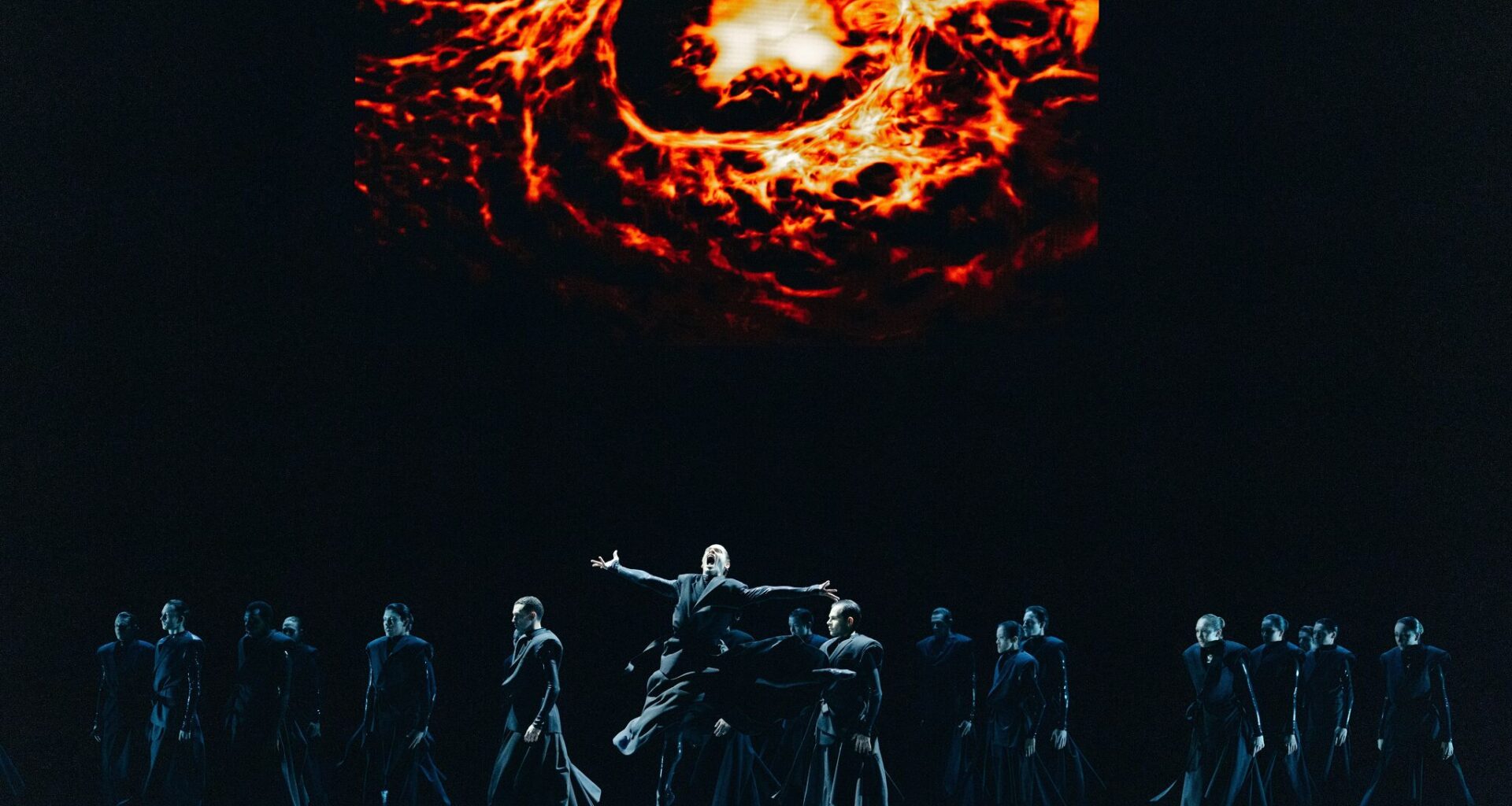
San Francisco Ballet in Aszure Barton and Floating Points’ “Mere Mortals.”
Lindsey Rallo/San Francisco Ballet
Any controversy over San Francisco Ballet’s Kennedy Center cancellation faded inside the War Memorial Opera House, where “Mere Mortals” drew a raucous standing ovation on the opening night of its return to the city.
“I loved it. I’m overwhelmed. It was incredible,” Michelle Wasserman, a Ballet subscriber of 25 years, told the Chronicle after the performance Friday, April 24. “I want the world to see it.”
“Mere Mortals”: San Francisco Ballet. Through Sunday, May 3. $35-$575. War Memorial Opera House. 301 Van Ness Ave., S.F., 415-865-2000. www.sfballet.org
On the company’s decision to forego its Kennedy Center engagement in Washington D.C., originally scheduled for next month, she was just as clear.
Article continues below this ad
“I’m glad it didn’t go to the Kennedy Center this year,” Wasserman said. “I don’t like the idea of using our hometown company as (President Donald Trump’s) propaganda.”
The Ballet held out notably longer than many of its peers before canceling its May 27-31 run of “Mere Mortals” at the Washington D.C. venue in late February. High-profile artist withdrawals — Issa Rae, Renée Fleming, Stephen Schwartz, Philip Glass, the Martha Graham Dance Company — swept the national venue in the first weeks following its Trump-era board overhaul and renaming.
San Francisco Ballet in Aszure Barton and Floating Points’ “Mere Mortals.”
Lindsey Rallo/San Francisco Ballet
All the while pressure mounted at home. Chronicle contributor Rachel Howard made a public plea to skip it, while longtime Ballet patron Daniel Detorie launched a Change.org petition that garnered nearly 7,500 signatories. The furor revealed how strongly Bay Area residents identify with the local company, the oldest ballet in the nation, and how a perceived mismatch in values can spoil an evening for many audience members.
San Francisco Chronicle Logo
Make us a Preferred Source to get more of our news when you search.
Add Preferred Source
San Francisco residents Chris Alford and Sean Dwyer, who admitted they had followed little of the controversy, were “blown away” by the evening’s performance.
Article continues below this ad
“I would still go to see the performance regardless,” Dwyer told the Chronicle, quickly adding, “I’m glad that they decided to pull out.” He recognized the appeal “to have the venue and the opportunity. I understand wanting it.”
That tension between the best of intentions and unintended fallout sits at the core of “Mere Mortals,” a futuristic take on the ancient Greek myth of Pandora’s box through the lens of artificial intelligence and human invention.
Prometheus, a Titan, steals fire from the Olympian gods to give to humans. To punish Prometheus, the king of the Olympian gods, Zeus, orders the creation of Pandora, a human woman, and marries her to Epimetheus, Prometheus’s brother. She is given a sealed container with a warning to keep it closed. But curiosity leads Pandora to open the box, from which all the ills of the world emerge, while only hope remains inside.
Canadian choreographer Aszure Barton reimagines the myth as the unleashing of AI upon the world, an unknown. Will AI possess both the destructive and creative potential of fire or will it devastate like the sickness and death released from Pandora’s box?
Barton’s ballet opens and closes with Hope, danced by an ethereally avian Wei Wang on opening night, but what it suggests might depend on individual perspective.
Article continues below this ad
“I think it’s a little bit agnostic,” opined Wasserman.
Wei Wang and San Francisco Ballet in Aszure Barton and Floating Points’ “Mere Mortals.”
Lindsey Rallo/San Francisco Ballet
When “Mere Mortals” premiered in an AI-giddy San Francisco in 2024, the ballet’s intensity delivered a “sheer popular hit,” according to a review by Howard at the time, prompting an unusual second run added to the end of the season. The avant-garde work even catalyzed a $60 million donation by an anonymous patron, the largest in the Ballet’s 93-year history.
In 2026, the threatening aspects of “Mere Mortals” may resonate more clearly as public opposition to AI has grown. A drive into San Francisco is a tour of billboards touting the inevitability of an AI future, though one might wonder how many people find “Stop hiring humans” appealing. Many subreddits now ban AI content. Internet users decry “AI slop.” And yet, on stage Friday, “Mere Mortals” triumphed again.
The Ballet’s human dancers stunned. Wang’s opening solo as Hope flutters, performing seemingly impossible balances. Joseph Walsh leaps with superhuman vigor as Prometheus, leading a scintillating corps de ballet in rigorous union to steal fire from the gods.
Article continues below this ad
The sheer number of mere mortals on the stage sharpens the intensity. Black costumes, a la “The Matrix,” lent an air of surreality to the dancers. Their bowed heads, throbbing in rhythm, implied downtrodden laborers yearning for liberation. Yet the militaristic grid formations they march threatened regimented violence.
After the tension of Prometheus’s theft, Nikisha Fogo’s Pandora arrives. She first appears exploring her limbs like a newborn giraffe, delighting in each discovery before her innocent wonder quickly curdles. She then inadvertently releases a series of ills into the world and cannot undo it, no matter how poignant a pas de deux with Parker Garrison’s Epimetheus.
Nikisha Fogo and San Francisco Ballet in Aszure Barton and Floating Points’ “Mere Mortals.”
Lindsey Rallo/San Francisco Ballet
The consequences arrive and the dancing halts. Pandora stands alone, motionless, silhouetted before projections. AI-twisted images reminiscent of bioluminescent organisms, crashing waves and spiraling clouds populate the screens as the audience watches alongside her, witnessing the scale of what has been set in motion.
The parallels to AI with its data centers and enormous energy costs, job losses and intellectual property theft are unmistakable, and more urgent than when “Mere Mortals” made its world premiere here in January 2024. Accounts of AI-psychosis litter the news. Just this month Sam Altman, CEO of OpenAI, apologized for the failure to alert law enforcement to a ChatGPT account linked to a mass shooting.
Article continues below this ad
“It’s very timely,” Alford said of the ballet. “Will we create a thing that will harm us all?”
For all the debate around the Ballet’s Kennedy Center planned appearance, the response inside the opera house Friday suggested the company has lost little trust among its patrons. Bay Area audiences remain eager for art confronting the great questions of our time.
From here, “Mere Mortals” will still travel — to the Edinburgh International Festival and London’s Sadler’s Wells this summer — taking the work beyond any single American stage to an international audience.
Letha Ch’ien is a freelance writer.