
Since arriving in Berkeley, I have been aware of an almost ridiculous wealth of connections between myself and both the city and campus. No matter how proximate the connection to myself in my everyday life here, these were still connections which held no emotional significance to me. This began to change after an accident I got myself into, which seemingly should have had no emotional resonance. However, it did. To try to parse why, in the past month, I began thinking about one of the few — if not only — major feelings I have had of connection to those who came before me.
When he was 16, my paternal grandfather spent a summer in southeast Alaska that changed his life. I never heard about this directly from him, because by the time I was interested, his dementia had been bad for a number of years. But the effect of that summer on him is evidenced variously. There are the secondhand stories my dad has told me. There are documents I’ve seen where my grandfather mentioned Alaska, even though the connection was meager. There are the long poems about Alaska he learned to recite; through the seemingly uncrossable void of memory loss, he is still able to finish the rhyming ends of them if someone else speaks them aloud.
I spent my 16th summer in the same region at a summer program, at the recommendation of an administrator at my high school. I did not even know my grandfather had been in the same place when I began to apply. This chance connection between us is one that, during my time in Alaska, I started to understand as not coincidental, but fated. When required by my program to author an oral story, I spoke about this connection, his dementia, and a particularly long poem he had once memorized. I myself memorized that poem and recited it in my story. I felt that I was meant to be there, in that place, at that point in my life. I was sure that I was embodying something nearly spiritual.
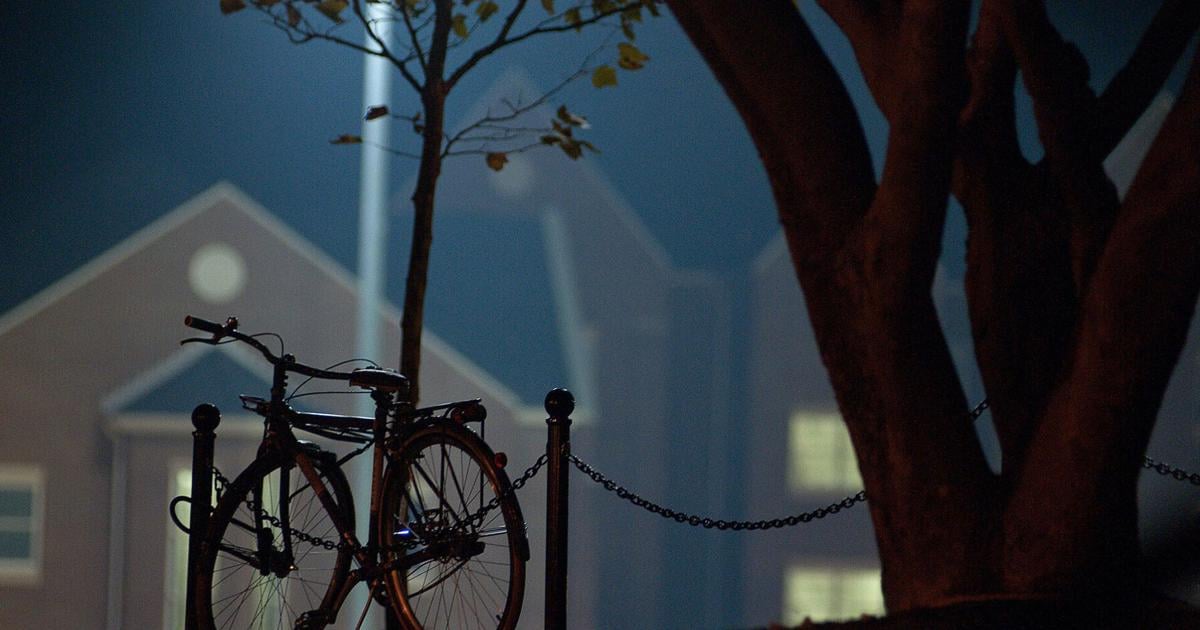
This is a feeling that I never investigated. It remained a sacred pinprick in my otherwise secular upbringing. Then, a few weeks ago, I tried to ride my bike 10 miles from a rave in Richmond back to my dorm room at 3 a.m. Drunk and without any lights, I made it eight miles to Albany, then stacked over my handlebars. My trip through the air was brief and dreamlike, and the impact felt almost gelatinous. Despite this, there was an instant pain in my left wrist. Sitting up on the concrete, I was reminded of an incident in which my dad tried to ride his bike home drunk, fell off and injured the same wrist that I was hazily realizing might be quite damaged.
I was in urgent care less than 12 hours later, and getting X-rayed 24 hours after that. In appointments and waiting rooms, I thought of my dad and his wrist and wondered if it meant anything to be in the same exact circumstance as him, as it had meant something to be in the same circumstance as my grandfather in Alaska. Of course, crashing my bike drunk was a trivial circumstance, a stupid one. But the synchronicity was there still, wasn’t it?
It ended up being just a sprain, but my fall had more lasting effects. That silly line between my dad and me was nagging me. It seemed to ask: “Am I significant?” All rational thinking seemed to say no. Yet my sprained wrist made me think more about my dad, and more about myself in relation to my dad, than I had in weeks.
Over spring break, I went home and didn’t wear my wrist brace much, not wanting to remind my parents that they had good reason to scold me. Over break, they also met my girlfriend for the first time. She grew up a 10-minute walk from what was Mills College, where my mom went.
The coincidences I had not paid much attention to before became more obvious and seemed to multiply. Back in Berkeley, I walked to my band’s practice at Bowles Hall. My dad lived there during his first semester at UC Berkeley. I was worried about where I would live next year. Some friends of mine had a vacancy in a house they lease parts of, a house which turned out to be the same one my older sister spent three years in. There are more of these coincidences than I can count, ways in which I am circling through the same places my family has inhabited. I walk past the laundromat that my maternal grandfather took my grandmother to on their first date, getting candy bars from the vending machine because he didn’t know the cafe he wanted to take her to was closed on weekends. I pass International House weekly, where my great-grandparents’ parents met. I’m planning on turning down the offer to live in the house my sister did, but I’ve accidentally ended up with a place in the only co-op she ever spent time in.
As I walk around, I’ve wondered how many times my dad, my sister or my mother — who was born in a house on Northside and went to Berkeley High School — walked on the same exact squares of pavement I did. Most of all, I’ve wondered why I’ve only begun to consider these things after injuring my wrist; my wrist injury being the loosest and silliest connection of all. I was frustrated by the impenetrability of my own emotional experience. What about injuring my wrist had the power to give me a similar feeling to the one I felt in Alaska? Was the wrist connection contrived? More disturbingly, was the Alaskan one contrived too?
It might be, because I didn’t really know what he did that summer. I know he worked in a fish cannery. I know he drove up with his friend, who played accordion the entire way. Those details are the same two I knew three years ago, when I told that oral story about him. I came to the realization that the practical relation our 16th summers had to each other is likely tangential and loose. Even my definition of place is broad. Ketchikan, where he was, and Sitka, where I was, are more than 150 miles apart.
Yet, despite not “really knowing” about his time there, the truth of that summer did not falter: that at 16 there was a direct and resonant line, like a taut piece of string which went straight upwards and downwards from my chest, sinking itself through the sky and earth miraculously back in time, to when my grandfather was the same age.
And so I wind up at a deceptively simple answer: that my feelings about Alaska and my drunk bicycle accident are deeply true; that they are unique and important links between my family and me, just by virtue of my belief that they are. These are not feelings which should, or could, be escaped by comparison or investigation. This realization stems from the faith in myself that builds from the bits of fate I encountered in those moments. While I was in Alaska, any practical reason about why I was there was usurped by a sense of, “Of course I am here.” Sprawled out on the concrete bike path, there were all of the practical reasons I was there: my intoxication, the state of my bike, my lack of a flashlight. And yet, none of those reasons feels relevant to me, then or now. It’s not that I’m stuck repeating familial mistakes. Rather, there is a graceful inevitability to my life that there is no use in fighting. Of course, I am here.